The e-commerce sole proprietorship had already been dissolved, so why was the owner ultimately ordered to pay 9.71 million?
Published: September 14, 2026
Many e-commerce business owners have done something similar in recent years: in order to open multiple stores and operate under multiple business entities, they have registered several, a dozen, or even dozens of individually owned businesses. While the stores continued to sell products normally and generated sales on the platforms, some of these business entities never filed tax returns or consistently filed zero-income returns. Later, when they decided to close the stores, the owners’ first reaction was:“Wouldn’t it just be a matter of canceling the business license?”
However, a case recently disclosed by the State Taxation Administration serves as a wake-up call to all e-commerce business owners who have engaged in similar practices:Just because a sole proprietorship has been dissolved doesn’t mean its past tax issues have disappeared as well.
Today, we’ll explain this topic in detail using a real-life example. If you have any questions about cross-border e-commerce compliance, feel free to contact our Qicaiying customer service team directly.
For compliance issues, you can also contact our Qicaiying customer service directly (WeChat: jxhqcy890 / Mobile: 16625410105). We’ll help you sort out your historical business entities and transaction records first, and then determine where to start addressing the issue.
.
PART.01 The sole proprietorship had already been dissolved, but the owner was ultimately ordered to pay 9.71 million.
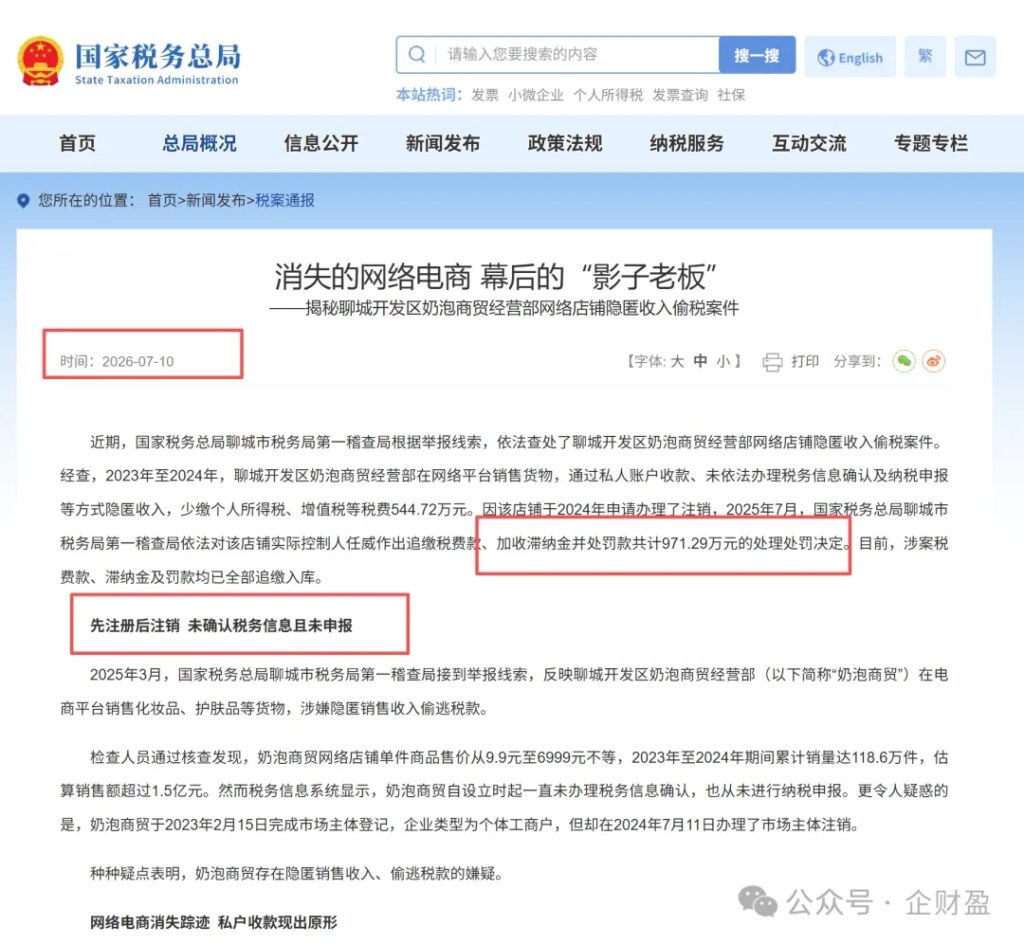
In July 2026, the State Taxation Administration disclosed a tax evasion case involving the online store of the Liaocheng Development Zone Nai Pao Trading Department.
This case closely resembles the business models many e-commerce owners have used in the past. Nai Pao Trading is aa private firm (PRC usage), from 2023 to 2024, the store sold cosmetics, skincare products, and other goods through an online platform. During an audit, tax authorities found that the store’s cumulative sales over the two-year period reached1.186 million itemsBased on preliminary estimates of the product's selling price, sales volume is already quite substantial.
However, the tax system shows:Since its registration and establishment, this sole proprietorship has never completed the tax information verification process and has never filed a tax return.
More importantly, this self-employed individual was inIn July 2024, the business entity had already been deregistered.The
If we go by what many business owners used to believe—that once a business license has been revoked, the company or sole proprietorship no longer exists—does that mean the matter is settled? The answer is clearly no.
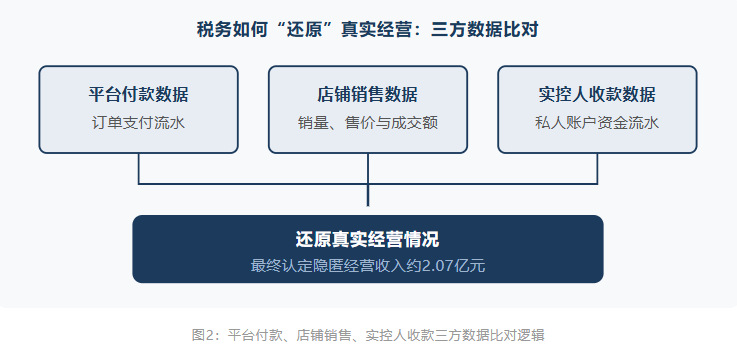
The tax authorities subsequently cross-referenced payment data from the platform, store sales data, and payment receipt data from the actual controller, ultimately determining that from 2023 to 2024, this business entity sold goods through an online platform by exploitingConcealed business income totaling 207 million yuan through methods such as receiving payments into personal accounts and failing to file tax returnsThe
It was ultimately determined that the company had underpaid personal income tax, value-added tax, and other taxes and fees.5.4472 million yuan. In July 2025, the tax authorities issued a decision imposing penalties on the actual controller of the store:A total of 9,712,900 yuan in back taxes, late payment penalties, and fines was collected.. At present, all relevant funds have been fully recovered and deposited into the treasury.
That is to say:Although the business license was revoked about a year ago, tax issues arising from the company’s previous operations are still being pursued.
.
PART.02 Why do tax authorities continue to investigate a sole proprietorship even after it has been dissolved?
Many business owners tend to confuse these two concepts:Business Deregistrationrespond in singingHistorical Tax LiabilitiesThey're not the same thing.
01 Business Deregistration Indicates that this market entity has ceased operations.
02 Historical Tax Liabilities Actual business activities and revenue are not automatically reset to zero upon deregistration.
If business operations actually took place in the past—including sales revenue, platform transaction records, and receipt of funds—but taxes were not reported and paid in accordance with the law, the cancellation of the business license does not automatically mean that those activities “never occurred.”
The case described above is a very typical example. In its case report, the tax authority clearly established that the business entity had conducted a large volume of online sales prior to its deregistration and had failed to complete tax information verification, file tax returns, and had received payments through personal bank accounts.
That’s why, when we’ve been meeting with some e-commerce business owners recently, we’ve repeatedly reminded them:I’ve registered many sole proprietorships in the past. Don’t just look at whether the business licenses are still valid; what’s more important is whether these entities actually had genuine business transactions back then.
In particular, the following situations should be given special attention:
✓Self-employed individuals who have linked their accounts to stores on Taobao, Pinduoduo, Douyin, and other e-commerce platforms
✓The store has actually generated sales revenue.
✓A sole proprietor has not filed tax returns for a long time.
✓The store has revenue, but its tax returns have consistently shown zero income.
✓Platform revenue is deposited into the accounts of the legal entity, the business owner, or individual employees
✓The same owner had previously registered multiple entities in bulk
✓The store has closed, but the historical transaction records have not yet been organized.
✓In the past, we directly processed the business deregistration, but the historical tax matters were not fully resolved.
While these entities may appear to be “useless,” what really matters is their past operating record.
If you currently have a sole proprietorship left over from your previous e-commerce business and are facing issues such as long-term non-filing, tax irregularities, significant back taxes, or difficulties proceeding with a standard deregistration, please contact our Qicaiying online customer service (WeChat: jxhqcy890 / Mobile: 16625410105). We will then arrange for a professional account manager to provide tailored guidance based on your situation.
.
PART.03 In the past, e-commerce companies used to register individual businesses in bulk. Why are the risks becoming increasingly apparent now?
The tax regulatory environment has undergone significant changes in recent years.
To be implemented starting in 2025Tax Information Reporting System for Internet Platform Companies, requiring Internet platforms that meet the specified criteria to submit information on the business operators on their platformsIdentification Information and Income Information. Online merchandise sales platforms fall within the scope of these regulations.
Simply put: In the past, tax authorities mainly looked at how much businesses or self-employed individuals reported on their own; nowOperational data from online platforms has also gradually become an important source of information for tax administration.The
So if we continue to use the same approach as before, the risks will only continue to increase:
Old Ways of Thinking
Why isn't it established now?
“If the store closes, no one will know.”
Even though the store has closed, the platform will still report its operational data as required.
“It’ll be fine once the license is revoked.”
Income actually earned prior to deregistration and the obligation to file tax returns do not cease to exist as a result.
“If the money didn’t go into the public account, it can’t be traced.”
Platform payment data, store sales data, and payment data for the actual controller will be cross-checked.
This case in Liaocheng has actually provided us with the answer. Tax officials did not simply check whether the sole proprietor had filed a tax return; instead, they cross-referenced data from three sources and ultimately reconstructed the true state of the business:
.
PART.04 Why are some individual e-commerce business owners now finding that they can’t close their businesses even though they want to?
This is also a situation we’ve encountered quite frequently recently. The business owner had previously registered a number of sole proprietorships to open stores, but now that the business model has changed and these entities are no longer needed, he plans to deregister them all. However, when he went to process the deregistration, he discovered that:The business registration process may not be the most troublesome part; the real bottleneck is the tax process.
Therefore, if a sole proprietor has previously encountered any of the following situations, it’s difficult to simply assume that “all they need to do is cancel their business license”:
Past Situations
Why does it get stuck?
The business has actual operating revenue but has not filed tax returns for an extended period.
Although the income was actually earned, the obligation to report it has not been fulfilled.
I've consistently filed zero-revenue returns, but the platform actually has a very high transaction volume.
Significant discrepancies between reported figures and platform data are likely to trigger alerts.
There are already risk alerts, tax irregularities, or the account has even been flagged for an audit.
Does not meet the criteria for immediate processing; pending matters must be resolved first.
What really needs to be addressed isResolve the series of historical tax issues prior to deregistrationThe
.
PART.05 The biggest headache isn’t actually the deregistration—it’s figuring out “exactly how much tax was owed in the past.”
When many business owners come to us, the thing they worry about most is:“If we dig up all our past transaction records, won’t we have to pay a lot of back taxes?”
This issue cannot be viewed solely in terms of revenue. To determine how to properly handle historical sole proprietorships, it is necessary to conduct a detailed review based on their actual business operations at the time, including:
How long has the business been in operation?
What were the actual sales revenues for each year?
Is there a refund?
Do the platform transaction amounts match the actual funds received?
What was the entity's tax registration status at that time?
What collection method should be used?
Have you ever filed a return before?
Is there any information on costs and expenses?
Have you already paid any portion of the tax?
Are there any payments received from private accounts?
Have you received any tax risk alerts, notices, or audit materials to date?
These situations are different, and the corresponding solutions may ultimately be completely different.
Therefore, for individual historians, the two extremes to be avoided at all costs are:
Extreme Case 1: Seeing the high tax refund amount, they simply choose not to take any action Procrastination will only cause late fees to keep piling up, extend the window of risk, and—if left unaddressed until an on-site inspection takes place—result in even higher costs to resolve the issue.
Extreme Case 2: Without sorting through any data, simply making up the shortfall based entirely on the platform’s total transaction volume. Failing to distinguish between refunds, failing to verify receipt of payments, and failing to confirm the collection method—and blindly filing full supplementary returns—often results in the overpayment of taxes.
This case in Liaocheng, involving a fine of 9,712,900 yuan, serves as a very clear warning to business owners who previously registered individual businesses in bulk to operate e-commerce.
A self-employed individual:The business has been deregistered; its business address cannot be located, and its contact number is no longer valid.—But the platform transactions, payment receipts, and historical business data did not disappear as a result. In the end, the tax authorities were still able to reconstruct the company’s actual business operations.
So, if you’ve previously registered multiple sole proprietorships for e-commerce purposes—especially if any of the following apply:There are unreported cash flows, long-term zero-reporting, receipts through private accounts, bulk business entities, some entities that have already been deregistered, a current deregistration process that has been stalled, and tax risk alerts that have already been received.In these situations, it is not recommended to wait until the formal inspection begins to start organizing your documents.
You can start by conducting a systematic review of all past entities, stores, and transaction records to determine which ones are legitimate and which have a history of tax-related issues, and then decide on a course of action.
If you currently have a sole proprietorship left over from your previous e-commerce business—and are now facing issues such as long-term non-filing, tax irregularities, significant back taxes, or difficulties with the standard deregistration process—you can first organize the details regarding the number of business entities, years in operation, platform transaction history, and current tax status, and then determine the best course of action.
This article is compiled based on publicly available case studies from the State Taxation Administration and current publicly available policies, and is intended solely for the exchange of information regarding corporate tax compliance. Specific tax treatments should be determined in light of the actual circumstances of the business entity and the requirements of the competent tax authorities.
.
Long-time E-commerce Sole Proprietors · Free Risk Assessment
Help you organize a complete list of entities, stores, and transaction records — A detailed review of each item, from registration date and linked store to platform transaction volume
Assessing Tax Risk Levels — Distinguishing between entities with no prior tax issues and those with existing historical tax issues
One-on-One Customized “Review—Filing—Cancellation” Solution — Provide a practical sequence of steps based on the specific circumstances of the entity
If you still have individual business registrations left over from your previous e-commerce ventures and aren’t sure which ones can be directly deregistered, which ones require back-file tax returns, and which ones have been flagged as abnormal—feel free to reach out, and we’ll help you analyze each one.
Add Qicaiying’s online customer service (WeChat: jxhqcy890 / Mobile: 16625410105) to receive a free assessment of historical entity risk screening and deregistration options. We’ll arrange for a professional consultant to address your questions and provide one-on-one, end-to-end compliance solutions.
.
Tags:
Self-employed e-commerce entrepreneurs
Deregistration of a Sole Proprietorship
concealment of income
pay a tax one has evaded
E-commerce Tax Audits
Tax Self-Assessment
tax risk
Risks Associated with Receiving Payments Through Personal Accounts
Golden Tax IV, the fourth installment of the tax system
Financial and Tax Compliance
tax inspection
cross-border e-commerce
Recommended
Cross-border e-commerce B2B must see! Registered Hong Kong company stationed in the Ali International Station, really fragrant!
In today's globalized business environment, the cross-border e-commerce B2B model is rapidly emerging with its unique advantages. For many enterprises engaged in cross-border trade, choosing a suitable platform and registering an advantageous company are undoubtedly the key keys to open the door to the international market.
2024 Hong Kong Company Account Opening Tips! How to choose the right Hong Kong bank account?
Global anti-money laundering regulations are becoming more and more stringent, the banks to maintain an account of the sunk cost is getting higher and higher, not moving hundreds of millions of dollars in fines, so that the major banks to open an account threshold as well as the audit process high up, already have a Hong Kong company bosses, how to choose the Hong Kong bank to open a public account? How much does it cost and how to operate? Today to give you a detailed introduction to the Hong Kong company account how to choose, as well as the approximate costs required and other content.
Hong Kong company registration advantages + registration conditions + registration process to share!
If you want to start a business and develop overseas markets, registering a Hong Kong company is undoubtedly a very forward-looking choice. With its unique geographical location, sound legal system, low tax rate and open business environment, Hong Kong company has become a "sharp weapon" for many business owners to open up overseas markets. Why is it so important to register a Hong Kong company in 2024?