A Must-Read for Cross-Border Sellers: What Upgrades Has the Saiwei Model 2.0 Introduced? How Can Multi-Store Sellers Ensure Compliance?
Published: June 5, 2026
You’ve probably heard the term “Saiwei Model” more than once.
When Amazon sellers discuss platform architecture, they bring it up; when sellers managing multiple stores worry about taxes, they bring it up; and even the recent statistical report on cross-border e-commerce multi-store models issued by the tax authorities specifically targets it.
But if you ask ten business owners in the cross-border e-commerce industry what exactly the SAIWEI model is, I doubt many of them could explain it clearly.
In today’s post, we’ll go over the underlying logic from the beginning.
I. Where Did the Suntech Model Come From?
The "Saiwei Model" originated from a Shenzhen-based cross-border e-commerce company called Saiwei Times.
This company was one of the early leaders among top-selling Amazon sellers. During its expansion, it developed an architectural framework to address the challenges of managing multiple stores, multiple companies, and fund consolidation. This approach was later widely emulated across the industry and gradually came to be known by a commonly accepted name: the Saiwei Model.
The core contradiction it addresses is as follows—
Major cross-border platforms like Amazon require one store per company, but what can sellers do if they want to operate dozens or even hundreds of stores at the same time?
The answer is: Register multiple domestic companies, with each company operating a separate store—collectively referred to as “store companies.” However, this raises major issues regarding how to consolidate funds, handle tax matters, and allocate costs.
The Savi Model is, in essence, an architectural solution designed specifically to address this issue.
II. The Core Architecture of Saiwei 1.0
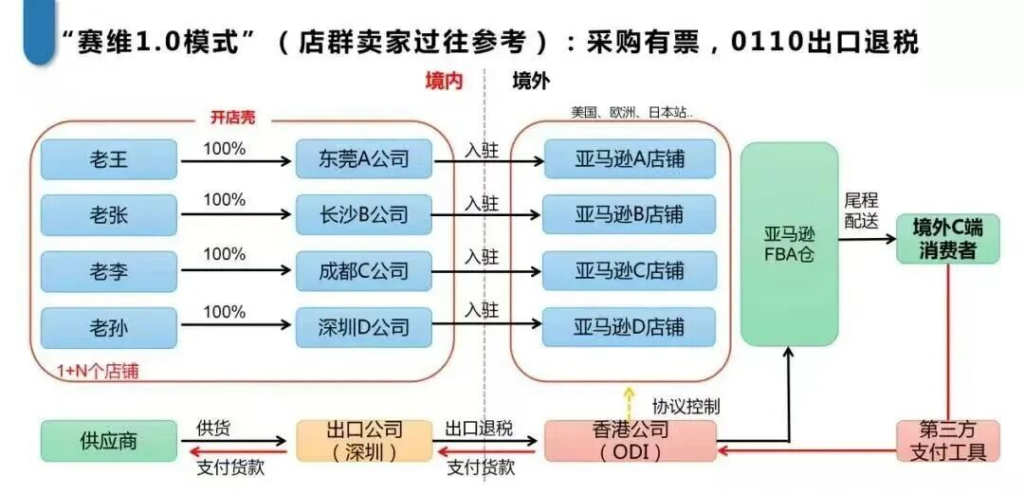
Saiwei 1.0 is the first iteration of this model, with a relatively simple architecture:
Architectural Framework
· Domestic Store Companies: These correspond to stores on various platforms; they are solely responsible for opening the stores and do not perform actual business operations. Tax filings for these companies are typically zero-declaration filings.
· Domestic export companies: Responsible for domestic procurement and proper customs clearance for exports; they are the entities eligible for tax rebates.
· Domestic operating companies: Provide services such as operations and marketing, charge service fees, and pay taxes within the country
· Hong Kong companies: Consolidate incoming payments on a single platform, then return the funds to mainland companies in the form of payments for goods and service fees
How do funds flow?
Customer payment → Platform → Payment processing tool (e.g., Payoneer) → Hong Kong company account → Routed back to mainland China via two channels:
Pay the export company (for the goods) on one hand, and pay the operating company (for service fees) on the other.
The entire process is traceable and transparent, and tax revenue is not lost—this is the logical foundation for the initial acceptance of the 1.0 model.
III. What Is the Problem with Savi 1.0?
The core issue of 1.0 revolves around one thing: zero-reporting by store companies.
Under the 1.0 framework, the store’s company corresponds to the platform’s actual revenue, but there is no revenue or cost recorded in the books, and tax returns are filed as zero. This approach was barely acceptable when regulations were still unclear in the early days, but it is no longer sustainable.
Phase IV of the Golden Tax System can now directly compare sales data pushed by the platform with the tax filings of companies operating within China. The tax authorities have a clear picture of how much revenue your store generates from the platform each quarter.
You filed a zero-income tax return, but the platform’s data shows you have several million in income—this contradiction cannot be explained at this time.
In addition to zero reporting, there are two other common issues with version 1.0:
✘ The agreement control structure is not standardized, and there is a lack of a complete chain of contracts and supporting documents among the various parties.
✘ Fund consolidation is unclear, and it is impossible to accurately match the inflows and outflows of funds from the Hong Kong company to each mainland company.
IV. What upgrades were made in Saiwei 2.0?
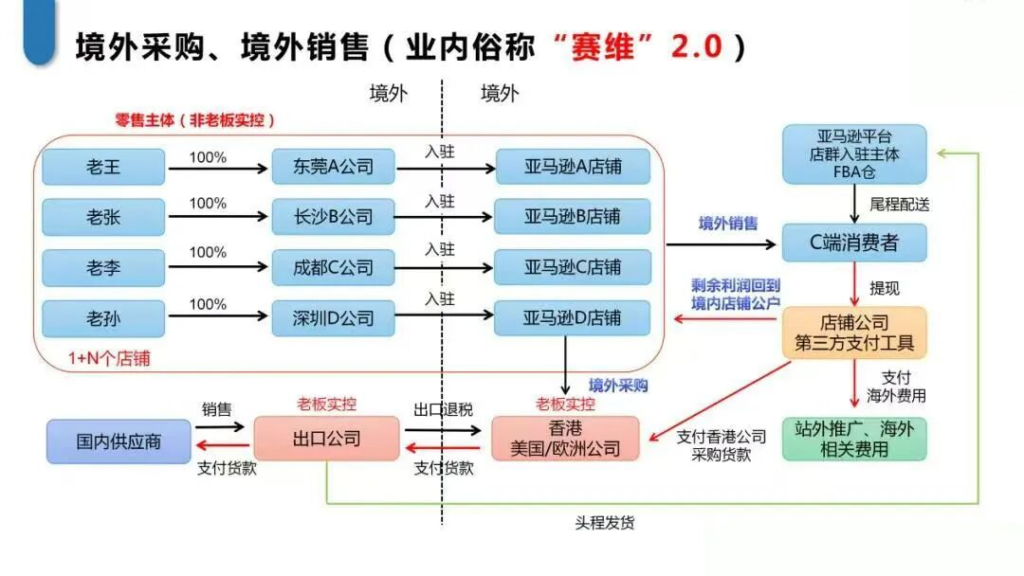
Saiwei 2.0 is a compliance-upgraded version released against the backdrop of tighter regulations. It features three key changes:
Change 1: Retail businesses are no longer required to file zero-revenue tax returns
Version 2.0 requires each store company to maintain separate accounting records and file separate tax returns based on the actual revenue reported by the platform. Revenue will no longer be consolidated under the Hong Kong company but will instead be allocated to each store company.
Change 2: Hong Kong Companies Transforming into Genuine Trading Entities
Under the 2.0 framework, Hong Kong companies are no longer merely transit accounts for receiving payments; instead, they perform actual overseas procurement and sales functions, forming a complete closed-loop process of overseas procurement—overseas sales—domestic export declaration.
Change 3: Stricter Requirements for the Integration of the Four Flows
Contracts, cash flows, logistics, and accounting records must all align perfectly; every transaction must be supported by documentation. There must not be a transaction record without a contract, nor a contract without actual goods.
1.0 vs. 2.0: Key Differences
dimension (math.)
Saiwei 1.0
Saiwei 2.0
Store and Company Registration
Typically, a zero return
File separate tax returns by platform revenue
The Role of Hong Kong Companies
Transition to Centralized Fund Management
Genuine Trading Entities
Allocation of Revenue
Centralized in Hong Kong
Each store is responsible for its own confirmation.
compliance risk
Zero-Declaration vs. Discrepancies in Platform Data
Clear chain of command, low risk
Tax Compliance
Partially accepted (controversial)
More in line with regulatory trends
Applicable Stage
The Period of Lax Regulation Before Tighter Oversight
Under the routine supervision framework of the Golden Tax Phase IV system
V. The Three Bottom Lines of Compliance
Whether it's 1.0 or 2.0, there are three things that cannot be overlooked:
✔ Proper customs clearance is the minimum requirement. Goods must be cleared for export through official channels; without a customs declaration, tax-exempt status is not valid.
✔ Business processes must be clear. The four integrated flows—contract flow, cash flow, logistics, and accounting flow—are all essential, and supporting documents must be retained in their entirety.
✔ Paying taxes in accordance with the law is a red line. Preventing the loss of tax revenue is a core regulatory concern, and corporate structures must not be used to evade taxes.
The Saiwei Model is not a tool for tax evasion; it is a compliance solution that enables multi-store structures to operate sustainably within the legal framework.
Scan the QR code to add a consultant and get a free one-on-one architecture assessment
Cell phone: 18676749275 | WeChat: qcygscszk
common problems
Q: What is the difference between the Savi model and a typical multi-company structure?
A: A typical multi-company structure simply involves registering multiple companies that operate independently, without a systematic approach to fund consolidation or tax management. Building on this foundation, the Saiwei model establishes a division of labor among the export company, the operating company, and the Hong Kong company, defining a closed-loop logic for the flow of goods, funds, and taxes. It represents a more systematic compliance solution for store clusters.
Q: Does using the SAIWEI model guarantee compliance?
A: No. The Savi model is a structural framework; compliance depends on each company’s actual operations: whether there are contracts, customs declarations, and proper accounting records, and whether the cash flow is transparent. The framework itself is compliant, but if it’s implemented haphazardly, there are still risks.
Q: Am I currently on version 1.0 or 2.0? How can I tell?
A: The simplest way to determine this is to check whether your store’s company files separate tax returns based on platform revenue. If the return shows zero revenue, you’re most likely still at 1.0. We recommend conducting a structural review as soon as possible to assess whether an upgrade is necessary.
Qicaiying: Why Choose Us to Assess Your Savi Architecture?
Understanding what the Savi model is is only the first step. The real key lies in the second step: Are you currently at version 1.0 or 2.0? Which areas are already at risk? Where should you start making improvements? — You won’t find the answers to these questions simply by checking off boxes in an article.
✔️ One-on-One Architecture Assessment:We’ll review each company’s registration information, filing status, and capital flow to generate a comprehensive risk list, identifying which issues are ”red lines that will definitely cause problems if not addressed immediately” and which are ”buffer items that can be gradually optimized.”
✔️ 2.0 Compliance Upgrade Plan:It’s not just about telling you that ”it’s time for a change”—it’s about providing you with a concrete roadmap for upgrading: which company to tackle first, how to adjust equity relationships, and how to redesign the funding structure, with a timeline for each step.
✔️ Dual-Track Structure Combining a Hong Kong Company and a Mainland Entity:With a three-tier structure comprising an export company, an operating company, and a Hong Kong company, Qi Cai Ying handles everything from registration to account opening to bookkeeping in a single, streamlined process, ensuring that the flow of goods, cash, and taxes align from the very beginning.
✔️ Ongoing Compliance Maintenance:Setting up your corporate structure isn’t the end of the process. Annual reviews, audits, corporate income tax filings, and VAT filings—Qicaiying helps you compile compliance records for each reporting period, building a chain of evidence of business operations recognized by the tax authorities.
We have helped thousands of cross-border sellers in Shenzhen, Guangzhou, Shanghai, Ningbo, and other cities complete their Saiwei architecture diagnostics and 2.0 upgrades. Scan the QR code to add a consultant and get a free one-on-one architecture diagnostic.
Cell phone: 18676749275 | WeChat: qcygscszk
About Enterprise Caiying Group
Established in 2015 and headquartered in Shenzhen, Qicaiying Group specializes in providing one-stop financial, tax, and corporate compliance services to cross-border e-commerce companies and businesses expanding overseas. Its services include company registration in Hong Kong and overseas, bank account opening, cross-border financial and tax compliance, VAT/EPR registration, bookkeeping services, and corporate identity planning. Having served over 10,000 companies to date, it is a trusted financial and tax compliance partner for cross-border sellers. Qicaiying Group provides business registration and related commercial and tax services for companies in the United States, Singapore, Japan, Thailand, Malaysia, Canada, Mexico, Brazil, UK companies, French companies, New Zealand companies, Vietnamese companies, Indonesian companies, Philippine companies, and Dubai companies, among others. We also provide corporate services for domestic company registrations in Hong Kong, Shenzhen, Guangzhou, Shanghai, Hangzhou, Beijing, and Hainan, including annual reviews and audits, bookkeeping and tax filing, Mandatory Provident Fund (MPF) contributions, information updates, bank account openings, ODI filings, BVI registrations, tax compliance, and cross-border e-commerce support and management services. Please feel free to contact me if you need assistance. 📱 Mobile: 13045886252, 💬 WeChat: qcy20251218
Tags:
Multi-Store Compliance
Safeway model
Safeway Model Compliance
Cross-border e-commerce fiscal compliance
Recommended
Cross-border e-commerce B2B must see! Registered Hong Kong company stationed in the Ali International Station, really fragrant!
In today's globalized business environment, the cross-border e-commerce B2B model is rapidly emerging with its unique advantages. For many enterprises engaged in cross-border trade, choosing a suitable platform and registering an advantageous company are undoubtedly the key keys to open the door to the international market.
2024 Hong Kong Company Account Opening Tips! How to choose the right Hong Kong bank account?
Global anti-money laundering regulations are becoming more and more stringent, the banks to maintain an account of the sunk cost is getting higher and higher, not moving hundreds of millions of dollars in fines, so that the major banks to open an account threshold as well as the audit process high up, already have a Hong Kong company bosses, how to choose the Hong Kong bank to open a public account? How much does it cost and how to operate? Today to give you a detailed introduction to the Hong Kong company account how to choose, as well as the approximate costs required and other content.
Hong Kong company registration advantages + registration conditions + registration process to share!
If you want to start a business and develop overseas markets, registering a Hong Kong company is undoubtedly a very forward-looking choice. With its unique geographical location, sound legal system, low tax rate and open business environment, Hong Kong company has become a "sharp weapon" for many business owners to open up overseas markets. Why is it so important to register a Hong Kong company in 2024?