The latest global e-commerce report is out! U.S. Holds Second Place!2026 A Hands-On Guide to U.S. Company Incorporation + Structuring + Tax Compliance!
Published: 2026-03-12
Enterprise Caiying Group provides U.S. companies / Singapore companies / Japanese companies / Thai companies / Malaysian companies / Canadian companies / Mexican companies / Brazilian companies / British companies / French companies / New Zealand companies / Japanese companies / Singapore companies / Vietnam companies / Indonesia companies / Philippine companies / Dubai companies and other foreign companies registered in the relevant business and taxation services, but also to provide Hong Kong companies / Shenzhen companies / Guangzhou companies / Shanghai companies / Hangzhou companies / Beijing companies / Hainan companies and other domestic companies registered corporate services, company annual audit / bookkeeping tax / payment of MPF / change information / bank account opening / ODI filing / B Company / Guangzhou company / Shanghai company / Hangzhou company / Beijing company / Hainan company and other domestic company registration of corporate services, company annual audit audit / bookkeeping and tax reporting / payment of MPF / change of information / bank account opening / ODI filing / BVI registration / tax compliance / cross-border e-commerce accompanied by running on behalf of the operation of the enterprise one-stop service, you have the need or interested in any time to drop me (phone and WeChat consulting: 13045886252).
U.S. e-commerce sales second in the world! Latest Global Ecommerce Market Report Released
It was recently reported that global e-commerce sales will grow by about 121 TP3T to reach $6.88 trillion in 2026, according to research firm MobilLoud.
In the 2025 ranking of countries, China is ranked first in the world with $3.45 trillion in e-commerce revenue. The U.S. ranked second with $1.38 trillion.
The United Kingdom was third with $195 billion, Japan with $169 billion, South Korea with $147 billion, Germany with $140 billion, India with $136 billion, Indonesia with $94 billion, France with $92 billion and Canada with $88 billion.
In terms of e-commerce penetration, China ranks first with 471 TP3T in 2025, significantly higher than other countries. Indonesia ranks second with an e-commerce penetration rate of 32%.
The UK is at 311 TP3T and South Korea is at 301 TP3T. e-commerce penetration in the U.S. is at 15.81 TP3T, or about 161 TP3T, which is the sixth highest among the top 10 countries, slightly lower than France's 171 TP3T.
The report states that in the U.S. market, 761 TP3T of e-commerce transactions are completed through mobile devices, with Amazon, Walmart, eBay, and Shopify being the major e-commerce platforms. Mobile spending is driving US e-commerce to realize a year-on-year growth of 10.51 TP3T from 2024 to 2025.
In terms of overall retail structure, global e-commerce sales accounted for 20.11 TP3T of total retail sales in 2025 and are expected to rise to 21.11 TP3T in 2026.
The number of global online shoppers was 2.77 billion in 2025 and is expected to exceed 2.9 billion in 2026. Global e-commerce grew by 8.31 TP3T year-on-year in 2025 and is projected to grow at a rate of 7.21 TP3T in 2026.
MobilLoud says the U.S. market is more mature, but not yet saturated.
With e-commerce penetration below 16%, there is still significant room for growth, especially in less online segments such as grocery and business-to-business (B2B).
In contrast, demand is more stable in high-penetration markets such as China and the UK, while the US still needs to deal with the structural challenges posed by traditional retail systems.
MobilLoud's statistics combine data from Statista, eMarketer, Shopify Enterprise, Trade.gov, and regional market research organizations. Relevant figures are 2025 estimates and 2026 forecasts as of February 2026
Overall, the global e-commerce market size continues to expand in 2025, but there are significant differences in the development stage and growth potential of different countries.
But cross-border e-commerce done for a long time, we all know a fact: make money by the time and place, pay taxes by “you have no advance brain”.
U.S. companies have been checking more and more diligently in the past few years, especially cross-border e-commerce, because of data transparency, clear payment paths, warehouse address a check to know in which state there is nexus, belongs to the category of the best to catch.
This article does not talk about fancy concepts, but only about the three things that cross-border sellers are most concerned about on a daily basis: how to save taxes on U.S. companies, how not to step on mines, and how to reasonably fall on U.S. accounts for offshore expenses.
01 Structure determines the tax rate, movement determines the tax amount
Tax Planning for Cross-Border Sellers in the U.S., 70% determines whether this company chooses to be an LLC or a C-Corp at the outset.
1) The nature of LLC
Most people register an LLC because in the early days it was only used to collect money. However, the profits of LLC are directly attributed to the individual shareholders. If the Chinese owner is in China, he can't use the U.S. deduction at all, and the book profit is directly calculated according to the personal tax rate, but it may be more expensive.LLC is not impossible to use, but it is suitable for sellers who have a small business scale, and the company's profit is not recognized in the United States.
(2) Nature of C-Corp
The vast majority of cross-border sellers, inventory in the United States, warehouse in the United States, revenue in the United States, this situation with C-Corp is more stable. Fixed 21% federal tax, plus local state tax, the overall control, but also can do the cost structure, but also can do the associated purchase price.
Cross-border sellers 80% should all move from LLC to C-Corp to have room for tax savings.
Figure from the Internet
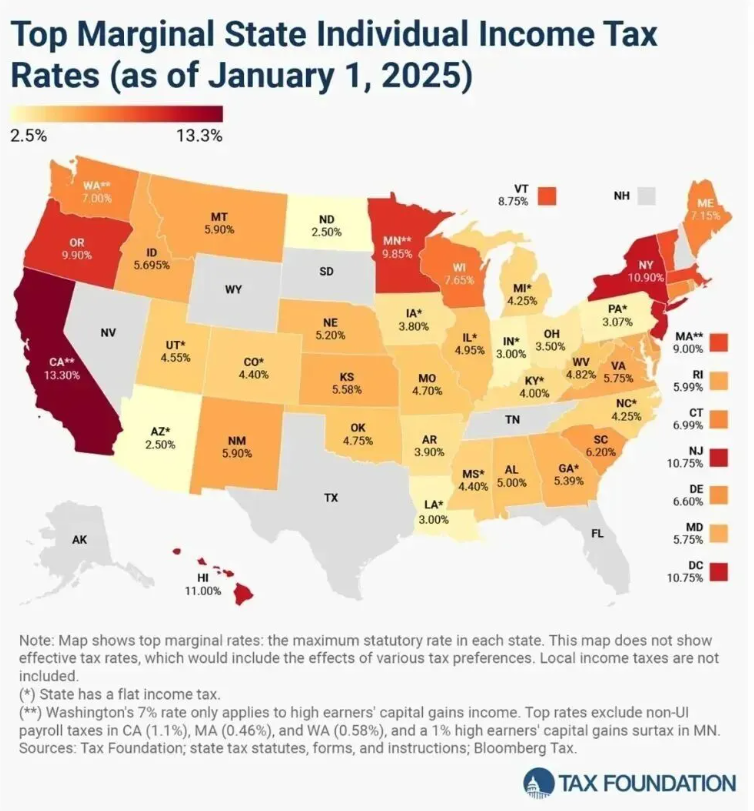
Here are the eight states that will have low taxes in 2026:
1) Indiana:The single tax rate (flat rate) is reduced from 31 TP3T to 2.951 TP3T in 2025 and will be further reduced to 2.91 TP3T on January 1, 2027; Indiana passed legislation in 2025 that provides for a single personal income tax rate to be reduced by 0.051 TP3T in every even-numbered year from January 1, 2030 onwards, as long as the income threshold is met. The range is gradually reduced to 2.55%.
2) Kentucky:The single tax rate was reduced from 41 TP3T to 3.51 TP3T.
3) Mississippi:The single rate was reduced from 4.41 TP3T to 41 TP3T, the final reduction in a multi-year plan to phase down Mississippi's personal income tax.
4) Montana:The top marginal rate has been reduced from 5.91 TP3T to 5.651 TP3T and is scheduled to be further reduced to 5.41 TP3T in 2027.The lower rate of 4.71 TP3T will remain unchanged, but the scope of application will be extended.
5) Nebraska:The maximum interest rate was reduced to 4.551 TP3T from 5.21 TP3T as part of a plan to gradually reduce the maximum interest rate to 3.991 TP3T by 2027.
6) North Carolina:The single rate was reduced from 4.251 TP3T to 3.991 TP3T, the final rate reduction in a multi-year plan to cut individual income tax rates.
7) Ohio:The single tax rate is reduced from 3.125% to 2.75% for taxpayers earning more than $26,050 per year; those below that income threshold are exempt.
8) Oklahoma:The top rate was reduced from 4.751 TP3T to 4.51 TP3T, and the personal income tax brackets were reduced from six to three.
Therefore, if your side is optimistic about the low tax rate of different states in the United States, you can consult the Enterprise Caiying Group for efficient and professional processing; at the same time, today we also share the applicable groups of U.S. company registration, as well as how to register U.S. companies, how to pick the right state to register the U.S. company to escort your cross-border business to enter the U.S. market!
02 Ways Cross-Border Sellers Can Legally Reduce Profits
The biggest difference between a cross-border seller and a local U.S. company is that "the person is not in the U.S., and most of the expenses are incurred outside of the country". Therefore, tax-saving actions must be combined with cross-border realities, otherwise either the deduction is not possible or the risk is too high.
1) Wages
U.S. companies can pay the owner, family members, and offshore staff, but one condition needs to be met: the work must be real. The owner does management, strategy, finance, supply chain, and can usually explain it. Family members can also be paid if they are involved in operations. Wages are the most direct deduction on the U.S. corporate end.
Wages need to be reasonable, you can't have a seller with millions of dollars in annual profits paying themselves $60,000, the logic doesn't make sense. Wages are expenses of the year and need to be paid that year, not the next year.
2) Normal operating expenses
There are more expenses that cross-border sellers can deduct than one might think, such as advertising, SaaS software, ERP, live-streaming equipment, third-party warehousing fees, celebrity marketing, subscription tools, product development materials, and more. All can be deducted as long as they can be proven to be related to the company's business.
3) How to put expenses incurred abroad into US accounts
This is the most common question asked by cross-border e-commerce companies. The reality is that as long as the business is indeed being done by a U.S. company, the offshore costs can be fully covered by the U.S. company, as long as the following requirements are met:
The invoice corresponds to services valid for U.S. companies.
Offshore suppliers can be Chinese companies, Hong Kong companies, or individuals.
The payment path should be able to be matched.
A contract or description of services (in English or bilingual is fine) is desirable.
4) Common offshore expenses that can be put on U.S. accounts include:
Labor costs for the China team (operations, artwork, customer service).
Selection team fees.
Offshore PR services.
Factory sampling and testing costs.
Technology outsourcing, development.
Hong Kong Procurement Services Fee.
Video shooting, editing.
As long as you can show that the services were generated for the real business of the US company, the US company is perfectly fine to account for them. In other words, there is no need for the person to necessarily be in the U.S. The expenses are deductible as long as they are useful to the U.S. company.
ATTENTION!!! U.S. companies paying overseas expenses, services must not be in the U.S. or they are subject to 30% income tax withholding.
5) Depreciation of assets
Computers, photography equipment, warehouse shelves, balers, live equipment can be depreciated, the United States now still retains part of the Bonus Depreciation, you can accelerate the deduction. Many sellers buy equipment without replacing it with new, and wait to replace it with old, instead of wasting the tax-saving space.
6) Purchase prices of affiliated companies
Cross-border sellers almost always have Chinese subjects supplying US companies. This price determines US company profits. China's shipment price is high, the United States profit is low. But the price must be compliant, there is a basis, can not blindly make up the price at the end of the year.
The most stable practice:
Purchase prices are determined six months in advance.
Keep several peer price references for similar products.
Retain measurement documents: e.g., operating costs on the U.S. side, advertising costs, warehousing costs, theoretical achievable profit margins.
Payback is linked to the purchase price.
With this set of documents, a lower profit in the U.S. will not be labeled as profit shifting by the IRS.
7) Pension Plan
Pensions (401k or SEP IRA) are clean tax savings for sellers with high profits. Deductions on the company's end, tax deferred or tax free on the owner's end. Generally companies with profits of half a million dollars or more can be considered. But this is only for Americans.
03 Applicable people for registering a U.S. company
1) Chinese sellers seeking a foothold in the US market:
For Chinese businesses looking to gain a firmer foothold in the U.S. market, having a "local identity" enhances the trust of local consumers and helps them better penetrate and expand into the U.S. market.
2) Merchants who reduce the risk of operating an e-commerce platform:
If business on cross-border e-commerce platforms such as Amazon performs well and orders continue to grow, registering a U.S.-based company can effectively reduce the risk of account blocking and may enjoy various preferential policies and support provided by the platforms for local businesses.
3) Entrepreneurs seeking tax benefits:
Some U.S. states have implemented a variety of tax incentives for local businesses that are designed to promote business activity, innovation, and enterprise development. Therefore, by incorporating in specific regions of the United States, cross-border sellers have the opportunity to take advantage of these financial incentives.
4) Companies that focus on brand image building:
In order to establish a more positive and professional image in the U.S. market, some Chinese companies choose to register their companies in the U.S. in order to obtain an official office address and contact information, thus demonstrating to consumers their identity as a reliable partner, and further enhancing brand recognition and credibility.
5) Businesses that plan to raise capital or go public for expansion:
For Chinese companies that intend to expand through financing, or even seek an IPO, registering an entity in the U.S. often makes it easier to attract the attention of investors.
This is not only because the U.S. has a mature capital market system, but also because it provides access to a wide range of investment resources. If you need to register a U.S. company or localize and operate a cross-border e-commerce business to start a U.S. business, feel free to inquire (WeChat: 13045886252)▼▼▼▼
04 How do I incorporate a U.S. company?
①English company name and state of incorporation (company name without punctuation as much as possible, before confirming to the verification of the name).
②Corporate registered capital (default 1,000 shares, one share of one U.S. dollar).
③ business scope of the company (not limited to the number of words, business scope is more to provide its main business products or services can be).
④Over 18 years of age shareholder director ID card front and back or passport, if the shareholder is a company, you also need to provide the business license of the shareholder company.
⑤ If the customer's own U.S. address, it is required; if not, it is ignored.
(6) Shareholder and director e-mail and contact number.
⑦ Shareholder director blank A4 paper signature (or group information confirmation is sufficient).
If you need to register a U.S. company or localize cross-border e-commerce operations to start a U.S. business, you can drop me (WeChat: 13045886252) at any time to do a good job of planning▼▼▼▼
05 How to Pick the Right State to Incorporate a U.S. Company?
Before applying for registration of a U.S. corporation, it is important to define what the purpose and use of the registration is according to your needs.
For example: to register e-commerce platforms such as Amazon and Tik Tok Shop through a U.S. company, or to receive and pay for foreign trade, or to run a business on the ground, or to plan for a U.S. visa, and so on.
Once the main purpose is clear, you can better examine how to apply for the registration of a U.S. company.
Then, plan holistically with your business purpose and approach and choose the state where the business environment is suitable.
When registering a U.S. corporation, the following are generally considered:
1) Which state is best suited for the industry in which the company operates.
2) Which state has the most favorable tax rate for the industry it belongs to.
3) States with low registration fees, operating costs of registration and other cost issues.
4) Whether the registration is easy to manage subsequently.
5) The company's physical business address.
6) How well known is the place of registration.
7) Consider bank account opening.
Characteristics of a Frequently Registered State:
1) Delaware
Pros:① No sales tax, inventory tax, or intangibles tax. ②No local operations, no corporate state income tax. ③Preferred location for the establishment of U.S. public companies.
What industries are suited to Delaware -Manufacturing, financing listed companies, finance, tourism.
2) Nevada
Pros:① Zero state tax, no corporate or personal income tax, no estate tax. ② The Internal Revenue Service (IRS) does not exchange corporate data.
What industries are good for Nevada -Agriculture, minerals, gaming.
3) California
Pros:①Highly recognized in the eyes of Chinese people and economically developed. ②There is no restriction on the scope of business. ③Freedom to name the company.
What industries are California good for -Internet, 3C, IT.
4) Wyoming
Pros:① Zero state tax. ② Rich coal resources, natural gas and oil resources, and good business environment.
What industries are suitable for Wyoming? --Agriculture, Mining, Tourism, no financing needs for listing.
5) Washington State
Pros:① Zero state tax, no interest tax, dividend tax or capital gains tax. ② Electricity is very abundant and cheap, and the manufacturing industry can operate at a lower cost.
What industries are good for Washington State -Manufacturing, import and export, science and technology, trade services.
6) Texas
Pros:① Zero state tax. ② Large population for small and medium-sized businesses operating on the ground.
What industries are good for Texas -Agro-industry.
7) New York State
Advantages: ①Biennial annual review. ② New York State is the world's financial center as well as the largest port in the United States, the Port of New York, which is conducive to the financial and foreign trade industries.
What industries are suitable for New York State? --Foreign trade, finance.
8 ) Colorado
Advantages: ①It is very free to take a name when registering a U.S. company. ② Low registration price and simple management.
What industries are suitable for Colorado--Agriculture, minerals, e-commerce. If you plan to register a U.S. company/Singapore company/Japanese company/Thailand company/Malaysia company/Canada company/Mexico company/Brazil company/Britain company/France company/New Zealand company/Japanese company/Singapore company/Vietnamese company/Indonesia company/Philippines company/Dubai company, etc., and other related business and taxation services for foreign company registration, or plan to register a Hong Kong company/ Shenzhen company / Guangzhou company / Shanghai company / Hangzhou company / Beijing company / Hainan company and other domestic companies registered business services, the company's annual audit audit / bookkeeping tax / payment of MPF / change of information / bank account opening / ODI record / BVI registration / tax compliance / cross-border e-commerce accompanied by running on behalf of the operation of the enterprise one-stop service, you can add my WeChat (phone with V: 13045886252) Consultation at any time ↓↓↓
If you need to register a U.S. company or operate cross-border e-commerce locally to start a business in the U.S., feel free to inquire (WeChat: 13045886252)▼▼▼
06 U.S. companies are registered, how to maintain later?
1) Annual Audit
An annual review includes confirming or updating the basic business information of the company, such as registered address, agent information, and director information.
The timing and requirements for annual audits vary from state to state; for example, Delaware regular corporations are required to complete an annual audit by March 1, while LLCs are required to do so by June.
Other states, such as New York, have biennial annual audits, while California and Nevada have natural annual audits, i.e., one audit per year.
Failure to keep annual audits on time may result in fines or other legal consequences.
2) Tax Returns
Tax returns for U.S. corporations include both state and federal taxes.
For federal taxes, companies are required to file a tax return at the rate of 21% if there is a business profit, and not if there is no profit.
State taxes vary from state to state; some states such as Nevada, Texas, and Washington do not have a state income tax, while others may have a franchise tax that needs to be paid even if the company does not operate locally, such as California and New York.
When filing taxes, companies are required to file the appropriate tax forms and reports and pay the appropriate taxes based on their type (e.g., C-Corporation or LLC) and operations.
Be careful: even if there are no operations, the company is required to file a zero tax return!
Enterprise Caiying Group, not only can help you register the U.S. company, but also can register the company of other countries overseas, the need to be able to consult at any time, WeChat the same number: 13045886252.
3) Cross-border sellers are most likely to step on the chargeback misunderstanding
The following situations may seem deductible, but cross-border sellers are most likely to be rejected by the IRS: rent for the home, meals for friends, lodging accompanied by family members, fitness, health care products, gas for personal vehicles, and purely living expenses.
The logic of IRS is simple: what you can deduct is business, what you can't deduct is your life.
4) State Taxes and Inventory Issues
Is the biggest risk point for cross-border sellers Of all the tax risks for cross-border sellers, state taxes are the most likely to be detected and have the highest penalties.
The source of the problem is pretty clear: you have inventory in the U.S., which is nexus. you put stock in TikTok warehouses, third-party warehouses, indie station warehouses, and as long as the inventory is there, you're considered to be operating in that state.
State taxes are not difficult, what is difficult is that you don't file. Each warehouse corresponds to a state's state income tax filing, which is an action that cross-border sellers must deal with.
Do not want to pay state taxes to prove the real existence of the three-party warehouse, so some large third-party warehouses into the FBA TBA, etc., more credible.
It's not the end of the world if you have to pay taxes; after all, it's based on profits.
5) The categories in which the IRS is most likely to catch cross-border sellers
Inventory is not filed for state taxes in the U.S.; banks are not filing tax returns in the U.S.; related transactions are not documented; profit margins are abnormally low but advertising costs are abnormally high; statements are consecutively losing money but the seller is expanding warehouses on the operations side, recruiting, and doing live streaming.
What IRS fears most is that “you pretend to lose money”. Cross-border sellers are more likely to be judged as “not acting like a normal business” because of the transparency of their data.
6) Landing Execution Checklist for Sellers
This part is the most crucial and something you can do right away as a corporate America business owner.
A. Compile data from collection platforms, including TikTok, Shopify, Stripe, and Payoneer.
B. Categorize all offshore expenses and include all that can be attributed to U.S. companies.
C. Create a documentation of the basis for the purchase price of the Chinese company's supplies to the U.S. company.
D. Pay off all the SaaS and services you are sure to buy a year in advance before the end of the year.
E. Check before the end of the year whether advertising and warehouse expenses can be recognized in the current year.
F. A list of U.S. warehouses lists the states in which they are warehoused and determines the corresponding state taxes.
G. If profits are on the high side, evaluate whether to add a pension plan. When these actions are done, profits naturally move downward and in a compliant manner.
Finally summarize: cross-border sellers are not unable to save tax, is not to go off the beaten path. U.S. tax is actually very good reasoning, as long as your statement logic can be self-explanatory, IRS will not be difficult for you.
The real danger is the kind of "can't read, don't dare to say, don't dare to report" accounts. But remember, substance is more important than form, whether there is a transfer of funds to pay, the cost is not reasonable, is the most important thing that the Inland Revenue Department.
If you need, welcome to consult me (WeChat No.: 13045886252), or [scan the QR code below] to match your needs, there will be a professional tax consultant to communicate with you in detail ↓ ↓↓↓
07 Choosing Enterprise Caiying Group as a long-term partner
🏆 Why choose Enterprise Finance? --Professional strength, global trust
Enterprise Caiying Group, since its establishment in 2015, has always been adhering to the mission of "empowering every entrepreneurial dream", focusing on providing one-stop globalized industry, commerce, finance and tax and business services for enterprises.
Our bottom line, from the deep precipitation and authoritative certification:
✅ Service Scale Witnesses Reputation: Accumulated services for more than 300,000+ enterprises, long-term cooperation with more than 50,000+ customers.
✅ Global Network Local Support: Branches are set up in Beijing, Guangzhou, Shenzhen, Hong Kong, Southeast Asia, and the United States, with services covering Asia, Europe, and the Americas.
✅ Official certification qualification escort: with 3 Hong Kong government certified licensed secretarial firms, a U.S. branch and a self-employed Hong Kong accounting firm, and at the same time is the vice president of the Shenzhen Agency Bookkeeping Association, etc., to ensure that the service is fully compliant and reliable.
The four core advantages of Enterprise Caiying's overseas company registration service:
🔹 1. A team of experts to guide you throughout the process
Our team of nearly 400 professionals consists of senior lawyers, accountants, tax accountants and cross-border business consultants. They are well versed in international regulations, handle thousands of high-end cases annually, and can provide optimal customized solutions from structural design to on-the-ground implementation.
🔹 2. digitally empowered, smart and efficient
We have spent 20 million RMB to research and develop our own digital system "Echobo", which realizes process standardization and progress visualization. The integration of AI intelligent analysis can provide quick insight into demand and assist in generating solutions, making complex affairs clear, transparent and efficient.
🔹 3. Eco-links, extra value
We connect over 500,000+ entrepreneurs with domestic and international associations. By regularly organizing cross-border salons, tax law seminars and other activities, we not only solve registration problems, but are also committed to linking resources and creating business opportunities for you.
🔹 4. Full-cycle accompaniment for worry-free sailing
Our services go beyond "successful registration". We provide a full life cycle of services from early consultation, mid-term implementation, to late financial and tax declaration, annual audit and maintenance, and compliance consulting, to become your long-term and stable partner for overseas expansion.
statement denying or limiting responsibility
Image source: some of the image material in this article from the network, such as copyright issues, please contact us to replace the deletion of processing.
Information reference: The content of this article is synthesized from the internal materials of Enterprise Caiying and relevant public network information.
Content Editor: This article was edited and designed by the Operations Department of the Enterprise Caiying Group.
Warm reminder: The relevant policies, conditions, time limits, fees and other information described in this article may be subject to dynamic adjustments, please refer to the latest official announcements or the actual application of the specific circumstances prevail.
Tags:
U.S. Company Registration Tips
Advantages of U.S. Company Registration
U.S. Company Registration Process
Incorporate a U.S. Company
U.S.A. Inc.
U.S. Company Registration
Recommended
Cross-border e-commerce B2B must see! Registered Hong Kong company stationed in the Ali International Station, really fragrant!
In today's globalized business environment, the cross-border e-commerce B2B model is rapidly emerging with its unique advantages. For many enterprises engaged in cross-border trade, choosing a suitable platform and registering an advantageous company are undoubtedly the key keys to open the door to the international market.
2024 Hong Kong Company Account Opening Tips! How to choose the right Hong Kong bank account?
Global anti-money laundering regulations are becoming more and more stringent, the banks to maintain an account of the sunk cost is getting higher and higher, not moving hundreds of millions of dollars in fines, so that the major banks to open an account threshold as well as the audit process high up, already have a Hong Kong company bosses, how to choose the Hong Kong bank to open a public account? How much does it cost and how to operate? Today to give you a detailed introduction to the Hong Kong company account how to choose, as well as the approximate costs required and other content.
Hong Kong company registration advantages + registration conditions + registration process to share!
If you want to start a business and develop overseas markets, registering a Hong Kong company is undoubtedly a very forward-looking choice. With its unique geographical location, sound legal system, low tax rate and open business environment, Hong Kong company has become a "sharp weapon" for many business owners to open up overseas markets. Why is it so important to register a Hong Kong company in 2024?