Hong Kong CRS 2.0 era is coming: cryptocurrency tax transparency, how to layout global assets in advance?
Published: 2026-02-06
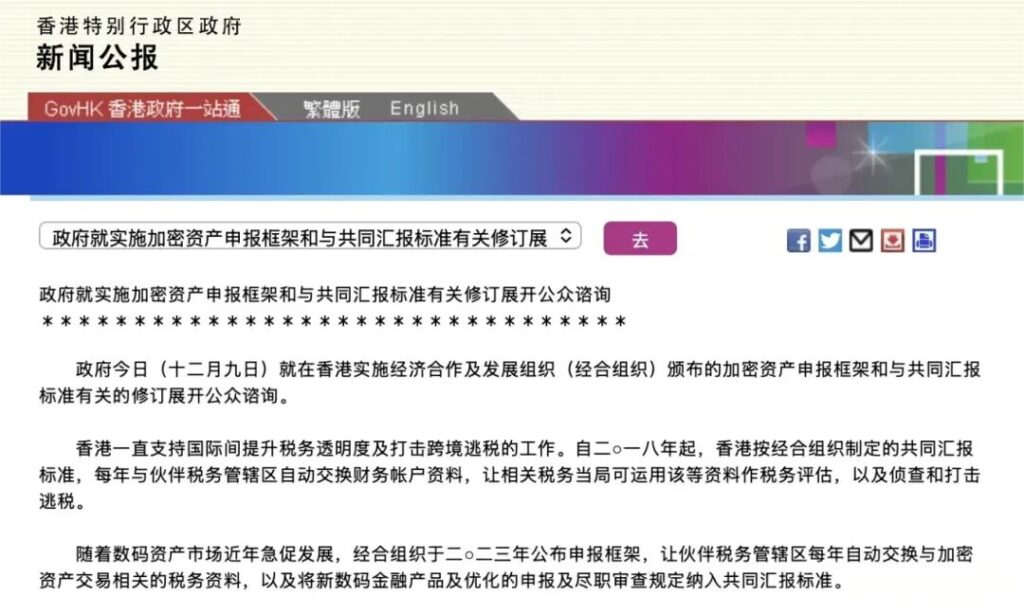
On December 9, 2025, the Hong Kong SAR Government issued a public consultation paper on the Crypto Asset Reporting Framework (CARF) and the revised Common Reporting Standard (CRS), formally kicking off a new round of institutional updates to align with international tax transparency standards.
This system update, jointly promoted by the Financial Services and the Treasury Bureau and the Inland Revenue Department, marks Hong Kong's full inclusion of crypto assets into the international tax information exchange system, formally stepping into the "CRS 2.0 Era" and establishing a new benchmark for tax compliance in the digital financial sector.
Hi ~ I am the customer service of Enterprise Finance Group! We provide domestic (Shenzhen, Guangzhou, Shanghai, Beijing, Hangzhou, etc.) company registration, overseas (Hong Kong, the United States, Japan, the United Kingdom, Singapore, Thailand, Vietnam, etc.) company registration, Hong Kong identity application and renewal services, while covering the cross-border tax planning, shareholding structure design, compliance and risk control programs, such as the whole chain of corporate services. Contact me at any time if you have the need.Tel: 16620947137, WeChat: Qicaiyingjituan (can be added by direct search) or scan the QR code below to add!
This also means that in 2026, the "tax-free era" of cryptocurrency will officially come to an end - the global crypto tax regulation has moved from policy discussion to substantive implementation, with Italy, the UK and other countries taking the lead in launching new tax regulations, and CRS (Common Reporting Standard) and CARF (Crypto Asset Reporting Framework) being promoted in concert. The concerted promotion of CRS (Common Reporting Standard) and CARF (Crypto Asset Reporting Framework) will allow crypto transactions to bid farewell to the gray area of "anonymous tax avoidance", and will usher in fundamental changes to the asset planning and tax reporting process of ordinary investors.
One,Crypto Taxation in 2026: A Global Trend from "Optional" to "Mandatory"
The year 2026 is not the "starting point" for crypto tax payments, but rather the "centralized effective year" for global regulation. As early as 2022, Italy has taken the lead in taxing cryptocurrencies, and on January 1, 2026, the country will increase the withholding tax rate from 26% to 33%, and completely abolish the 2,000 euro exemption threshold - even if the annual income of only 1 euro, you need to declare the full amount of tax.
Meanwhile, the UK has required all crypto exchanges and wallet service providers to report user transaction data in real time to the tax authorities since New Year's Day 2026, including sales, purchases, pledges, mining and even small grants, with a minimum fine of £300 to start for those who don't voluntarily report.
In addition to the EU countries, the United States also in the 2026 tax season to enable the Form 1099-DA, exchanges need to declare to the IRS users of crypto assets sale proceeds, if investors fail to clearly declare the cost of their own, may be defaulted to "zero-cost" tax, triggering the risk of paying penalties. Behind this series of policies is the global competition for the tax base of crypto assets - data show that the world's annual loss of fiscal revenue due to crypto tax evasion exceeds $100 billion, and countries are adopting uniform rules to plug this loophole.
Hi ~ I am the customer service of Enterprise Finance Group! We provide domestic (Shenzhen, Guangzhou, Shanghai, Beijing, Hangzhou, etc.) company registration, overseas (Hong Kong, the United States, Japan, the United Kingdom, Singapore, Thailand, Vietnam, etc.) company registration, Hong Kong identity application and renewal services, while covering the cross-border tax planning, shareholding structure design, compliance and risk control programs, such as the whole chain of corporate services. Contact me at any time if you have the need.Tel: 16620947137, WeChat: Qicaiyingjituan (can be added by direct search) or scan the QR code below to add!
Two,CRS and CARF: How does the "double insurance" of crypto regulation work?
Many ordinary people are not unfamiliar with CRS, an international mechanism promoted by the OECD, which has long realized the automatic exchange of cross-border financial account information, but cryptocurrencies have always been outside the regulation in the past. CARF, as the "encrypted version of the CRS patch", completely fills this blind spot, and the two collaborate to build a regulatory network with no dead angle:
- CRS 2.0 upgrade:Crypto assets are included in "financial accounts": starting in 2026, the CRS will include e-money and central bank digital currencies in its scope of regulation, requiring financial institutions to report information on the holders of crypto assets, their balances, and the type of controllers, just as they do for bank deposits and stocks, and high-net-worth accounts (usually exceeding $1 million) will be reviewed on a yearly basis. Review.
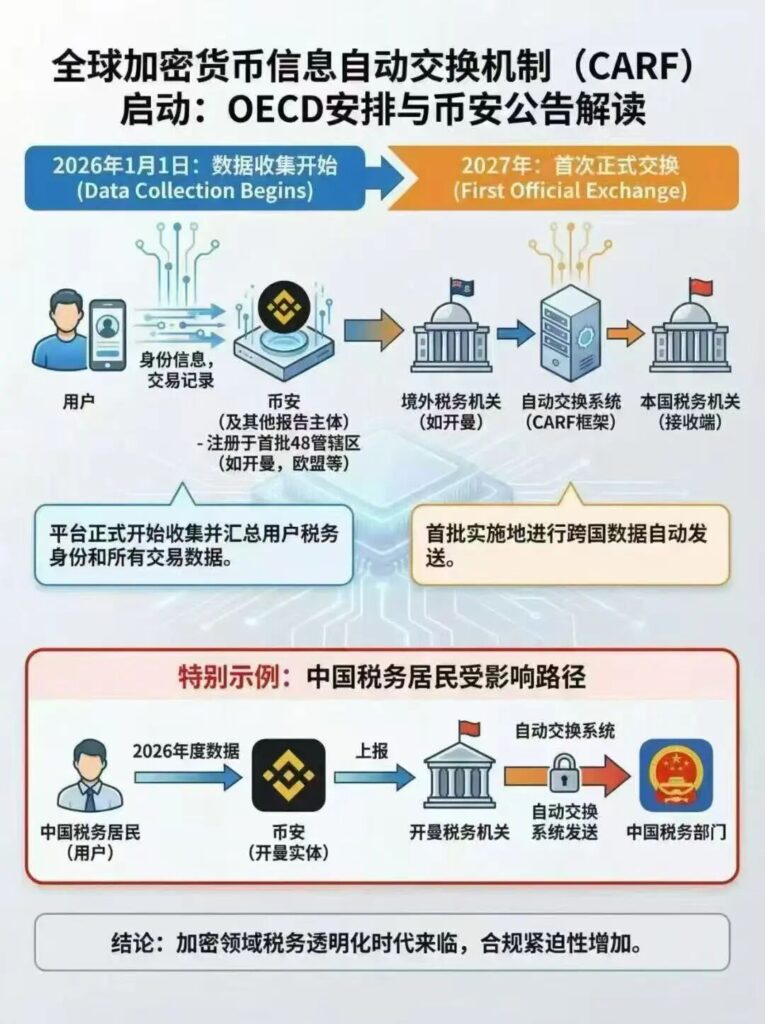
- CARF Penetrating Regulation:Coverage of full-scenario transactions: as the core new regulation, CARF explicitly includes all digital assets such as bitcoin, stablecoin, NFT, etc., not only covering centralized exchanges, but also decentralized platforms, crypto ATMs and even some DeFi protocols. Starting from January 1, 2026, 48 jurisdictions around the world have initiated data collection, requiring service providers to report core data such as users' tax residency status, wallet address, transaction flow, etc., and in 2027, cross-border information exchange will be officially realized.
The scope of implementation covers the world's major financial centers, including the United Kingdom, European Union member states, Japan, South Korea, Singapore, Switzerland, Brazil, South Africa and the Cayman Islands, etc., the first batch of a total of 48 European countries and major offshore financial centers mainly countries and regions.
The asset coverage covers almost all digital assets with investment or payment functions, including both mainstream cryptocurrencies such as bitcoin and ethereum, as well as various types of stablecoins such as USDT and USDC, and also includes tradable NFT digital collections.
Simply put, even if you trade on overseas exchanges or use an anonymous wallet, your crypto asset positions and earnings will be synchronized to the tax authorities of the host country through this mechanism, and the path to cross-border tax avoidance is completely blocked.
Hi ~ I am the customer service of Enterprise Finance Group! We provide domestic (Shenzhen, Guangzhou, Shanghai, Beijing, Hangzhou, etc.) company registration, overseas (Hong Kong, the United States, Japan, the United Kingdom, Singapore, Thailand, Vietnam, etc.) company registration, Hong Kong identity application and renewal services, while covering the cross-border tax planning, shareholding structure design, compliance and risk control programs, such as the whole chain of corporate services. Contact me at any time if you have the need.Tel: 16620947137, WeChat: Qicaiyingjituan (can be added by direct search) or scan the QR code below to add!
III. Three core impacts on ordinary people: filing, costs and risks
01,The complexity of tax returns has increased dramatically, and "muddling through" doesn't work anymore.
In the past, crypto trading records were scattered and loosely regulated, and many investors lacked the habit of keeping records, but from 2026 onwards, tax filing will become a "fine job": the United States requires that the cost of each wallet and each exchange account be individually accounted for, and when selling, only the batches of assets in the matching account can be used, and those who have operated on multiple platforms or made frequent transfers are required to rebuild their entire history. Transaction records; the United Kingdom requires the declaration of all types of transactions, including mining, airdrop gains, even losses need to be retained records, in order to offset future taxable income. For small investors, organizing this data may take a lot of time, and even require the use of professional tax tools.
02,Rising compliance costs make small investments less cost-effective
On the one hand, the high tax rates in some countries may squeeze the revenue space of small investors - the withholding tax of Italy's 33% is already higher than that of traditional financial products, and although the tax rates in the United Kingdom and the United States are relatively mild, the time cost of the filing process and the potential consulting fees make the "small profits "On the other hand, in order to meet regulatory requirements, exchanges may pass on compliance costs to users, such as increasing transaction fees and charging data filing fees. For ordinary people who only use crypto assets for small payments or experimental investments, the utility of crypto assets may be reduced by the cost of paying taxes.
03,High risk of late or missed reports, low threshold for penalties
The penalties for non-compliant declarations in various countries have increased significantly: the UK has a minimum fine of £300 for failure to declare on time, and those with serious circumstances are required to recover the full amount of tax and additional penalties; the US may face high fines or even criminal charges if they are found to be intentionally concealing the information. What is more important to note is that, due to the lag of CARF data exchange, some users may mistakenly think that overseas transactions will not be discovered, but after the information exchange in 2027, past undeclared earnings may be taxed retroactively, creating the risk of "settling scores".
Four,Compliance Response for the Average Joe: 3 Simple, Actionable Steps
In the face of regulatory change, compliance is the only option, and the average person can quickly adapt from the following three points:
1,Comprehensive inventory of assets:Sort out all exchange accounts and wallets (including self-hosted wallets) under your name, record the type of asset, number of positions, time and cost of purchase, and establish a clear trading ledger.
2,Confirmation of tax resident status:Clarify your tax resident country based on factors such as length of residence and center of economic interest to avoid multi-country taxation or tax evasion due to ambiguous status.
3,Consult a professional in a timely manner:Due to the complexity of crypto tax rules and the large differences between countries, it is recommended to contact an accountant familiar with digital asset taxation in advance, especially for users with multi-platform operations and cross-border transactions, to avoid risks arising from filing errors.
2026 crypto tax payment and CRS, CARF landing, is essentially the crypto assets from the "barbaric growth" to the "standardized development" of the sign. For ordinary people, this means that they need to manage their crypto investments with the same attitude as stocks and funds, and give up the lucky idea of "anonymous tax avoidance". Although the initial process may face cumbersome, rising costs and other issues, but in the long term, standardized regulatory environment can also reduce market chaos, providing a safer ecosystem for real investors.
Hi ~ I am the customer service of Enterprise Finance Group! We provide domestic (Shenzhen, Guangzhou, Shanghai, Beijing, Hangzhou, etc.) company registration, overseas (Hong Kong, the United States, Japan, the United Kingdom, Singapore, Thailand, Vietnam, etc.) company registration, Hong Kong identity application and renewal services, while covering the cross-border tax planning, shareholding structure design, compliance and risk control programs, such as the whole chain of corporate services. Contact me at any time if you have the need.Tel: 16620947137, WeChat: Qicaiyingjituan (can be added by direct search) or scan the QR code below to add!
Tags:
Hong Kong CRS Exchange
Global Asset Layout
Hong Kong Identity
Recommended
Cross-border e-commerce B2B must see! Registered Hong Kong company stationed in the Ali International Station, really fragrant!
In today's globalized business environment, the cross-border e-commerce B2B model is rapidly emerging with its unique advantages. For many enterprises engaged in cross-border trade, choosing a suitable platform and registering an advantageous company are undoubtedly the key keys to open the door to the international market.
2024 Hong Kong Company Account Opening Tips! How to choose the right Hong Kong bank account?
Global anti-money laundering regulations are becoming more and more stringent, the banks to maintain an account of the sunk cost is getting higher and higher, not moving hundreds of millions of dollars in fines, so that the major banks to open an account threshold as well as the audit process high up, already have a Hong Kong company bosses, how to choose the Hong Kong bank to open a public account? How much does it cost and how to operate? Today to give you a detailed introduction to the Hong Kong company account how to choose, as well as the approximate costs required and other content.
Hong Kong company registration advantages + registration conditions + registration process to share!
If you want to start a business and develop overseas markets, registering a Hong Kong company is undoubtedly a very forward-looking choice. With its unique geographical location, sound legal system, low tax rate and open business environment, Hong Kong company has become a "sharp weapon" for many business owners to open up overseas markets. Why is it so important to register a Hong Kong company in 2024?