Is Takealot the Next Big Thing in Cross-Border E-Commerce? Analysis of the South African E-Commerce Market + A Guide for Chinese Sellers to Set Up Shop
Published: October 8, 2026
While many sellers are still focused on price wars and advertising battles on established platforms like Amazon and Shopee,Some people have already quietly begun researching the South African market.The
Recently, there’s been a noticeable increase in inquiries about Takealot through our backend: What kind of platform is this? Can Chinese sellers join? Do I need to register a South African company? This article provides a comprehensive overview of the fundamentals of the South African e-commerce market, Takealot’s eligibility requirements, and the store setup process—offering a complete reference for sellers who are still on the fence.
Conclusion in a nutshell:Takealot is South Africa’s leading e-commerce platform by market share. It began accepting applications from Chinese sellers in June 2025, and since there are currently very few Chinese sellers on the platform, this represents a prime window of opportunity to ”get an early start and position yourself early.”
If you’re interested in learning more about Take-A-Lot in South Africa but aren’t sure how to get started, feel free to scan the QR code to contact Qicaiying’s online customer service (WeChat: jxhqcy890 / Mobile: 16625410105) 👉 Based on your specific situation, we’ll assign a professional consultant to address your questions and provide one-on-one, end-to-end compliance solutions.
.
PART.01 What is Takealot?
Many domestic sellers are unfamiliar with this name, which is perfectly normal. But in South Africa, Takealot is the equivalent of the local“JD.com”::
The platform has also established its own logistics and delivery system, covering major cities in South Africa, with same-day and next-day delivery capabilities. Simply put, it is not a new platform that has just emerged, but ratherThe Preferred Gateway for South African Consumers to Shop OnlineThe
.
PART.02 Why Is Now Considered a Window of Opportunity?
Three reasons.
First, the recruitment of Chinese sellers has just begun.
In June 2025, Takealot officially opened its platform to Chinese sellers. Compared to Amazon and Temu, which each host hundreds of thousands of Chinese sellers, the number of Chinese sellers on Takealot remains very small—some estimates put the figure at fewer than 5,000, representing a very small percentage of the total.
Second, the platform is in the market expansion phase.
The platform is actively expanding its product categories and supply. For sellers, as long as their products match customer demand and they put a little more effort into their product pages, they have a chance to gain visibility—something that would be almost unthinkable on a mature platform.
Third, many people are waiting to see what happens, while few are taking action.
Most sellers get stuck because they ”don’t understand South African consumer habits, aren’t familiar with the platform’s rules, and don’t know where to start.” But market opportunities often go to those who research and plan ahead—as more people recognize the opportunity, competition intensifies. This pattern has been proven time and again in every emerging market.
.
PART.03 Is the South African Market Worth Entering?
When it comes to Africa, many sellers' first thought is: limited purchasing power?
Once you get to know South Africa, you’ll discover that it is one of Africa’s most industrialized economies with the most mature consumer market:Online shopping habits have already taken root; the mainstream consumer base is quite receptive to online shopping and has a sustained demand for high-quality products....but local supply hasn't kept up.
How obvious are the advantages of the supply chain? Here’s an example: A phone case that costs just over ten yuan on 1688 can sell for about 80–130 rand. Sellers with well-established domestic supply chains naturally have price and supply advantages in many product categories.
Just a reminder
You can’t just copy your domestic strategy and expect to succeed effortlessly in the South African market. Product selection must be based on the actual needs of local consumers, and products must be differentiated—there’s no way around doing this groundwork.
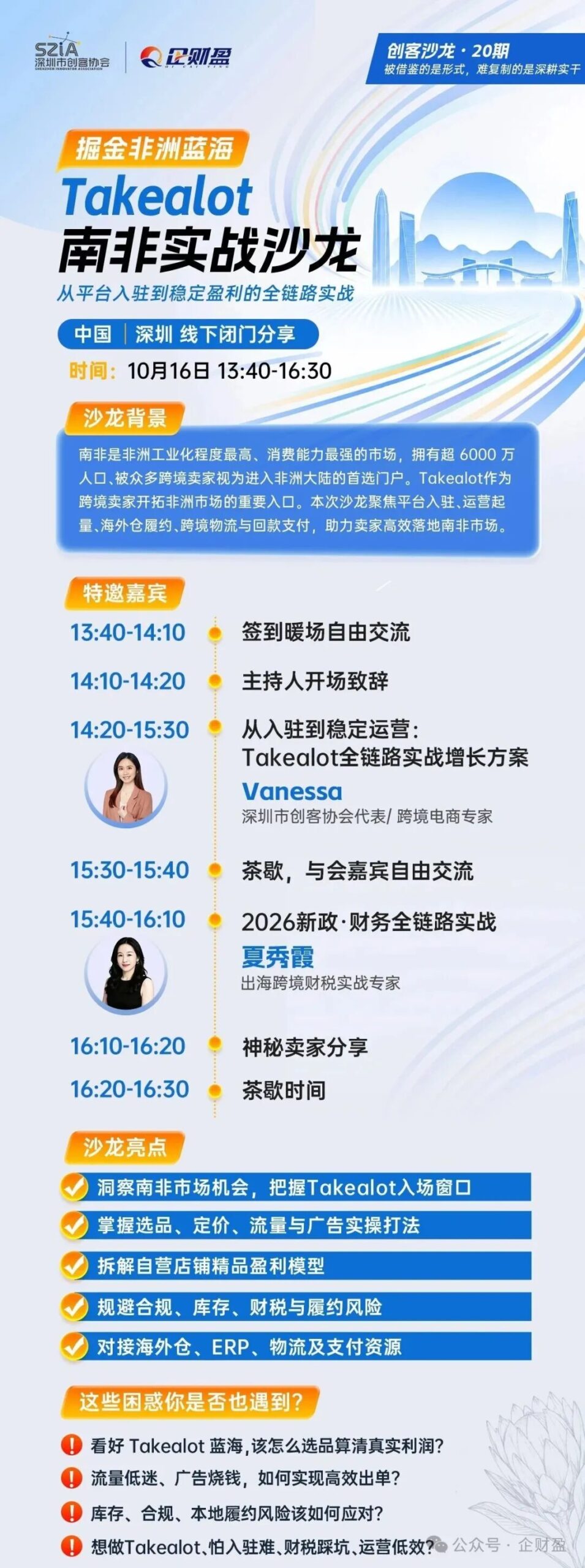
Are you optimistic about Takealot but worried about the difficulty of setting up a store, uncertainty about actual profits, wasting money on ads without generating orders, or running into pitfalls with financial and tax compliance? Join us for an in-person, closed-door seminar in Shenzhen on October 16.Takealot South Africa Hands-On Workshop
Cross-border e-commerce experts, hands-on finance and tax specialists, and a mystery seller will break down the full-funnel strategy for the South African market and connect you with overseas warehouses, ERP systems, and logistics resources. Cross-border business owners looking to tap into the blue ocean market of South Africa—don’t miss this in-person networking opportunity! Reserve your spot 🉑 by scanning the QR code to add Qicaiying’s online customer service (WeChat: jxhqcy890 / Mobile: 16625410105) 👉
.
PART.04 The Two Issues That Matter Most to Chinese Sellers
Based on the inquiries we’ve received recently from sellers, most of them are stuck on these two issues.
Question 1: Should I register a company in South Africa?
There are two types of stores on Takealot, each with different requirements for the business entity:
Store Type
Main Requirements
specificities
cross-border store
Domestic Business Entities
The barrier to entry is low, but there are restrictions on product categories, traffic, and payment methods.
local store
South African Company Entity + Local Bank Account
More comprehensive category permissions, higher traffic weighting, and smoother payment processing
From a long-term business perspective, sellers who want to expand their presence in the South African market will almost always end up establishing a local store—which means they can’t avoid the step of ”registering a South African company and opening a local bank account.”
Question 2: How is shipping handled?
There are three main methods: platform-operated logistics and delivery, stocking inventory in third-party overseas warehouses, and direct cross-border small-package shipping. Since the end of South African Post’s monopoly on small-package services in 2026, there have been significantly more logistics options than in previous years, and costs have been declining. The specific combination of options depends on product category, average order value, and inventory strategy.
.
PART.05 The Onboarding Process from 0 to 1
Taking a brick-and-mortar store as an example, starting from scratch generally involves five steps:
01 Evaluating Product Selection Strategies Identify the key product categories to promote based on South African market demand and our own supply chain.
02 Setting Up a South African Company Registering a South African Company and Opening a Local Bank Account
03 Submit an Application to Join Submit the required documents to the platform to complete the seller qualification review
04 Store Setup and Listing Products After approval, set up your store, list products, and set prices
05 Operations and Collections Track orders, optimize web pages, handle after-sales service, and collect payments on a regular basis
Steps 2 and 3 are where it's easiest to run into problems.
The documentation requirements for registering a company in South Africa differ significantly from those in China, and the details of the approval process directly affect how quickly you can launch your business. If you’re not familiar with these two steps, it’s best to seek guidance from someone with experience—avoiding detours saves money.
.
PART.06 Which Sellers Should Enter the Market Now?
To be honest, Takealot isn't for everyone:
✔ Suitable Sellers
Those who have a supply chain and product resources; those who are tired of the intense competition on Amazon or Shopee and are looking for new growth opportunities; and those who are willing to accept a 3- to 6-month adjustment period in a new market.
✖ Situations in Which Entry Is Not Recommended
Those who are counting on ”top-tier products to sell like hotcakes”—beginners who have never done e-commerce before and lack supply chain resources—the South African market does offer real opportunities, but success depends on product selection and supply chain capabilities, not luck.
put at the end
To summarize: Takealot is South Africa’s leading e-commerce platform by market share. It only opened its doors to Chinese sellers in June 2025, so competition is currently low, making it a classic “window of opportunity” market. For sellers with supply chain advantages, this is a new direction worth researching and preparing for in advance.
We offer one-stop services for the South African market:South African Company Registration, Takealot Local Store Setup Assistance, and Operational Training and Mentoring...From establishing the company to obtaining the business license for the store and launching operations, someone will guide you through the entire process.
If you're also interested in the South African market, or if you have any questions about setting up a store on Takealot or selecting products, feel free to add our customer service WeChat to ask:WeChat: jxhqcy890 / Cell: 16625410105
.
PART.07 How We Can Help You
Photos from Previous Take-A-Lot Offline Meetups in South Africa
.
We independently operate more than 20 store clusters in South Africa, and we experience firsthand the advantages of having local stores every day. From company registration and tax compliance to store onboarding, product selection, and operations,We can handle the entire process for you—all you have to do is stock up and sell.The
If you're facing any of the following situations, feel free to contact us for assistance:
I want to start a business like Takealot in South Africa, but I don't know how to register a company there or what type of company to register;
I’ve already applied on the official website myself and was rejected; I’m worried that my business license will be flagged, which could affect future applications;
I want to sign up with a local store to get 70% traffic and 48-hour payouts, but I can't find the sign-up portal;
Concerns regarding VAT compliance and subsequent cash flow issues for South African companies;
We’re struggling to make headway on European and American platforms, so we’re looking for new markets with less competition and more stable profits;
I want a one-stop management service that covers everything from registration, tax matters, and setting up shop to day-to-day operations—so I can just focus on stocking inventory and selling products.
The blue ocean won’t stay empty forever. With Chinese sellers accounting for less than 3% of the market, the sooner you enter and secure your position, the more at ease you’ll be down the road.
.
📌 South Africa’s Blue Ocean: A Limited Window of Opportunity
We don't encourage you to jump in blindly, but we do recommend that you take the time to learn more about it.
Scan the QR code to add Qicaiying’s online customer service and have a professional account manager assist you.
WeChat: jxhqcy890 / Mobile: 16625410105
We’ll assign a professional consultant to answer your questions and provide one-on-one service throughout the entire process ↓↓↓
Tags:
Signing Up as a Chinese Seller
New Cross-Border E-Commerce Platform
South African Market Analysis
South African Company Registration
Takealot Local Store
South African cross-border e-commerce
Cross-border e-commerce blue ocean
Takealot inbound
Takealot
South African e-commerce
Recommended
Cross-border e-commerce B2B must see! Registered Hong Kong company stationed in the Ali International Station, really fragrant!
In today's globalized business environment, the cross-border e-commerce B2B model is rapidly emerging with its unique advantages. For many enterprises engaged in cross-border trade, choosing a suitable platform and registering an advantageous company are undoubtedly the key keys to open the door to the international market.
2024 Hong Kong Company Account Opening Tips! How to choose the right Hong Kong bank account?
Global anti-money laundering regulations are becoming more and more stringent, the banks to maintain an account of the sunk cost is getting higher and higher, not moving hundreds of millions of dollars in fines, so that the major banks to open an account threshold as well as the audit process high up, already have a Hong Kong company bosses, how to choose the Hong Kong bank to open a public account? How much does it cost and how to operate? Today to give you a detailed introduction to the Hong Kong company account how to choose, as well as the approximate costs required and other content.
Hong Kong company registration advantages + registration conditions + registration process to share!
If you want to start a business and develop overseas markets, registering a Hong Kong company is undoubtedly a very forward-looking choice. With its unique geographical location, sound legal system, low tax rate and open business environment, Hong Kong company has become a "sharp weapon" for many business owners to open up overseas markets. Why is it so important to register a Hong Kong company in 2024?