The Criteria for Determining ”Associated Relationships” That Amazon Reviewers Won’t Tell You—I’ve Summarized Them for You
Published: August 14, 2026
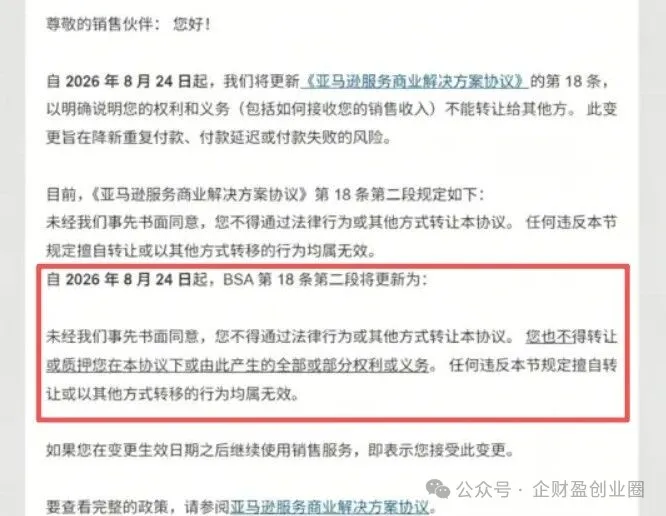
The hottest topic of discussion in the Amazon community lately has been the BSA's new regulations announced on August 24.
Everyone is saying, ”The ”entity change” feature is going to be permanently shut down” and “Switching from mainland China to Hong Kong is completely out of the question.”
But did you know?The new regulations do not prohibit changes; rather, they impose stricter scrutiny on the grounds for making such changes.
The platform will ask you one crucial question:“What’s your connection to the mainland?”
In this article, I’ll provide a comprehensive overview of the criteria for determining ”affiliation” as recognized by Amazon reviewers, along with the required documentation.
01 Get the facts straight first ::What exactly is Amazon investigating?
The update to Article 18 of the BSA, which took effect on August 24, essentially states that ”Store agreements and rights may not be transferred or pledged without the platform’s written consent.".
It is not a ”one-size-fits-all approach to closing all channels for entity changes.”The
What has really changed is:Review criteria for cross-entity changes will be applied strictly.The
In the past, you could change it for any reason, but now the platform will ask:“What gives you the right to switch it?”
The key to answering this question lies in ”proving the causal relationship.”
02Amazon's ”3 Types of Legitimate Affiliations”
Based on current practical feedback from the industry, the following three types of relationships can be changed by applying through official channels,There is a relatively high probability of receiving approval from the platform::
Scenario A: Father-Son/Immediate Family Relationship
The legal representatives of the new and old entities are immediate family members (spouses, parents, children, etc.).
Required Materials: Notarized proof of kinship + a complete copy of the household registration booklet + notarized copies of the ID cards of the new and former legal representatives + the business licenses of the new and former companies
crux: The notarization must be completed before the change takes effect; it cannot be done retroactively.
Scenario B: Controlling Interest
A Hong Kong company holds a controlling stake in a mainland company (holding more than 50% of the shares).
Required Materials: Hong Kong Company Registration Certificate + Certificate of Share Capital + Mainland China Corporate Credit Report (showing equity structure) + Documents notarized and forwarded by an overseas attorney
crux: Controlling InterestMust have existed prior to the change... Last-minute, last-ditch stock purchases may be deemed an attempt to maliciously circumvent regulations.
Scenario C: Mergers and Acquisitions/Business Succession
When a mainland company is wholly acquired by a Hong Kong company, there may be a genuine business succession relationship.
Required Materials: Share Transfer Agreement + Bank Transfer Receipt + Notice of Business Registration Change + Proof of Asset/Business Transfer
crux: Proof requiredBusiness operations are continuous., not just a ”shell swap”
03These materials aren't easy to prepare.
By now, you’ve probably realized that:
Where can I get a notarized certificate of kinship? What is the process?
Who should a Hong Kong company contact to have documents notarized and forwarded by an overseas lawyer?
How should a share transfer agreement be drafted to meet Amazon’s review standards?
Where can I download a corporate credit report? Does it need to be notarized?
Any mistake in the details could result in the review failing.
Enterprise Finance GroupWith deep expertise in cross-border financial and tax compliance, we provideHong Kong Company Registration, Overseas Notarization, Equity Structure Design, Auditing and Tax Filingend-to-end services, etc.
In response to the new regulations issued on August 24, Qicaiying has launched “Specialized Compliance Services for Entity Changes” ::
✅ Diagnosis of Related Party Relationships— Determine whether your new and existing entities meet the review criteria ✅ Preparing All the Materials—Assistance with notary services, attorney-to-attorney service of process, and equity documents ✅ Opening a Case, Reporting, and Guidance—We’ll help you craft the perfect application pitch so you’re approved on the first try ✅ Tax System Integration—Guidance on the Order of VAT Deregistration/Registration and Simultaneous Changes to Payment Accounts
04Review Period and Risk Disclosure
audit cycle: Generally3 to 6 weeksThe
Risk Warning::
There is a risk that your store may be suspended during the transition period.—The store may be suspended from sales until the review is approved.
May trigger a thorough KYC verification process in Europerespond in singingComprehensive Review of Consumer Legislation
If there are any errors in the information, the change will be rejected outright, and it may even trigger long-term account risk controls.
special reminder: Under no circumstances should you rush to submit your application right at the deadline in mid- to late August! The closer it gets to the deadline, the more congested the review queue becomes, and risk control scans will be even stricter.
05Those ”Fatal” Moves
The following steps,It's basically suicide.::
A ”shell-for-shell” swap with no equity ties”—Applications for transferring assets from mainland China to Hong Kong solely for tax planning purposes, without any proof of equity ownership, have an extremely low approval rate.
Falsified Proof of Shareholding Relationship (Photoshopped)—This is fraud; your account will be immediately suspended, with no opportunity to appeal.
Modify the receiving account during the changeover period—This will trigger multiple risk control measures, resulting in an extremely high failure rate for changes.
Find ”inside connections” to force changes—The Unified Social Credit Code has currently been locked in the backend system; any so-called ”internal channels” are scams.
06Specific Recommendations for Three Types of Sellers
Category 1: Those who are planning to move from mainland China to Hong Kong
First, conduct a self-assessment: Are there actually any equity, family, or merger and acquisition relationships between the new and old entities?
If so → Prepare the materials according to the checklist above and follow the official case-filing process.
If not → It is recommended that you give up., Don't take that risk
Category 2: Those that have already been replaced but have not yet been reviewed
Verify that the submitted materials are complete and accurate
Keep your backend systems and email accessible, and be ready to submit additional materials at any time.
Under no circumstances should you perform any sensitive actions (such as changing your payment account or password) during the review period.
Category 3: Those who have purchased an account or are using one registered under another company's name
This is not a problem that can be solved by a ”change of entity.”
This is the fundamental issue of ”discrepancy between the registered entity and the actual operating entity.”
We recommend consulting a professional compliance advisor as soon as possible to assess the risks.
👇Instead of figuring it out on your own and running into problems, let a professional team handle it for you once and for all, Scan the QR code to consult with a Qicaiying compliance advisor and get a free assessment
📱 WeChat: qcygscszk 📞 Phone: 18676749275
Tags:
An Analysis of Amazon's New Policies
Amazon Compliance
Amazon's New Rules
Recommended
Cross-border e-commerce B2B must see! Registered Hong Kong company stationed in the Ali International Station, really fragrant!
In today's globalized business environment, the cross-border e-commerce B2B model is rapidly emerging with its unique advantages. For many enterprises engaged in cross-border trade, choosing a suitable platform and registering an advantageous company are undoubtedly the key keys to open the door to the international market.
2024 Hong Kong Company Account Opening Tips! How to choose the right Hong Kong bank account?
Global anti-money laundering regulations are becoming more and more stringent, the banks to maintain an account of the sunk cost is getting higher and higher, not moving hundreds of millions of dollars in fines, so that the major banks to open an account threshold as well as the audit process high up, already have a Hong Kong company bosses, how to choose the Hong Kong bank to open a public account? How much does it cost and how to operate? Today to give you a detailed introduction to the Hong Kong company account how to choose, as well as the approximate costs required and other content.
Hong Kong company registration advantages + registration conditions + registration process to share!
If you want to start a business and develop overseas markets, registering a Hong Kong company is undoubtedly a very forward-looking choice. With its unique geographical location, sound legal system, low tax rate and open business environment, Hong Kong company has become a "sharp weapon" for many business owners to open up overseas markets. Why is it so important to register a Hong Kong company in 2024?