Now that the income tax assessment has been approved, will there be a retroactive VAT collection? Export sellers who issue invoices, take note!
Published: July 24, 2026
Several sellers have approached me recently, and their situations are surprisingly similar.
“I’ve already had my income taxes for Q3 and Q4 of last year assessed and paid, and the tax authorities have accepted them. Does that mean I’m in the clear?”
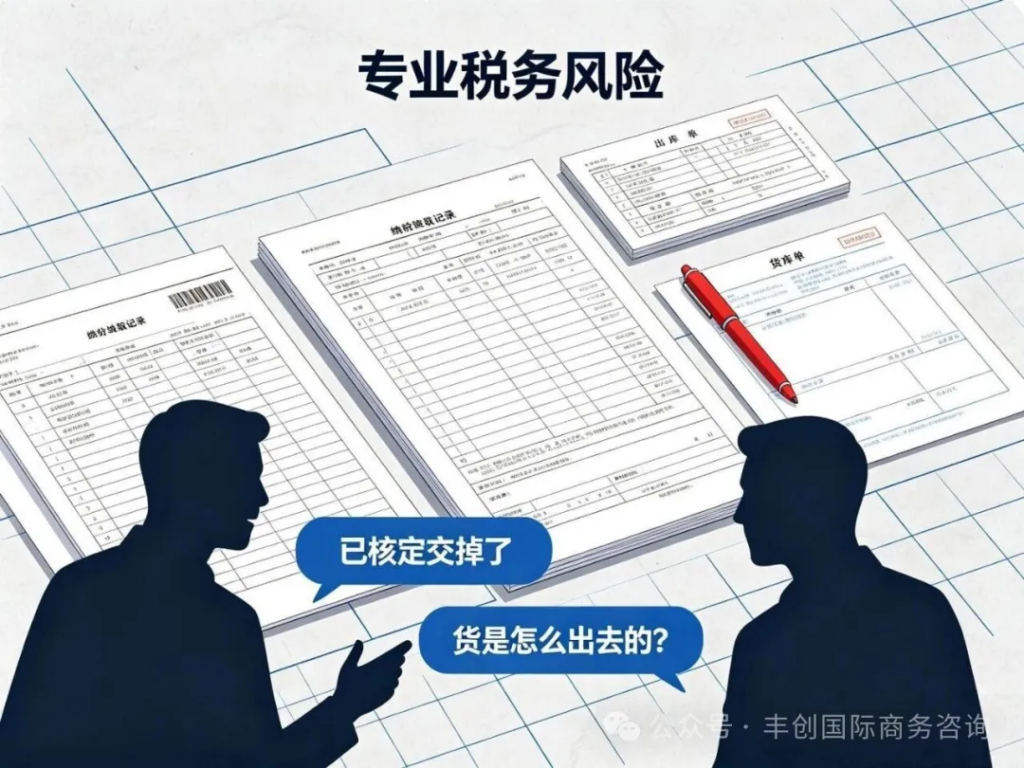
I asked them, “How did your goods get out?”
He was silent for three seconds, then said, “...I’ll pay.”
This is a very common scenario, and it’s also one of the most easily overlooked risks in the industry today. Today, I’m going to explain this issue thoroughly.
I. An income tax assessment does not mean the matter is closed.
Many business owners think like this:The company has sales revenue → Filed an income tax return → The tax authority approved it → All doneThe
But the reality is,Income tax and value-added tax are two separate systems; each is audited independently.
The tax authority reviews your income tax return to determine your tax liability at the profit level. As for VAT, it looks atOutput and InputThe relationship between the two is such that their review processes follow entirely different logics. Just because your income tax has been assessed doesn’t mean you’ve cleared the VAT hurdle.
II. Export Sales on a "Buy-and-Sell" Basis: A Deadlock at the VAT Level
The core issues with payment-on-export transactions can be broken down into three:
First.You did not use your company's letterhead when filing the customs declaration., There are no records of your exports at Customs.
Second.You don't have a purchase invoice, so you can't claim any input tax credits.The
Third, your company’s books show only sales revenue, but there is no corresponding export customs clearance data.
How does this look to the tax authorities?
It’s just a typical domestic trading company. It has sales revenue, but no invoices for purchase costs and no export records.
The result:All sales revenue is treated as domestic sales, and VAT is paid in full.
III. Do the math, and it’ll all become clear
Suppose you run a retail business that generated 5 million in sales in 2025:
If calculated using the 1% tax rate for small-scale taxpayers, the VAT would be 50,000.
If classified as a general taxpayer, the VAT would be 650,000 yuan at a rate of 13%.
And that doesn't even include surcharges and late payment penalties.
Furthermore, since this is an export transaction where you pay the full amount, you won’t be eligible for any export tax rebates. This 650,000 is a pure, additional cost.
IV. The Issue of Retroactive Tax Collection Is More Complicated Than You Might Think
Many business owners feel that the past is behind them.
However, according to the Tax Collection and Administration Law, if the taxpayer made a calculation error, back taxes may be collected within three years. IfTax Evasion and Tax FraudIn such cases, there is no time limit on the collection of back taxes.
Paying for exports without declaring VAT can easily be deemed tax evasion. This means that records from several years ago could be dug up.
V. The tax and customs systems are now integrated.
In the past, the tax authorities couldn't access your customs declaration data, and customs couldn't see your tax payment records.
The information-sharing mechanism between the State Taxation Administration and the General Administration of Customs has now been fully implemented. Specifically:Does your company have any export records? Customs will find out as soon as they check..;If your company reports revenue but has no export data, the system will automatically trigger an alert..;When the company name on your customs declaration doesn't match your store's company name at all...This is a very clear warning sign.
VI. What Can We Actually Do Right Now?
The historical customs declarations have already been filed, so it’s not practical to file them retroactively. However, that doesn’t mean we have to just sit back and wait to be assessed back taxes. At this point, there are two relatively feasible approaches:(For specific plans, please contact +csdrcc12345)The
Option 1: Outsourcing and Export Model
pertainHas a stable supply chainThe Seller.
The advantage of this approach is that it eliminates the “payment” step at the source; since the store company is not subject to VAT, it is not required to pay VAT. The downside is that historical issues remain, so the key is to ensure the chain of evidence is solid.
Option 2: Engage in tax-related communication to seek tax-exemption filing
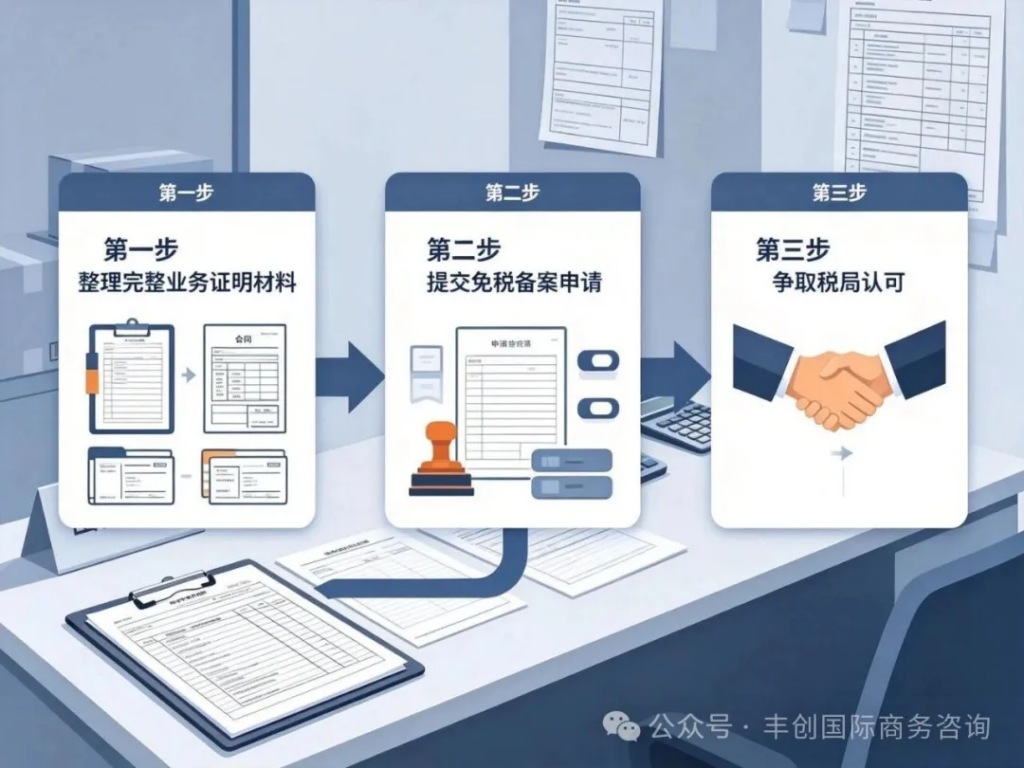
This is for sellers who have made mistakes in the past and now want to resolve the issues. Based on practical experience, this is currently one of the more viable approaches. The specific process consists of three steps:
Step 1: Gather all necessary business documentation.
Step 2: Submit an application for tax exemption filing to the competent tax authority.
Step 3: Seek approval from the tax authorities.
The tax authority also has some discretion; the key is whether your supporting documentation is complete enough and whether your argument holds up logically.
The key point of this proposal is that,You're not there to fight the tax authorities; you're there to communicate and provide evidence.. Many business owners are afraid to contact the tax authorities, thinking, “If I reach out to them, they’ll audit me.” However, practical experience shows that proactive communication is always better than passively waiting for a notice. The tax authorities are reasonable; if you provide complete documentation to prove that “I operate a cross-border e-commerce business and simply had some irregularities in my customs declarations in the past,” they are generally willing to give you an opportunity to rectify the situation.
VII. To Be Honest
If you’re still making export sales on a cash basis and your company’s books show sales revenue in the range of several million to over ten million, then VAT is indeed a looming concern.
The good news is that taking the initiative to communicate is much cheaper than sitting back and taking the hit.By proactively filing for tax-exempt status and proactively contacting the tax authorities to explain the situation, you may be able to secure lenient treatment under tax law.We'll explain it when the auditors come—the costs are completely different.
Tags:
Tax and Financial Compliance Case Studies
Case Studies on Financial and Tax Compliance
Tax and Financial Compliance Solutions
Approved levy
Recommended
Cross-border e-commerce B2B must see! Registered Hong Kong company stationed in the Ali International Station, really fragrant!
In today's globalized business environment, the cross-border e-commerce B2B model is rapidly emerging with its unique advantages. For many enterprises engaged in cross-border trade, choosing a suitable platform and registering an advantageous company are undoubtedly the key keys to open the door to the international market.
2024 Hong Kong Company Account Opening Tips! How to choose the right Hong Kong bank account?
Global anti-money laundering regulations are becoming more and more stringent, the banks to maintain an account of the sunk cost is getting higher and higher, not moving hundreds of millions of dollars in fines, so that the major banks to open an account threshold as well as the audit process high up, already have a Hong Kong company bosses, how to choose the Hong Kong bank to open a public account? How much does it cost and how to operate? Today to give you a detailed introduction to the Hong Kong company account how to choose, as well as the approximate costs required and other content.
Hong Kong company registration advantages + registration conditions + registration process to share!
If you want to start a business and develop overseas markets, registering a Hong Kong company is undoubtedly a very forward-looking choice. With its unique geographical location, sound legal system, low tax rate and open business environment, Hong Kong company has become a "sharp weapon" for many business owners to open up overseas markets. Why is it so important to register a Hong Kong company in 2024?