Is it really safe if quarterly sales stay under 300,000? This misconception in cross-border e-commerce is truly dangerous!
Published: July 24, 2026
You may think you've thought everything through, but the tax authorities may understand your business model even better than you do.
I. Let’s start by talking about this common “clever idea”
I’ve been talking to quite a few sellers recently and have noticed a deeply ingrained belief:
“The platform pushes the data—so be it. I keep the quarterly revenue for each of my stores under 300,000, so the tax authorities don’t even notice me. Even if I were to get flagged, revenue under 300,000 per quarter is treated as domestic sales and exempt from VAT—I wouldn’t have to pay much in back taxes anyway. So I’ll keep purchasing without invoices and continue to export using sales receipts; there’s no problem with that.”
On the surface, this logic seems to be well-structured and thorough, with each step building on the last. But does it really hold up to scrutiny? Let’s take a look, step by step.
II. Point-by-Point Analysis: Why These Ideas Actually Don’t Hold Water
Misconception 1: “If I earn less than 300,000 per quarter, the tax authorities won’t catch me.”
Let’s start by acknowledging a fact: You can indeed register stores under different legal entities, at different addresses, and with different company names. Amazon reports data to tax authorities based on the store’s legal entity, and the current system isn’t yet capable of automatically linking the ten stores you own to a single individual with a single click.
However, this “no problem” is only temporary, and things can easily go wrong. The risks can be viewed in three layers:
First Level: Even when looking at a single store, the data itself is problematic. Even if the tax authorities are completely unaware that you also own other stores and are only looking at the records for this one store: Amazon's submission to the tax authorities:Zhang San Trading Co., Ltd. reported sales of 980,000 in 2025. You must file your own tax return with the tax authorities:Zhang San Trading Co., Ltd. will report zero sales for 2025, or perhaps a nominal figure of a few ten thousand yuan. At the same time, you do not have the corresponding input invoices, nor do you have any export customs declaration records.
The tax authorities don’t even need to link this to your other stores—the discrepancies between the tax return data and the platform data for this single store alone are already significant. The core function of the Golden Tax Phase IV system is to compare data, not to speculate on who the owner behind the scenes is. When the data doesn’t match, it triggers an anomaly alert. This alert pertains specifically to this taxpayer and has nothing to do with your other stores.
Second Level: Once an alert is triggered, the tax authorities have access to a great deal of information. Once a business is flagged as suspicious, the tax authorities can access more than just your tax returns: Bank account statements showing fund transfers between corporate accounts and the legal representative’s personal account; Social security contribution records, where you pay your social security contributions, and which companies you are currently affiliated with; Regarding business registration information: even if the legal representatives are different, could the registered address, contact number, and tax filing representative be the same person?; In an investigation into the actual controller, once the audit process begins, the auditors have the authority to determine who is pulling the strings behind the scenes.The
If a single store is flagged due to unusual data and an investigation is launched, other stores will inevitably come to light as well—and this process is easier than you might think.
Third: It’s not hard to find out that you run multiple stores. Although the system does not automatically map ten stores operated by different legal entities as a single network, traditional investigative methods are more than sufficient. The routes through which bank funds are consolidated, whether the operational teams consist of the same group of people, and whether the shipping warehouses are centralized in one location—this information is virtually impossible to conceal entirely from an administrative investigation.
So, the key point isn’t that “the system automatically linked all your stores,” but rather:Discrepancies in a single store’s data → trigger an alert → lead to an audit → during the audit, it’s impossible to hide the issues at your other storesThe
Misconception #2: “Even if I get audited, I’ll just have to pay a little extra VAT. Since amounts under 300,000 are tax-exempt on a quarterly basis, how much could it possibly be?”
The reality is that,Value-added tax is just one part of it; corporate income tax is the real focus.The
Let’s start by clarifying a basic fact: When goods are treated as domestic sales and exempt from tax, the exemption applies to value-added tax. However, the profits you generate from your business are subject to corporate income tax.
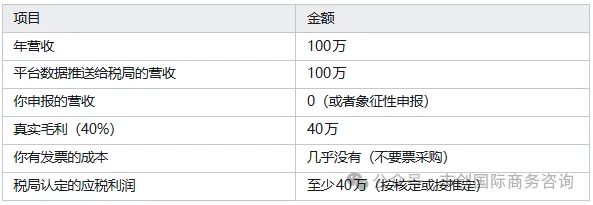
Let's do a simple calculation: An Amazon store with annual revenue of 1 million RMB (averaging exactly 250,000 RMB per quarter) and a gross profit margin of 40%.
Annual revenue: 1 million. This is the figure the platform reports to the tax authorities. The revenue you reported: 0, or a nominal amount. The actual profit, calculated at 40%, is 400,000. Your invoice costs: virtually none, since we’ve always purchased without invoices. Taxable profit as determined by the tax authorities: at least 400,000. Without invoices, the tax authorities cannot verify your costs; they may assess the amount based on the full amount or the industry profit margin.
What is the approximate corporate income tax rate? 400,000 × 5% (preferential tax rate for micro and small enterprises) = 20,000 yuan.
At this point, some people might think, “20,000 a year isn’t that much.”
But the issue has never been just about “the 20,000 in taxes this year.” There are also late fees:At 0.05 percent per day, if you go back three years, the late payment penalty could exceed half the tax amount. And there are also fines:Fines for tax evasion range from 0.5 to 5 times the amount of tax owed. Furthermore,The investigation covers not just this year, but the past three years and even longer.
Suppose you do this for three consecutive years: An annual tax back payment of 20,000—that’s 60,000 over three years; late payment penalties easily exceed 30,000; and even if fines are calculated at just 100 percent of the tax owed, that’s another 60,000. For corporate income tax alone, a single store could end up owing more than 150,000.
And that doesn't even account for the potential issues with VAT or the customs charges. Will the money you saved by purchasing without invoices be enough to cover this shortfall?
Misconception 3: “Everyone’s doing ”buy-side exports’—what’s the big deal?”
The reality is that export invoice fraud is not just a routine violation; it is far more serious in nature.
"Exporting under someone else's declaration" refers to shipping one's own goods using another party's export declaration. The provisions regarding this practice are clearly outlined in the *Customs Law*. Article 15 of the *Regulations on the Implementation of Customs Administrative Penalties*: Where evasion of customs supervision constitutes an act of smuggling, the smuggled goods and illegal gains shall be confiscated, and a fine of up to three times the amount of taxes evaded may also be imposed. In serious cases, the matter shall be referred to the public security authorities.
Based on the information available, the number of investigations into export transactions involving third-party payment processing in the cross-border e-commerce sector has increased significantly from 2024 to 2025. If caught, businesses face not only back taxes but also the possibility of criminal liability.
Furthermore, there is a logical inconsistency between export invoices and your tax returns that you can’t explain: The platform records show that you sold the goods, but there is no record of your export in the customs system. So how did your goods actually leave the country? Once you look at these two figures side by side, there’s simply no room for interpretation.
III. The Bigger Problem: Just because it wasn’t found today doesn’t mean it won’t be found tomorrow
Many sellers say, “I’ve been doing it this way for three years now, and nothing bad has happened.”
That’s not safety—that’s luck. And that luck is becoming less and less reliable.
Several trends are quite clear: Data connectivity is a one-way process; there’s no going back.The data that platforms submit to the tax authorities will only become more detailed. A special inspection of cross-border e-commerce is already underway.In cities like Shenzhen, Hangzhou, and Guangzhou—where sellers are concentrated—the tax authorities have long had dedicated teams in place. The barriers to big data screening are coming down.In the past, it might have taken several million in annual revenue to get noticed, but now that threshold is getting lower. Once a single store has been investigated, a follow-up investigation into related entities is standard procedure.Although the system does not automatically link stores owned by different legal entities, if one store is audited, all affiliated companies associated with its legal representative, shareholders, and financial officer can be retrieved, making the information immediately clear.
The reason you weren't caught today isn't because you were so thorough—it's simply because the computational power hasn't been directed at you yet.
IV. The Cost of Compliance Isn’t as High as You Might Think
Many sellers insist on purchasing without invoices for one reason: requesting an invoice means paying additional tax, and if costs go up, there’s no profit left.
Let's do the compliance math honestly.
Follow the compliance path, such as ensuring compliance for individual stores using the 9810 method: When purchasing, you need to request an invoice and pay an additional 8%-13% in tax, but this amount is eligible for a VAT credit. If you go through the proper customs clearance process for exports, you can receive a tax refund. Profits are calculated in accordance with tax regulations, and corporate income tax is paid based on actual profits.
All things considered, when operating in compliance with regulations, the combined tax burden for cross-border e-commerce—comprising value-added tax and corporate income tax—can range from 0.4% to 0.8% for well-managed businesses, while many product categories typically fall within the range of 3% to 8%.
There’s a very simple principle:The cost of compliance is a one-time expense that can be clearly calculated, but the risk of noncompliance is a constant threat. You saved 100,000 yuan this year by purchasing goods without invoices, but a single enforcement order next year could force you to give back all your profits from the past three years.
V. In conclusion
I’m not writing this to create tension—that would be pointless—but simply to make one thing clear:What you think is safe may actually be full of vulnerabilities.
If you are currentlyMulti-Store Operations(math.) genusKeep quarterly revenue below 300,000(math.) genusLong-Term Procurement Without Bids(math.) genusThe exports weren't cleared through official customs procedures either.—Then you should have a pretty good idea of just how significant the cumulative risk from these actions really is.
Instead of waiting until you receive a notice and then panicking, it’s better to take some time now to get your affairs in order.
For many of the sellers we interact with on a daily basis, the question isn’t “Should we comply with regulations?” but rather “Where do we start?” Since every seller’s store structure, supplier situation, and export methods are different, there is no one-size-fits-all solution.
If you, too, want to figure out where your risks lie first,You can add our customer service WeChat account: csdrcc12345. Based on your specific circumstances, we will arrange for a professional manager to meet with you one-on-one to help you assess your current situation and then provide a compliance solution tailored to your needs.
Tags:
Tax and Financial Compliance Case Studies
Case Studies on Financial and Tax Compliance
Tax and Financial Compliance Solutions
’Tax and Financial Compliance'
Recommended
Cross-border e-commerce B2B must see! Registered Hong Kong company stationed in the Ali International Station, really fragrant!
In today's globalized business environment, the cross-border e-commerce B2B model is rapidly emerging with its unique advantages. For many enterprises engaged in cross-border trade, choosing a suitable platform and registering an advantageous company are undoubtedly the key keys to open the door to the international market.
2024 Hong Kong Company Account Opening Tips! How to choose the right Hong Kong bank account?
Global anti-money laundering regulations are becoming more and more stringent, the banks to maintain an account of the sunk cost is getting higher and higher, not moving hundreds of millions of dollars in fines, so that the major banks to open an account threshold as well as the audit process high up, already have a Hong Kong company bosses, how to choose the Hong Kong bank to open a public account? How much does it cost and how to operate? Today to give you a detailed introduction to the Hong Kong company account how to choose, as well as the approximate costs required and other content.
Hong Kong company registration advantages + registration conditions + registration process to share!
If you want to start a business and develop overseas markets, registering a Hong Kong company is undoubtedly a very forward-looking choice. With its unique geographical location, sound legal system, low tax rate and open business environment, Hong Kong company has become a "sharp weapon" for many business owners to open up overseas markets. Why is it so important to register a Hong Kong company in 2024?