Analysis of Hong Kong’s New Tax Policies for 2026: A Guide to FSIE Compliance for Cross-Border E-Commerce, Offshore Exemption Applications, and Bank Account Opening
Published: July 17, 2026
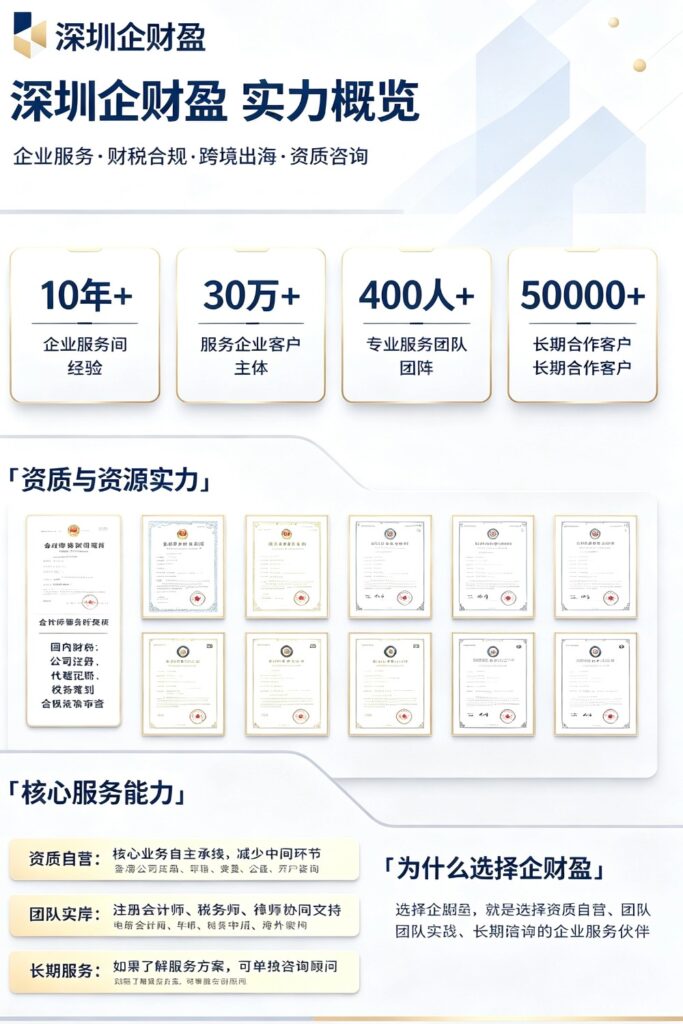
Qicaiying (formerly Jinxinheng) was founded in Bao’an, Shenzhen, in 2015. With over a decade of deep industry experience, it is a one-stop service provider specializing in business registration, accounting, taxation, and cross-border expansion for enterprises. The company has branches in Guangzhou, Shanghai, Hong Kong, and other locations, employs a team of over 400 professionals, and has served more than 500,000 companies to date. Core Services: Company registration and bookkeeping, tax planning, export tax rebates, cross-border e-commerce tax and financial compliance, domestic and international offshore company structuring, transparent fund repatriation, and assistance with tax audits and rectifications under the Golden Tax Phase IV initiative. The firm specializes in providing end-to-end tax and financial compliance implementation services for foreign trade and cross-border e-commerce sellers.
👋 Scan the code to add WeChat (WeChat:jxhcyb) or call customer service:18148556832, Get a free copy of the “2026 Hong Kong Tax Policy Compliance Self-Assessment Checklist + FSIE Economic Substance Compliance Plan + Offshore Exemption Evidence Chain Template”!
In 2026, Hong Kong’s tax environment will undergo its most profound transformation in nearly a decade. For cross-border e-commerce sellers, this represents both a period of policy benefits and a make-or-break moment for compliance. Hong Kong’s Budget has introduced several favorable measures, such as profits tax relief and improved customs clearance efficiency. However, three major red lines—the tightening of the FSIE foreign income exemption, the effective end of “zero-declaration,” and stricter scrutiny of offshore exemptions—are forcing companies to re-examine the tax structures and operational models of their Hong Kong entities. The policy window is narrowing, while compliance costs and risks are rising in tandem. Based on the latest 2026 legislation and practical case studies, this article systematically breaks down the core changes, key timelines, and response strategies of Hong Kong’s new tax policies to help sellers achieve tax optimization within the compliance framework.
I. Benefits of the New Policies: Hong Kong’s “Triple Package” of Fiscal and Tax Policies for 2026”
On February 25, 2026, Hong Kong Financial Secretary Paul Chan Mo-po delivered the new annual Budget, announcing a profits tax relief measure (100%) for the 2025/26 tax year, capped at 3,000 Hong Kong dollars. Approximately 171,000 businesses across Hong Kong will benefit from this measure, representing more than 40 percent of the total number of registered companies in Hong Kong as of 2024.
More importantly, the two-tier profits tax system remains in place: the tax rate on the first HKD 2 million in profits is only 8.25%, while profits above that amount are taxed at 16.5%. Take a cross-border e-commerce company with annual profits of HK$5 million as an example: Tax liability on the first HK$2 million = 2 million × 8.25% = HK$165,000; Tax liability on the remaining HK$3 million = 3 million × 16.5% = HK$495,000; The total tax liability is HK$660,000, representing a savings of HK$165,000 compared to a flat tax rate of 16.5%.
Please note: Among affiliated companies, only one may be designated to receive the two-tier tax incentive. The tax authority defines “affiliated companies” as follows: one company holds at least 50% of the equity in another company, or a third party simultaneously holds at least 50% of the equity in both companies. Of the cases in 2025 where back taxes were assessed due to incorrect reporting under the two-tier system, approximately 35% involved issues related to affiliated enterprises.
Improved Customs Clearance Efficiency: “Single Window for Trade” Fully Implemented
In 2026, the third phase of the “Single Window for Trade” was fully implemented. Businesses need only upload their data once, and the system automatically aligns with the requirements of both mainland and Hong Kong customs authorities. The time required to prepare documents was reduced from an average of 3.5 working days to less than 4 hours, and customs clearance efficiency improved by more than 90%.
Tiered Taxation for Cross-Border E-Commerce
The new regulations for 2026 implement a tiered tax rate system for the comprehensive tax on cross-border e-commerce: Category A essential daily necessities (infant formula, medicines, and maternal and infant products) have a comprehensive tax rate of 0.%; Category B upgraded consumer goods (cosmetics, small appliances, and apparel) have a comprehensive tax rate of 9.1%; Category C high-value goods (luxury goods, electronics) will have a comprehensive tax rate of 23.1%. This tiered structure significantly reduces the tax burden for sellers of essential consumer goods but imposes stricter requirements for product classification and declaration. Incorrect classification may result in back taxes and fines.
II. Compliance Red Lines: Three “Make-or-Break” Thresholds for 2026”
First Red Line: Comprehensive Tightening of the FSIE Exemption for Out-of-Town Income
Effective January 1, 2023, the FSIE (Foreign-Source Income Exemption) mechanism officially took effect. Effective January 1, 2026, the revised FSIE system will further expand its scope to include all four categories of passive income—foreign dividends, interest, royalties, and gains from the disposal of assets—under its regulatory framework.
To qualify for tax exemption, you must meet one of the following two conditions:
Shareholding Test: Hold ≥5% equity in an overseas company, and the effective tax rate in the investee company’s location is ≥9.9%.
Economic Substance Test: Must have a fixed office space in Hong Kong, at least two full-time employees, and annual local expenditures of at least 2 million HKD.
The "FSIE Practical Guidelines" issued by the Hong Kong Inland Revenue Department in January 2026 specify that for enterprises unable to provide proof of overseas shareholding or economic substance, the relevant passive income will be taxed at a rate of 16.5%. For most small and medium-sized cross-border e-commerce businesses, the threshold for holding a 5% equity stake in an overseas company is relatively high, making the economic substance approach a more realistic option. However, the requirement for HK$2 million in local expenditures means that simply using a registered office address is no longer sufficient to meet the criteria. It is worth noting that the source of profits and the economic substance requirements are considered separately; covered taxpayers may still apply for tax exemption on their offshore income.
The Second Red Line: The Era of “Zero Reporting” Has Essentially Come to an End
“Zero-return filing” has not been repealed by law, but the conditions have become extremely stringent. According to Section 379 of the Hong Kong Companies Ordinance, only companies that meet the definition of a “dormant company”—that is, companies that have had no accounting transactions throughout the entire fiscal year—are exempt from audit requirements. Once any accounting transaction occurs (such as bank fees), the company automatically ceases to be considered dormant.
The reality is that the vast majority of Hong Kong-based cross-border e-commerce companies open bank accounts for receiving and making payments. Even a single bank fee constitutes an accounting transaction and must be recorded and audited. The Hong Kong Inland Revenue Department has designated companies that have filed zero tax returns for multiple consecutive years as high-risk targets for audits and has strengthened oversight by using big data to cross-reference bank statements, customs records, and other information.
Third Red Line: Tighter Scrutiny of Offshore Exemptions
The offshore exemption is central to tax planning for Hong Kong companies. It is based on the territorial source principle set forth in Section 14 of the Hong Kong Inland Revenue Ordinance—only profits arising in or derived from Hong Kong are subject to taxation. As of 2026, the Inland Revenue Department’s audit standards have shifted from a “document-based” approach to a “substance-based” one.
A more comprehensive chain of evidence will be required when applying for an offshore exemption in 2026:
The counterparty cannot be a Hong Kong company or a Hong Kong permanent resident.
The entire process—from contract signing to procurement, sales, and logistics—does not take place in Hong Kong.
You must provide the overseas company’s certificate of incorporation, business registration certificate, and a “Declaration of Non-Operation in Hong Kong.”
In 2026, the rejection rate for offshore exemption applications rose year-over-year to 35%-. The main reasons for rejection were “incomplete chain of evidence” or “a substantive connection between the source of profits and Hong Kong”-.
III. The Race Against Time: The 2026 Tax Calendar for Cross-Border E-Commerce
Monthly Routine: Mandatory Provident Fund (MPF) Contributions
On or before the 10th of each month, Hong Kong employers must make Mandatory Provident Fund (MPF) contributions for all employees paid on a monthly basis. The MPF contribution rates for 2026 are as follows: 5% for employees and 5% for employers, with a cap of 5% of relevant monthly income (maximum contribution of 1,500 HKD). Failure to make contributions on time will result in a 5% initial surcharge.
April 1: The Annual Tax Season Kicks Off
On the first working day of April each year, the Hong Kong Inland Revenue Department issues two types of important tax forms in bulk: the Corporate Profits Tax Return (BIR51) and the Employer’s Remuneration Return (BIR56A). By participating in the “Bulk Extension Scheme” through a tax representative, M Code can extend the filing deadline to December 15, 2026 (paper filing) or January 2, 2027 (electronic filing). Even if the company has no employees, it must check “NO” on the BIR56A form and submit it.
Around May 4: Issuance of the BIR60 individual income tax return
General taxpayers: Must file within one month of the issuance date; Sole proprietors: Must file within three months of the issuance date; Electronic filing: The deadline is typically automatically extended by one month.
IV. Special Considerations for Cross-Border E-Commerce
Evidence Chain Management for Offshore Operations
For pure cross-border e-commerce businesses (where goods are sourced in mainland China, sold in Europe and the United States, stored overseas, and shipped without passing through Hong Kong), it is theoretically possible to apply for an offshore exemption. However, managing the chain of evidence is key to success. In 2026, the Hong Kong Inland Revenue Department requires the following documentation:
Purchase Contract: Must include the supplier’s name, address, and place of signing (which cannot be in Hong Kong)
Sales Contract: Displays buyer information, platform records, and place of signing
Logistics documents: bill of lading, warehouse receipt, customs declaration form—proving that the goods have not entered Hong Kong
Bank Statements: Records of payments received and made, showing that the counterparties are not Hong Kong entities
Meeting Minutes: Location of Board Decisions, Contract Approval Process
The conditions for the offshore exemption align perfectly with the cross-border e-commerce business model: no physical office in Hong Kong, no employment of local Hong Kong staff, goods do not pass through Hong Kong (shipped directly from mainland China to overseas FBA warehouses), and neither suppliers nor customers are local Hong Kong entities.
The Time Window for Export Tax Rebates
Under the new regulations effective in 2026, tax refund declarations for export transactions must be filed within 36 months; failure to do so will result in taxation at the domestic sales rate. It is essential to ensure that the “three flows”—cash flow, goods flow, and invoice flow—are consistent. Recommended structure: Mainland factory → Export agent → Hong Kong company (offshore account for receiving foreign exchange).
The Exchange Rate Advantages of RMB Settlement
In January 2026, the Hong Kong Monetary Authority announced that the funding quota for Hong Kong’s RMB business had doubled to 200 billion yuan. Cross-border e-commerce businesses can now directly use the RMB to access global markets, thereby avoiding the risks associated with exchange rate fluctuations.
V. Frequently Asked Questions (FAQ)
Q1: Under the new FSIE regulations for 2026, if my Hong Kong company is solely engaged in cross-border e-commerce re-export trade, will interest income from overseas sources still be tax-exempt?
Not necessarily. The new FSIE regulations effective in 2026 cover foreign interest income; to qualify for tax exemption, companies must meet the economic substance requirements (a fixed office location, at least two full-time employees, and annual local expenditures of at least HK$2 million) or hold a 51% or greater equity stake in the investee company, provided that the tax rate in the investee’s jurisdiction is at least 9.91%. Pure re-export trading companies typically do not meet the economic substance requirements, and the relevant overseas interest income will be taxed at a rate of 16.5%. It is recommended that you engage a professional firm as soon as possible to assess your current structure.
Q2: I’ve filed “zero returns” for the past three years. What should I do now to bring my tax filings into compliance?
You are required to submit audit reports and profits tax returns for all past fiscal years. Specific steps: Compile bank statements, contracts, and invoices from the past 3–5 years → Engage a licensed accountant to conduct an audit → File a profits tax return based on the audit results → If necessary, apply for an offshore exemption at the same time. Fines for voluntary retroactive filings are typically lower than those imposed following a tax audit.
Q3: What key supporting documents are required to apply for an offshore exemption? What changes have been made to the review criteria for 2026?
In 2026, six categories of core evidence must be provided: purchase contracts, sales contracts, logistics documents (bill of lading/warehouse receipt), bank statements, proof of foreign company registration, and minutes of board meetings. The stricter review process is reflected in the fact that the tax authority will verify, on a case-by-case basis, the location where contracts were signed and whether the counterparties are Hong Kong entities. In 2026, the rejection rate for offshore exemption applications rose year-over-year to 35%-.
Q4: My Hong Kong company does not have a physical office or employees. Will it still be able to operate in compliance with regulations in 2026?
Yes, but there are two key points to note: First, if there is no physical entity, the “zero-reporting” rule no longer applies; you must undergo an annual audit and file a corporate income tax return based on actual profits; Second, if applying for the offshore exemption, and the economic substance requirements (fixed premises, two employees, and 2 million in expenses) are not met, you must demonstrate eligibility for tax exemption on foreign passive income through your shareholding structure. For profits from active business operations (such as re-export trade), even without a physical entity, you may still apply for the offshore exemption as long as you can prove that the business activities do not take place in Hong Kong at all.
Q5: Does the 8.251% TP3T tax rate on the first HK$2 million under the two-tier profits tax system in 2026 apply to multiple Hong Kong companies within the group?
Not applicable. Affiliated companies may designate only one of their entities to receive the two-tier tax incentive. If multiple Hong Kong companies within a group fail to make such a designation, the tax authority will make its own determination and may revoke the incentive. We recommend that group clients concentrate their primary profits in a single eligible Hong Kong company, while the other companies file their returns at the standard tax rate of 16.51% (TP3T).
VI. Recommendations for Three Professional Accounting and Tax Firms in Guangzhou
Qicaiying Group (The Top Choice for Hong Kong Tax Compliance and Offshore Exemption Applications)
Formerly known as Jinxin Heng, the company was founded in Bao’an, Shenzhen, in 2015. With over a decade of deep industry experience, it has established branches in Guangzhou, Shanghai, Hong Kong, and other locations, employs a team of more than 400 people, and has served over 500,000 companies to date. Core services include Hong Kong company registration, bookkeeping and auditing, offshore exemption applications, Hong Kong profits tax filing, FSIE economic substance compliance, CRS 2.0 compliance, domestic and international offshore structuring, and cross-border tax planning. Key strengths: End-to-end oversight of offshore exemption application materials, extensive experience in responding to tax authority inquiries, and one-on-one support throughout the entire process. Ideal for cross-border sellers planning to register a Hong Kong company, enterprises with existing Hong Kong entities seeking offshore exemptions, and high-net-worth individuals requiring FSIE/CRS 2.0 compliance solutions.
TaxXiaoBang (Guangzhou) Enterprise Management Consulting Co., Ltd. (The Top Choice for Small and Medium-Sized Sellers and Cost Control)
Based in Panyu, we specialize in serving small and medium-sized cross-border sellers and startups. Our services include Hong Kong company registration, bookkeeping and auditing, guidance on offshore tax exemption applications, quarterly tax filing, and foreign exchange compliance. Package prices start at 800 yuan; we provide a preliminary proposal within 3 days, respond within 24 hours, and have zero hidden fees. Ideal for small and medium-sized sellers on Amazon, AliExpress, and Temu with annual sales of 3 million to 10 million, as well as startups that have just launched their Hong Kong companies and are seeking to ensure compliance.
Guangzhou Qi'an Financial Consulting Co., Ltd. (The Top Choice for Resolving Historical Issues and Risk Management)
With 9 years of experience in cross-border tax and finance, I specialize in cleaning up historical accounts for Hong Kong companies, responding to rejected offshore exemption applications, handling CRS audits, and ensuring compliance with cross-border structuring requirements. Services include cleaning up historical accounts, reporting previously undisclosed income, reapplying for offshore exemptions, and responding to tax audits. Comprehensive risk assessment, elimination of non-compliant operations, and standardization of the “four flows” of cross-border assets. Suitable for cross-border businesses and individuals with historical unreported income from Hong Kong companies, rejected offshore exemption applications, or those already flagged by tax authorities.
2026 marks a “turning point” for Hong Kong’s tax system. On the one hand, profits tax relief, customs clearance upgrades, and tiered tax rates have brought tangible policy benefits; on the other hand, three major red lines—the tightening of FSIE regulations, the end of zero-declaration filing, and stricter scrutiny of offshore exemptions—are reshaping the compliance landscape for cross-border e-commerce. For cross-border e-commerce sellers, the value of a Hong Kong company remains unchanged—low tax rates, free currency exchange, and offshore exemptions are still its core advantages. However, operational practices must evolve: from “register and forget” to “ongoing compliance reporting,” from “hoping to get away with zero filings” to “managing a complete chain of evidence,” and from “reactive compliance” to “proactive tax planning.” The policy window is narrowing, but compliance will always be the best moat.
👇 Scan the code to add WeChat (WeChat:jxhcyb)
📌 Call customer service:18148556832
📌 Scan the QR code below to immediately receive the “2026 Hong Kong Tax Policy Compliance Self-Assessment Checklist + FSIE Economic Substance Compliance Plan + Offshore Exemption Evidence Chain Template.”
📌 Recommended Reading: “An In-Depth Analysis of Hong Kong’s FSIE Mechanism: A Comprehensive Breakdown of the Economic Substance Test and Shareholding Test”
📌 Recommended Reading: “Progress on Hong Kong’s CRS 2.0 Legislation: The End of the Era of Offshore Structures and Dual-Identity Tax Avoidance”
📌 Scan the QR code below to get first-hand insights into cross-border tax and financial compliance.
We provide domestic (Shenzhen, Guangzhou, Shanghai, Beijing, Hangzhou, etc.) company registration, overseas (Hong Kong, the United States, Japan, the United Kingdom, Singapore, Thailand, Vietnam, etc.) company registration, Hong Kong identity application and renewal services, while covering the cross-border tax planning, shareholding structure design, compliance and risk control programs, such as the whole chain of corporate services. Feel free to contact me at any time with your needs, Tel:18148556832, microsoft:jxhcyb(You can add it by searching directly) or scan the QR code below to add it.
Cross-border e-commerce B2B must see! Registered Hong Kong company stationed in the Ali International Station, really fragrant!
In today's globalized business environment, the cross-border e-commerce B2B model is rapidly emerging with its unique advantages. For many enterprises engaged in cross-border trade, choosing a suitable platform and registering an advantageous company are undoubtedly the key keys to open the door to the international market.
2024 Hong Kong Company Account Opening Tips! How to choose the right Hong Kong bank account?
Global anti-money laundering regulations are becoming more and more stringent, the banks to maintain an account of the sunk cost is getting higher and higher, not moving hundreds of millions of dollars in fines, so that the major banks to open an account threshold as well as the audit process high up, already have a Hong Kong company bosses, how to choose the Hong Kong bank to open a public account? How much does it cost and how to operate? Today to give you a detailed introduction to the Hong Kong company account how to choose, as well as the approximate costs required and other content.
Hong Kong company registration advantages + registration conditions + registration process to share!
If you want to start a business and develop overseas markets, registering a Hong Kong company is undoubtedly a very forward-looking choice. With its unique geographical location, sound legal system, low tax rate and open business environment, Hong Kong company has become a "sharp weapon" for many business owners to open up overseas markets. Why is it so important to register a Hong Kong company in 2024?