Amazon Sellers with Multiple Stores: What Problems Does the Saiwei 2.0 Model Actually Solve? This Article Explains Its Business Logic in Detail
Published: July 7, 2026
“Saiwei 2.0” has been all the rage in the cross-border e-commerce community lately.
When multi-store sellers inquire about compliance solutions, they often ask the same question:“Can we do Savi 2.0? How much will it cost?”But before I answer that question, I’d like you to think about something else first:Why exactly do you need to adjust the architecture?
Is it because the local tax authority has started making calls? Or has the platform already sent the data to the tax authority? Or is it because you see your competitors making changes and feel you should too?
The solutions for these three scenarios are completely different.
In today’s article, Qicaiying will provide a detailed explanation, thoroughly breaking down the background, architectural logic, and core risks of Saiwei 2.0 all at once. After reading this, you can decide for yourself whether or not to make the switch. If you have any questions regarding financial and tax compliance...If you have any questions, feel free to add our Qicaiying customer service WeChat account for assistance.(Micro-signal: jxhqcy890 / Mobile: 16625410105)
.
01Why Has the SAIWEI Model 2.0 Suddenly Gone Viral?
Let's start by looking at a timeline.
June 20, 2025The State Council issued the “Regulations on the Reporting of Tax-Related Information by Internet Platform Enterprises” (State Council Decree No. 810), requiring internet platform enterprises to report the identity and income information of business operators on their platforms to the tax authorities.
October 13, 2025Amazon has officially issued a notice confirming that it will complete its first submission of tax-related information by October 31, covering data for the third quarter of 2025, including store identification information, transaction volume and value, and platform commissions and fees. Subsequent submissions will be made on a quarterly basis.
Starting in October 2025... Major platforms such as AliExpress and TikTok Shop have followed suit one after another.
2026 onwards, Cross-border e-commerce businesses are now subject to full audit-based taxation; the fixed-rate taxation method no longer applies. Every item of revenue, cost, and expense must be supported by valid documentation.
June 2026Amazon has sent an email to sellers regarding tax-related information for Q1 2026, confirming that data reporting has officially transitioned from the “pilot phase” to “routine operations.”
What do these series of actions mean?The tax authorities not only know how much you’ve sold on the platform, but they also know where every penny went.
The methods that used to work due to information asymmetry—zero declarations, under-reporting, export transactions with fake invoices, and receiving payments through personal accounts—are all no longer viable.
It was against this backdrop that Suntech 2.0 took center stage.
.
02Saiwei 1.0 vs. Saiwei 2.0: What Are the Key Differences?
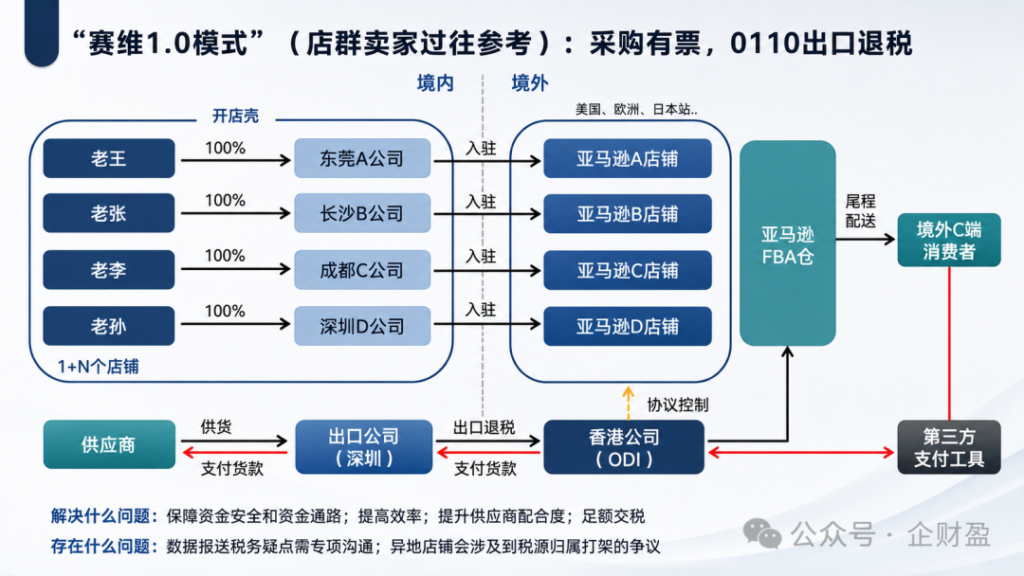
Let’s start with a brief review of Savi 1.0.
The Core Logic of Savi 1.0Is:
Multiple individuals or shareholders each control different corporate entities, and these entities each register Amazon stores, resulting in a structure of “1 controlling party + N store entities.”
A domestic export company handles customs clearance centrally; the goods are sold to a Hong Kong company under the general trade (0110) category, and the Hong Kong company then sells them to overseas consumers.
Sales revenue is consolidated through the Hong Kong company, while the mainland store companies file zero or low tax returns.
This model has indeed solved efficiency issues for sellers operating multiple stores in the past.—Fast customs clearance, smooth cash flow, and efficient management of multiple stores.
But here's the thing.: After the platform submits its data, what the tax authorities see is this: the store’s company has annual sales of several million or even tens of millions, yet its reported income is almost zero.
Data discrepancies are the biggest risk.
And so, SAIWEI 2.0 was born.
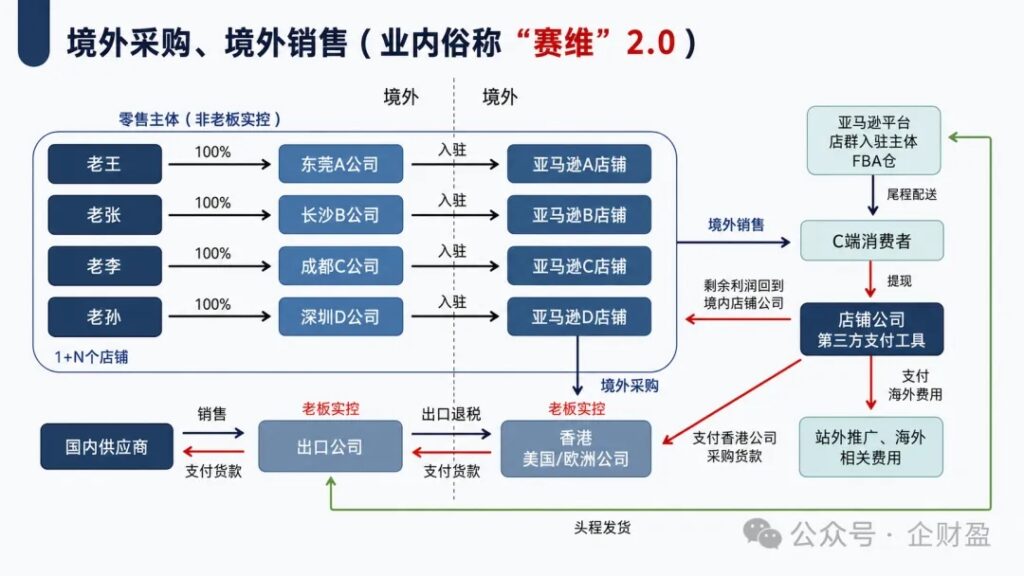
Key Changes in Savi 2.0: Hong Kong companies have evolved from “fund consolidation centers” to “genuine trading entities with full ownership of goods.” Storefront companies no longer file zero tax returns; instead, theyIndependent Revenue Recognition, Independent FilingThe
In a nutshell:
dimension (math.)
Saiwei 1.0
Saiwei 2.0
The Role of Hong Kong Companies
Transition to Centralized Fund Management
Genuine Trading Entities
Allocation of Revenue
Centralized in Hong Kong
Each store is responsible for its own confirmation.
Domestic Store Registration
Zero declaration/low declaration
Report based on actual income
Key Risks
Discrepancies Between Platform Data and Reported Data
Cost Vouchers, VAT Classification
This distinction seems simple—If every store and company reported their income, wouldn't the numbers add up?
But things are far from that simple.
.
03Architectural Logic of the SAIWEI 2.0 Model
The complete workflow for Savi 2.0 is:
Domestic Suppliers → Export Company(Purchasing + Export Tax Rebate) → Hong Kong company(Full ownership of the goods) → Retail Companies(Independent Procurement + Independent Sales) → Overseas Consumers
The key selling points of this architecture are:
First, address the issue of zero-reporting. Every store and company generates sales revenue; they are no longer just shell companies.
Second, do not change the business practices of the 1.0 model. The way it operates is pretty much the same as before, except there are a few more layers of transactions.
Third, it better aligns with the tax authority’s revenue reporting rules. Whatever amount the platform reports, the store’s company reports the same amount.
It sounds perfect, but there are three key issues.
.
04Three Core Issues with the SAIWEI 2.0 Model
Saiwei 2.0 is not a standard template.Since business conditions vary from company to company, there are still some issues that require careful evaluation during the actual implementation process.
I. Issues with Cost Documents—Are Pro Forma Invoices Tax-Deductible?
This is Savi 2.0The Biggest WeaknessThe
Under the Savi 2.0 model, the Hong Kong company is required to issue invoices to each store companyPro Forma Invoice (Invoice) , rather than those recognized domesticallySpecial VAT InvoiceThe
If the procurement costs are also based on pro forma invoices and there are no VAT invoices, then in the store company’s costs,The proportion of transactions without VAT invoices may be as high as 80%The
Here’s the question: Are these costs and expenses deductible for corporate income tax purposes?
Under current tax law,There is significant uncertainty as to whether pro forma invoices can be used as documentation for tax deductions.. It is difficult for tax authorities to verify the authenticity of the amounts listed on pro forma invoices.
What happens if costs can't be deducted?
The platform reported 10 million in revenue, but your costs were only 2 million, for which you have invoices—The remaining 8 million must be subject to corporate income tax on the profits.
That's not even the scariest part.
.
II. VAT Classification Issues—Is It Exempt or Taxable?
Saiwei 2.0 advocates “purchasing overseas and selling overseas,” soValue-Added Tax (VAT) can be reported as zero.The
However, there is a logical paradox here:
The company has consistently filed zero VAT returns, yet reported a large amount of income on its corporate income tax return. You say you’re an overseas sales representative, so you reported zero for VAT, but on the other hand, you reported tens of millions in revenue.
As soon as the system performs a comparison, it immediately triggers an alert.
The tax authorities will ask a fundamental question:Where exactly did your goods come from?
If the goods are shipped out of China, why shouldn't VAT be paid?
.
3. Substance Over Form—Regulators Focus on Business Operations, Not Organizational Structure
By 2026, the regulatory approach of tax authorities will haveShifting from “Formal Compliance” to “Substantive Compliance” . The focus is no longer solely on whether the format of the tax return is correct, but rather onAre the Substance of the Transaction and the Tax Treatment Consistent?The
Without genuine business operations to support it, the Savi 2.0 architecture runs the risk of being deemed a fictitious business.The
The tax authorities will ask:
Does the Hong Kong company have a physical business location? Does it have any employees?
Do the purchase contracts, payment vouchers, and logistics records match up?
Profits are retained in Hong Kong, yet the core operations team is based on the mainland—Does the transfer pricing comply with the arm's-length principle?
During the IPO review process for SAIWEI Times, the regulatory authoritiesParticular attention is paid to whether the pricing of related-party transactions complies with the arm’s-length principle.TheJust because a business model works for publicly traded companies doesn’t mean it’s safe for small and medium-sized sellers to copy it exactly.
We have helped thousands of cross-border sellers in Beijing, Shanghai, Guangzhou, Shenzhen, Hangzhou, Ningbo, and other cities complete Saiwei architecture diagnostics and 2.0 upgrades. Scan the QR code to add Qicaiying’s online customer service (WeChat ID: jxhqcy890 / Mobile: 16625410105).), arranging professional managers to answer queries and provideFull Process Compliance ProgramOne-to-one service ↓↓↓
.
05Which sellers should be prioritized for evaluation?
For the following types of sellers, we recommendCarefully evaluateIs Savi 2.0 a Good Fit, and How Can It Be Implemented?:
1. Sellers with stores located in different cities who are required by local tax authorities to file taxes separately for each store
2. Sellers who previously encountered obstacles in receiving tax refunds or whose tax refunds were held up and could not be processed
3. Sellers with 5 or more stores, those operating store clusters, or those with a large number of SKUs
4. Sellers of SAIWEI 1.0 who are subject to a “zero-tolerance” policy by local tax authorities
However, in the following situations, it is not advisable to blindly follow the trend:
Suppliers who are unable to provide complete invoices
Lack of sufficient financial staff to support complex accounting tasks
Businesses that are still small in scale and within the window of opportunity for adjustments .
06After reading this, ask yourself three questions
First, why do I want to change the architecture?
Have you already received a tax alert text message? Or did you just see someone else making changes? The former requires immediate action, while the latter can be assessed calmly.
Second, can my supplier issue an invoice?
If the purchasing party is unable to obtain a special VAT invoice, the “cost deduction” issue under SAIWEI 2.0 will becometime bombThe
Third, how much time do I have?
We are already halfway through 2026. Even if compliance efforts begin today, it will likely be the second half of 2026 before compliant goods are shipped by sea again, put back on the shelves, and generate compliant sales.
If we continue to wait, we risk losing nearly half a year of the compliance grace period.The
Saiwei 2.0 is attracting the attention of more and more sellers,It's not because this model is so perfect...but in this era of data transparency, sellers operating multiple stores no longer have the option of “not making adjustments.”
But making adjustments doesn’t mean blindly following the crowd. To truly make Savi 2.0 a success,At the very least, you need to clearly explain the three key aspects: business flow, cash flow, and goods flow.—Only when these three elements align does the structure make sense; if they don’t align, it doesn’t matter if you have a Hong Kong company, an overseas company, or a pile of invoices,It's just compliance on the surfaceThe
More importantly,: Saiwei 2.0 isn’t suitable for all sellers. Some need to adjust their business processes, some need to sort out their historical accounts first, some need to restructure their corporate relationships, and some may simply not be a good fit for this approach.
If you are currently operating stores on multiple platforms, or if you are already experiencing:
✅ Platform sales continue to grow, but reported figures are on the low side ✅ Multiple business entities, complex accounting ✅ Not sure if the current architecture poses any risks ✅ Not sure how to adjust things next
✔️ One-on-One Architecture Assessment:We’ll review each company’s registration information, filing status, and capital flow to generate a comprehensive risk list, identifying which issues are ”red lines that will definitely cause problems if not addressed immediately” and which are ”buffer items that can be gradually optimized.”
✔️ 2.0 Compliance Upgrade Plan:It’s not just about telling you that ”it’s time for a change”—it’s about providing you with a concrete roadmap for upgrading: which company to tackle first, how to adjust equity relationships, and how to redesign the funding structure, with a timeline for each step.
✔️ Dual-Track Structure Combining a Hong Kong Company and a Mainland Entity:With a three-tier structure comprising an export company, an operating company, and a Hong Kong company, Qi Cai Ying handles everything from registration to account opening to bookkeeping in a single, streamlined process, ensuring that the flow of goods, cash, and taxes align from the very beginning.
✔️ Ongoing Compliance Maintenance:Setting up your corporate structure isn’t the end of the process. Annual reviews, audits, corporate income tax filings, and VAT filings—Qicaiying helps you compile compliance records for each reporting period, building a chain of evidence of business operations recognized by the tax authorities.
We have helped thousands of cross-border sellers in Beijing, Shanghai, Guangzhou, Shenzhen, Hangzhou, Ningbo, and other cities complete Saiwei architecture diagnostics and 2.0 upgrades. Scan the QR code to add Qicaiying’s online customer service (WeChat ID: jxhqcy890 / Mobile: 16625410105).), arranging professional managers to answer queries and provideFull Process Compliance ProgramOne-to-one service ↓↓↓
Tags:
multi-store seller
Multi-Store Sellers
Cross-Border Tax Compliance
Safeway model
Cross-Border Compliance
export tax rebate
Financial and Tax Compliance
Amazonian
Hong Kong company
Recommended
Cross-border e-commerce B2B must see! Registered Hong Kong company stationed in the Ali International Station, really fragrant!
In today's globalized business environment, the cross-border e-commerce B2B model is rapidly emerging with its unique advantages. For many enterprises engaged in cross-border trade, choosing a suitable platform and registering an advantageous company are undoubtedly the key keys to open the door to the international market.
2024 Hong Kong Company Account Opening Tips! How to choose the right Hong Kong bank account?
Global anti-money laundering regulations are becoming more and more stringent, the banks to maintain an account of the sunk cost is getting higher and higher, not moving hundreds of millions of dollars in fines, so that the major banks to open an account threshold as well as the audit process high up, already have a Hong Kong company bosses, how to choose the Hong Kong bank to open a public account? How much does it cost and how to operate? Today to give you a detailed introduction to the Hong Kong company account how to choose, as well as the approximate costs required and other content.
Hong Kong company registration advantages + registration conditions + registration process to share!
If you want to start a business and develop overseas markets, registering a Hong Kong company is undoubtedly a very forward-looking choice. With its unique geographical location, sound legal system, low tax rate and open business environment, Hong Kong company has become a "sharp weapon" for many business owners to open up overseas markets. Why is it so important to register a Hong Kong company in 2024?