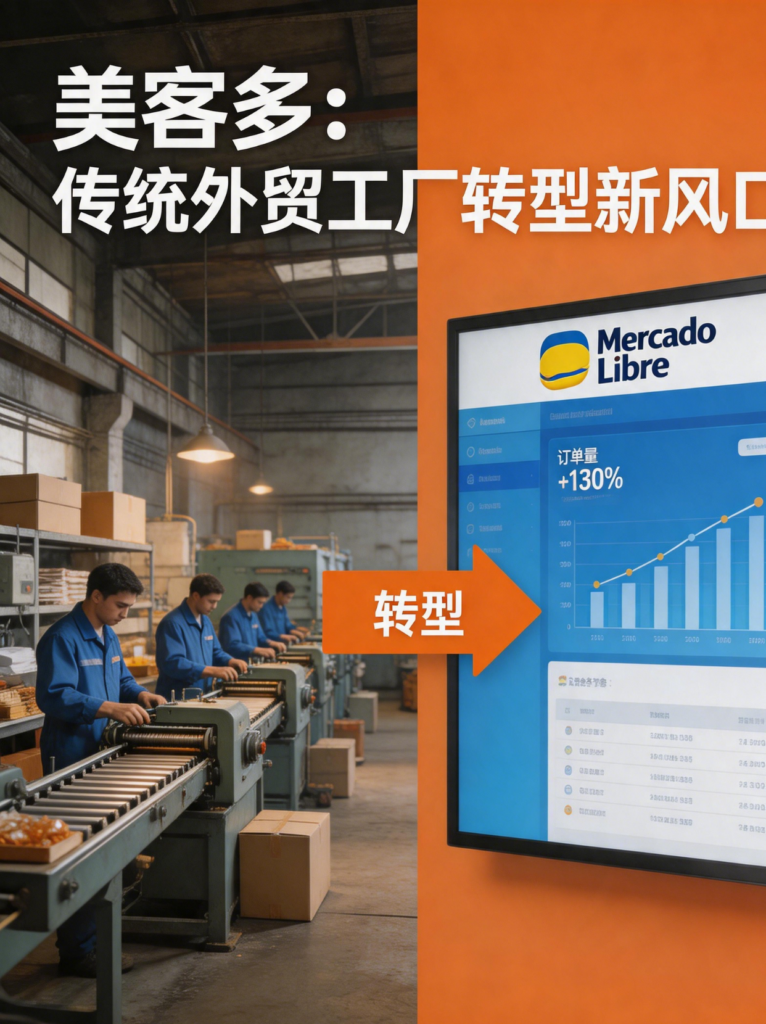
For Traditional Foreign Trade Factories Transitioning to Cross-Border E-commerce, Why Is Meike Duo a Better Fit Than You Might Think?
Published: May 26, 2026
Many traditional foreign trade factories have actually faced a problem in recent years:
Existing customers are getting better and better at haggling over prices. It's getting harder and harder to acquire new customers. I’ve been to quite a few trade shows, but very few of them actually led to deals. Competitors are offering lower and lower prices, and profit margins are getting thinner and thinner.
In the past, as long as factories produced high-quality products, kept prices low, and maintained consistent delivery times, they had no trouble securing orders.
But not anymore.
You'll find that relying solely on traditional foreign trade clients is becoming increasingly difficult.
You only get orders when customers place them. When customers haggle over the price, you have no choice but to offer a discount. When a customer switches to a different supplier, you’ll feel the pressure right away.
As a result, many factory owners are beginning to consider transitioning to cross-border e-commerce.
But when it comes to cross-border transactions, it can seem very complicated.
Amazon is way too competitive. TikTok is too focused on content. Running an independent website is too expensive. Temu is really aggressive on pricing.
Is there a platform out there that’s a better fit for traditional export-oriented factories?
Actually, you might want to take a closer look at:Meikeduo.
Why Should Traditional Foreign Trade Factories Focus on Meikeduo?
Mercado Libre is a very important e-commerce platform in the Latin American market, primarily serving markets such as Mexico, Brazil, Chile, Colombia, and Argentina.
For manufacturers, the greatest value of Meike Duo is not that it is “just another platform,” but rather that it provides them with an opportunity to enter the Latin American market.
The Latin American market is different from the European and American markets.
The European and American markets are already very mature, with many sellers, intense competition, expensive advertising, and price wars.
However, many product categories in Latin America are still in their growth phase, and consumers there are looking for products that offer good value for the price. Chinese manufacturers excel at producing products that are reliable, affordable, and offer a wide variety of choices.
This is an opportunity for factory-direct sellers.
What are the advantages of factories using Meikeduo?
The greatest strength of traditional foreign trade factories lies not in operations, but in their supply chains.
You have it in stock. You can control costs. You can make a sample. You can redesign it. You can deliver consistently. You can quickly adjust your product based on feedback.
When applied to cross-border e-commerce, these skills are actually extremely valuable.
Many traders can only source goods, exchange goods, and compete on price. But factories are different; they can optimize products right from the source.
For example, if the platform indicates that a certain color is selling well, you can change the color. If a certain combination has a high conversion rate, you can create a set. If a particular type of packaging receives a lot of negative reviews, you can adjust it right away. If a product shows signs of increasing in popularity, you can quickly restock it.
This is the fundamental advantage of factories transitioning to cross-border operations.
Which traditional foreign trade factories are suitable for Meikeduo?
Not all factories are suitable for direct stamping.
But if any of the following apply to you, it’s worth taking a closer look.
1. You have a stable export product
If your product has been exported before, that indicates you already have at least some foundation in overseas markets.
Factories like this have an advantage over sellers with no experience in international trade when it comes to Meike Duo.
2. Your products are relatively standardized
For example:
Home goods, kitchenware, storage solutions, hardware and tools, auto and motorcycle parts, pet supplies, small appliances, consumer electronics accessories, office supplies, etc.
User demand for these types of products is clear, and they don’t require extensive education, making them better suited for platform-based search and sales.
3. You have a price advantage, but profit margins in traditional foreign trade are getting thinner and thinner.
Many factories aren't lacking orders; rather, the more orders they fulfill, the less profit they make.
Customers push for lower prices year after year, competitors are snatching orders with rock-bottom prices, and with raw material costs rising, we don’t dare raise our prices.
If you have a cost advantage at the source, you shouldn’t just passively wait for customers in traditional foreign trade.
Meike Duo can serve as a new sales channel, giving you the opportunity to reach the end market directly.
4. You don't want to rely solely on a few long-time customers
The biggest problem for many factories is that their customer base is too narrow.
When a major client reduces its order, the entire factory feels the pressure.
So, transitioning to cross-border business isn’t about giving up your existing customers—it’s about opening up another avenue for growth.
I'll keep doing my old foreign trade work. Continue to maintain relationships with existing customers. At the same time, however, we will test a portion of our products in the Latin American market.
This is a more stable approach to transformation.
However, when factories sell on Meikeduo, they shouldn’t list products blindly.
I must point out one thing here:
On Meikeduo, you can't just list a product and expect it to sell.
Before starting production, you must at least consider the following issues:
Is your product suitable for the Latin American market? Are the logistics costs affordable? Is the profit margin sufficient? Will the after-sales service be too complicated? Are there any certification and compliance risks? What are the competitive prices for similar products? Which SKUs are best to test in the early stages?
If you don’t understand these points and just jump right in, you’re likely to take a detour.
The correct way should be:
First, screen the products; then, conduct small-batch testing; and finally, ramp up production.
Don't list dozens or even hundreds of SKUs right from the start. Start by testing the products with the best potential, and once the data comes in, decide which ones are worth continuing to develop.
put at the end
It’s not that traditional foreign trade can’t be done anymore.
But these days, factories really can’t rely on just one source of income.
In the past, you relied on customer orders. In the future, you'll need to learn to actively seek out markets.
For traditional foreign trade manufacturers, Mercado Libre may not be the only option, but it is certainly a gateway to the Latin American market worth considering.
In particular, factories with stable products, cost advantages, and export experience should begin researching this sooner rather than later.
If you’re the owner of a traditional export-oriented factory with products and production capacity but aren’t sure whether Meikeduo is a good fit for your business, please send me your product categories, product images, and export data.
I can give you a preliminary assessment:
Is your product suitable for Meikeduo?; Which SKUs should be tested first?; Which products are not recommended for direct listing; What do I need to prepare before moving in?; How can we minimize the cost of trial and error in the early stages?
If you'd like to learn more about joining Mercado Libre, helping factories transition to cross-border e-commerce, or selecting products for the Latin American market, feel free to DM me: Mercado Libre.
Traditional foreign trade is still viable. But smart factories have already begun to seek out a second growth stream.
Tags:
Mercado Registration
Mercado Mexico
Mercado Platform
Mercado Cross-Border E-Commerce
Mercado Full Hosting
Merkel is mostly hosted
Mercado Local Store
Mercado Brazil Local Store
Recommended
Cross-border e-commerce B2B must see! Registered Hong Kong company stationed in the Ali International Station, really fragrant!
In today's globalized business environment, the cross-border e-commerce B2B model is rapidly emerging with its unique advantages. For many enterprises engaged in cross-border trade, choosing a suitable platform and registering an advantageous company are undoubtedly the key keys to open the door to the international market.
2024 Hong Kong Company Account Opening Tips! How to choose the right Hong Kong bank account?
Global anti-money laundering regulations are becoming more and more stringent, the banks to maintain an account of the sunk cost is getting higher and higher, not moving hundreds of millions of dollars in fines, so that the major banks to open an account threshold as well as the audit process high up, already have a Hong Kong company bosses, how to choose the Hong Kong bank to open a public account? How much does it cost and how to operate? Today to give you a detailed introduction to the Hong Kong company account how to choose, as well as the approximate costs required and other content.
Hong Kong company registration advantages + registration conditions + registration process to share!
If you want to start a business and develop overseas markets, registering a Hong Kong company is undoubtedly a very forward-looking choice. With its unique geographical location, sound legal system, low tax rate and open business environment, Hong Kong company has become a "sharp weapon" for many business owners to open up overseas markets. Why is it so important to register a Hong Kong company in 2024?