Urgent! The new U.S. Customs regulations come into effect on March 20, your goods may be stuck in the port!IOR in the end? Sellers must see the guide to avoid pitfalls
Published: 2026-03-24
March 20, the U.S. Customs a new rules officially landed, countless Chinese sellers of containers are facing the risk of customs clearance detention! If you are still using the old way of transportation, or simply do not understand the three letters "IOR", then your warehouse is ready to send to the United States goods, it is likely that the next second will be labeled "detained".
Beginning March 20, 2026, at 12:01 a.m. EST, U.S. Customs and Border Protection (CBP) has officially gone into "Hell Mode" for IOR audits. The old patchwork, vague, or even false IOR information won't work anymore. Under the new rules, theNon-compliance means the goods won't arrive.The
I know what you're most concerned about right now:
What exactly is an IOR?
What exactly did this new rule change?
Will my shipment be affected?
What now?
The CBP official documents, industry notices and the internal news of the first-line logistics provider, the complexity of this new regulation, break open and crumble, with the big vernacular to give you a clear picture. After reading this, you will not only be able to keep your goods, but also be able to read the rules that must be followed to do business in the United States in the future.
Enterprise Caiying as a professional one-stop business services platform, is committed to providing customers with mainland company registration, Hong Kong company registration, offshore company registration, bookkeeping and tax reporting, annual audit, audit, open accounts, fiscal compliance, equity structure, ODI filing, cross-border e-commerce services, Hong Kong identity, immigration and study abroad and other high-quality services, to help the globalization of enterprises. (Phone with V: 18620388671) enterprise one-stop service, you can add my WeChat Consultation at any time ↓↓↓↓
I. What exactly is IOR? What we need to know
IOR, full name Importer of RecordThe term "importer of record" translates to "importer of record". You can think of it as the "first responder" in the eyes of U.S. Customs.
Simple and crude analogyYour goods into the U.S., like a person into the neighborhood. IOR is the gatekeeper (Customs) registered, signed, committed to the person (goods) in the district of all acts responsible for the "guarantor".
Two points at the heart of it, to the point.::
"1. Must be a U.S. entity The "guarantor" must be a company or organization legally registered in the United States (e.g., a U.S.-based company, or a branch of a foreign company in the United States). If you are registered in China, sorry, you are not qualified to be a "guarantor".
"2. Three certificates must be obtained A legitimate IOR must have three things in his hands:
U.S. state-issued "ID cards."(Certificate of Incorporation)
"Tax ID" issued by the IRS.(EIN, Employer Identification Number).
"Guarantee status" duly recorded with Customs.(CBP Form 5106 submitted and activated)
How serious are the consequences of non-compliance?
Cargo is detained directly at the port, incurring high demurrage charges on a daily basis.threefoldThe following are some of the reasons why you are not a licensed importer Multiple violations or serious cases, you, the IOR (or the real owner behind) will be pulled into the customs blacklist, and all future imports of goods will face the most stringent inspection, or even be rejected directly.
As a professional one-stop business service platform, Enterprise Caiying is committed to providing customers with high-quality services such as mainland company registration, Hong Kong company registration, offshore company registration, bookkeeping and tax reporting, annual audit, reconciliation of public accounts, financial and tax compliance, shareholding structure, ODI filing, cross-border e-commerce services, Hong Kong identity, immigration and study abroad, etc., which can help enterprises to globalize and develop.Phone with V: 18620388671 Enterprise one-stop service, you can add my WeChat Any time to consult ↓↓↓↓
Second, the new rules on March 20: in the end "new" where?
Previously, there may have been some information in the customs system that was not updated in time, or the use of "shell companies" to muddle through the IOR, the core purpose of the new regulation is toClose all loopholes and ensure that every IOR is a real, instantly verifiable live bodyThe
There are four specific hard changes::
Information must 100% be accurate and verifiable:Every bit of information on the CBP Form 5106 you submit to Customs - company name, address, EIN number - must stand up to real-time verification. It used to be that filling in an approximate address might be fine, but not anymore.
The IOR's own identity is to be verified:A valid, government-issued photo ID, such as a U.S. driver's license or a copy of a passport, is now required for the IOR himself or herself (usually the person in charge of the company). This means that it's going to be hard to get a shell company with an unknown person's name over the border.
EIN tax code documents must be "original":It can't just be a number, you need to provide an EIN approval document (such as a 147C letter) issued directly to you as a corporation by the IRS IRS. This proves that your company is actually filing taxes in the IRS system.
The authorization relationship must be clear:The customs broker who helps you with your customs declaration must have a valid Power of Attorney (POA) signed by you (IOR) in your own handwriting. Messing around with the authorization letter template or having a vague authorization relationship will get you stuck.
Effective time:March 20, 2026, 00:01 EST. no buffer.
III. Why the sudden martial law at customs?
U.S. Customs is not on a whim this time, but has been backed into a corner by three things:
First: huge trade data mismatch
According to the industry report, in 2025, the difference between the value of goods declared by Chinese exporters and the value of goods actually cleared by the U.S. Customs is$112 billion! With a hole that big, CBP has to look hard at it, and IOR is the most important breakthrough.
Second: "5H" identification operation upgrade
CBP has long been launching a special "5H" inspection campaign to target potential violations. In February 2026 alone, more than 3,800 containers departing from China triggered 5H inspections, of which over82% Being directly ordered to return shipments! That's a frighteningly high percentage.
Third: "Tightening the noose" at the legislative level
Members of the U.S. Congress have been promoting a bill called the SAFE Act, the core purpose of which is to restrict "non-resident importers" (that is, foreign companies or individuals without the existence of U.S. entities) to serve as IOR. although the bill has not yet been finally passed, the wind direction has been very clear:The United States wants to ensure that every link in the import chain is traceable and accountable.
Enterprise Caiying as a professional one-stop business services platform, is committed to providing customers with mainland company registration, Hong Kong company registration, offshore company registration, bookkeeping and tax reporting, annual audit, audit, open accounts, fiscal compliance, equity structure, ODI filing, cross-border e-commerce services, Hong Kong identity, immigration and study abroad and other high-quality services, to help the globalization of enterprises. (Phone with V: 18620388671) enterprise one-stop service, you can add my WeChat Consultation at any time ↓↓↓↓
IV. Deadly impact: the end of the "double clearing and tax package" model
Many sellers, especially small and medium-sized sellers, used to rely on "double clearing and tax inclusive" services. Freight forwarders do everything for you, you only need to pay a package price.
But the unspoken rule of "double clearing and tax inclusive" is that: Freight forwarders often use one or several U.S. shell companies that they control as a common IOR for thousands of shipments in order to control costs and convenience.
Here's where the new regulations strike the death blowCustoms now requires IOR information to be "real and verifiable". Shell companies that have no real operations, no permanent staff, or even a virtual address.It doesn't stand up to a phone call or an e-mail from Customs.The
Once the "public IOR" used by the freight forwarder is targeted by the Customs or verification failure, all the goods listed in the name of the IOR will suffer.
The industry has been the head of the logistics industry has issued an initiative, calling on everyone to say goodbye to the old model, turn to the "single ticket, single clear, trade closed loop" compliance model. It can be said thatPurely by information opacity to make money "double clear package tax" era, is rapidly ending.
V. Seller's Guide to Self-Help: Starting Now, Step by Step Compliance
It's just a few days before the new rules go into effect, so if you're still shipping, or planning to ship, follow these steps immediately:
Ask your freight forwarder/logistics provider"What is the full name of the IOR company I am using for this shipment and what is their EIN number? Can you provide me with their CBP filing and EIN?"
Judgmental risk: If the person is evasive or gives a company name that looks like a shell company (e.g., the name is a random combination of letters and the address is some shared office address), your shipment is extremely risky.
If you are an FBA seller or self-clearance: Immediately log into your seller's back office or clearance documents and verify that the IOR information is your own, true and valid U.S. company information.
Step 2: The Fundamental Solution - Incorporate Your Own U.S. Company
This is the best way to do it once and for all. Use your own U.S. company as the IOR and keep the initiative of customs clearance in your own hands.
mileageThe information is completely real and controllable, so you are not afraid of freight forwarding mines; establish the U.S. local business identity and enhance the trust of customers; and lay the foundation for the subsequent opening of U.S. bank accounts and tax planning.
How do you choose a state?Don't choose blindly, it's directly related to how much you'll pay in taxes later. Don't choose blindly. It's directly related to how much tax you'll pay later:
Trying to save on state taxes.: Focused considerationTexas, Florida, Wyoming(These states have no state personal income tax and are startup friendly).
Consideration of future financing::Delaware, US stateremains the preferred choice, with the most mature legal environment.
Business is local: For example, if your warehouse, customers are mainly in California, then registerCalifornia corporationThe
Step 3: After the company is registered, these three important financial and tax matters must not be forgotten
Annual Report: It's not just a matter of registering! Each state has different requirements, for example, California and Nevada have to be audited every year, and Delaware regular corporations have until March 1st. Forgot? Fines will be waiting for you, and the company will be canceled in serious cases!
Tax Filing::
federal tax: A company with a profit pays at the 21% rate; without a profit, it also has to do a zero return.
state tax: It varies from state to state. In California, even if you don't operate, you may have to pay a minimum "franchise tax" of a few hundred dollars.
Sales Tax: This is the hardest hit area for cross-border e-commerce sellers! Whenever your sales in a state exceed a certain threshold (usually $100,000 or 200 transactions), you must file and pay sales tax to that state.
Reporting of Connected Transactions (Form 5472): If your U.S. company and your company in China have money and goods exchanges, even if there is no profit, you must file this form with the IRS. Don't submit? The risk of audit is extremely high!
Sixth, three major perceived misconceptions about IOR and American business, so don't step on them!
Myth 1: "I don't have a U.S. company, just find a reliable forwarder and use their IOR."
Under the new regulations, there is no "reliable" public IOR, the "reliability" of the freight forwarder can only be reflected in the operation, but whether the IOR qualification itself can withstand customs verification is another matter. If you put your lifeblood in someone else's hands, you will have to bear the risk yourself.
Myth 2: "I do Amazon FBA, customs clearance and taxes are covered by Amazon"
Big mistake! Amazon is the platform, not your importer. the FBA headhaul shipping is either with Amazon's designated logistics provider (they may use your info or their own IOR) or with logistics you find yourself. But the ultimate legal liability, especially for IOR's, theIt must fall on the importer (probably you). Taxes are more your own business, Amazon will never file them for you.
Myth 3: "Registering a U.S. company is easy, just get an agent to do it and you'll be fine."
Registration is just the first step, equivalent to you getting a business license. The laterAnnual audits, tax returns, BOI information filingsIt is the ongoing cost of compliance. Many sellers have had their companies canceled or have been fined because they forgot about these "after-sales services".
Enterprise Caiying as a professional one-stop business services platform, is committed to providing customers with mainland company registration, Hong Kong company registration, offshore company registration, bookkeeping and tax reporting, annual audit, audit, open accounts, fiscal compliance, equity structure, ODI filing, cross-border e-commerce services, Hong Kong identity, immigration and study abroad and other high-quality services, to help the globalization of enterprises. (Phone with V: 18620388671) enterprise one-stop service, you can add my WeChat Consultation at any time ↓↓↓↓
VII. What can we do for you?
It's a real headache for one person to go it alone with such complex rules. If you need professional support, we are here.
We can help you turn U.S. company registration, IOR compliance filing, and subsequent tax maintenance, into a set of heart-saving and labor-saving "combined punch":
Precise registration, no waste of moneyAccording to your business model (e-commerce, branding, warehousing), we will help you analyze and select the most suitable state for registration, and at the same time, we will get the EIN tax number, so that you can get your hands on a "immediately available" U.S. company.
IOR filing for customs clearanceOur U.S. team is familiar with the latest CBP process and will help you prepare and submit all filing documents (including Form 5106) to ensure that your IOR status is real and effective and that your goods clear customs smoothly. If you need to purchase customs bond, we can also provide the best program.
Financial and tax compliance, professional backingThe U.S. has a plethora of tax forms. Our tax experts are well versed in the unique scenarios of cross-border e-commerce sellers - such as how to properly handle platform income on Form 1099-K, how to determine if you meet a state's "economic nexus" threshold for filing a sales tax return, and what to do with Form 5472. 5472. Our goal is for you to maximize your profits with absolute compliance.
Full accompaniment and timely remindersWhen is a company due for an annual audit and what's the deal with BOI information updates? How do I notify the government of a change of address? We have a dedicated consultant to remind you of these trivial but critical matters, and to be your "memo" on U.S. affairs.
The rules have changed and the way the game is played has to change. Compliance is no longer a cost of doing business in the U.S. market; it's a cost of staying alive, and living well, in yourminimum thresholdThe
statement denying or limiting responsibilityThe content of this article is based on U.S. Customs and Border Protection (CBP) official announcements, industry analysis and public information, and is intended to provide information for reference. Please refer to the latest official guidelines and professional advisors' opinions for details on the implementation of U.S. regulations.
If you still have any questions about the new IOR regulations, or need to handle U.S. company registration, IOR compliance filing and subsequent financial and tax services, please feel free to contact us.
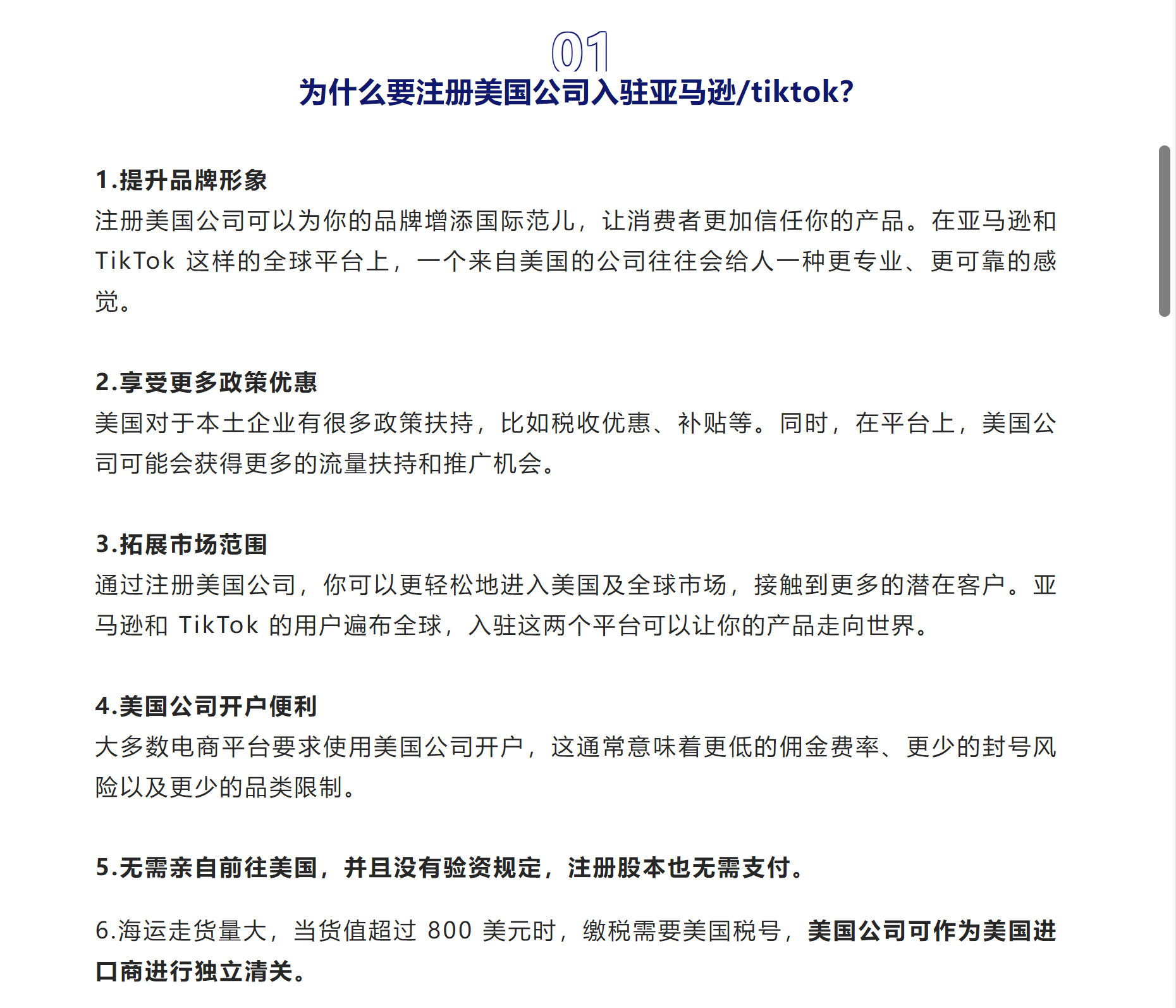
Cross-border e-commerce registering a US company to be on Amazon/tiktok is actually quite simple!
In the wave of cross-border e-commerce, more and more sellers are eager to expand their overseas markets, and registering a U.S. company and getting on Amazon and TikTok has become the choice of many. Today, we will analyze the process in detail for you, and you will find that it is not as complicated as you think.
How to choose between individual shareholding and company shareholding when registering an offshore company?
Nowadays, it is popular for foreign trade companies to register an overseas company to receive and pay foreign currency. For example, Hong Kong companies, Singapore companies or other island companies. The purpose is to hope that there will be foreign exchange free account to receive and pay, to bring many foreign trade enterprises to receive and pay the convenience of foreign currency. So, when we need to register an overseas company, the first thing to consider is whether to register with a domestic natural person or a domestic company as a shareholder?
Cross-border e-commerce registering a US company to be on Amazon/tiktok is actually quite simple!
In the wave of cross-border e-commerce, more and more sellers are eager to expand their overseas markets, and registering a U.S. company and getting on Amazon and TikTok has become the choice of many. Today, we will analyze the process in detail for you, and you will find that it is not as complicated as you think.