Now that platform data has been submitted, why are more and more cross-border sellers turning their attention to the Saiwei Model 2.0?
Published: July 24, 2026
In recent months, one of the most common inquiries we’ve received through our support system has been:
“Can we still use Savi 1.0?”
“Once the platform begins reporting store revenue, how should the store’s company file its tax return?”
“What problems does Savi 2.0 actually solve?”
“We have quite a few stores. Is it still too late to make adjustments now?”
In the past, many multi-store sellers adopted a business structure in which an export company handled centralized procurement and unified customs clearance, a Hong Kong company consolidated the proceeds, and the domestic store companies held the platform accounts.
This model has helped many sellers resolve issues related to centralized procurement, export customs clearance, and cash flow management.
However, once the submission of tax-related information by platforms became routine, new issues arose:
Platform records show that these store operators have consistently generated sales revenue; however, there are discrepancies between the historical tax filing data for some of them and the revenue reported to the platform.
Against this backdrop, more and more cross-border sellers are turning their attention to Saiwei 2.0.
Its core value lies not simply in adding a Hong Kong company or changing the accounting method, but in reorganizing the transactional relationships between the export company, the Hong Kong company, and the retail company, thereby making it easier to align platform operational data, business entities, and financial and tax filings.
If you’re running multiple stores on Amazon or other cross-border platforms and want to find out if Saiwei 2.0 is right for your business, feel free to contact Qicaiying’s online customer service. 👉 WeChat: jxhqcy890 / Mobile: 16625410105, Based on the number of your stores, platform revenue, export methods, and existing business entities, we will assign a professional manager to conduct a one-on-one assessment.
01 Why does SAIWEI 1.0 need to be reevaluated?
The common Savi 1.0 architecture is:
Several domestic retail companies hold platform accounts; a single domestic export company handles centralized procurement and unified customs clearance, and then a Hong Kong-based company handles the consolidation of a portion of the funds.
The advantage of this model is centralized management.
The export company is responsible for procurement, obtaining input invoices, handling customs clearance, and processing export tax rebates; the Hong Kong company is responsible for receiving payments from overseas; and the retail company primarily serves as the holder of the platform account.
The issue is that while some merchants continue to operate on the platform, their reported revenue has been zero for a long time, or their reported revenue is significantly lower than the sales data recorded by the platform.
The "Announcement of the State Taxation Administration on Matters Concerning the Submission of Tax-Related Information by Internet Platform Companies," issued in 2025, stipulates that internet platforms must submit tax-related information—such as the identities and income of business operators—in accordance with regulations.
The revenue information reported by the platform includes total revenue, refund amounts, net revenue, and the number of orders, among other details.As a general rule, platform commissions and service fees are not directly deducted from total revenue.
This means that tax authorities can obtain data on how much revenue a merchant generates on the platform through the platform’s reporting of tax-related information.
If there is a long-standing discrepancy between the platform operator, the actual business entity, and the entity filing the declaration, the seller will need to reassess its current structure.
Saiwei 2.0 has attracted attention precisely because it aims to address this issue. .
02 How exactly does Savi 2.0 work?
The typical business workflow for Savi 2.0 can be divided into three stages.
Domestic export companies purchase goods from suppliers on a centralized basis, obtain the corresponding purchase documents based on actual business transactions, and complete customs clearance procedures in accordance with the applicable export model.
The export company sells goods to a Hong Kong-based company, creating a chain of domestic procurement and export sales.
Paragraph 2: A Hong Kong company sells overseas goods to various retail companies.
After the goods are exported, the Hong Kong company sells them to various mainland retail companies in accordance with the actual terms of the transaction.
The store’s company thereby obtains the overseas procurement documentation corresponding to the sales made on the platform.
Hong Kong companies no longer serve merely as a fund consolidation hub; they can also participate in overseas procurement, ownership management, fund settlement, and commodity distribution in accordance with their actual business operations.
Paragraph 3: Retailers sell to overseas consumers through the platform
As the registered business entity on platforms such as Amazon, the store company recognizes sales revenue based on actual transactions, refunds, and platform settlements.
This makes it easier to establish a correspondence between platform stores, sales revenue, procurement costs, and the reporting entities.
To put it more simply:
Saiwei 1.0 focuses more on centralized procurement and unified exports for export companies; Saiwei 2.0, on the other hand, enables each store to maintain procurement and revenue records that correspond to its sales on the platform.
This is also why Saiwei 2.0 has attracted the most attention from sellers operating multiple stores.
.
03 The Four Core Advantages of Savi 2.0
First, reduce the discrepancy between the platform’s revenue and the reported data
Following the implementation of tax information reporting by the platform, whether the reporting data submitted by store operators matches the platform’s operational data has become a key issue for sellers to focus on.
Under the Saiwei 2.0 model, each store can confirm its revenue based on the platform’s actual sales, refunds, and settlement data.
The platform displays which store or company has generated sales revenue, and the corresponding entity handles the financial and tax matters based on the actual business transactions.
This helps reduce the following situations:
The platform continues to show sales revenue, yet the store’s company has been reporting zero revenue for a long time;
Although the store has continued to grow, its financial figures have not kept pace;
The entity operating the platform is not the same as the entity reporting the revenue;
The revenue from multiple stores is all channeled through a single export company;
The store's company cannot explain the source of the platform's data.
The first issue that Saiwei 2.0 addresses is the problem of matching platform operational data with the information reported by store operators.
This is particularly important for sellers who have already received a notification regarding discrepancies in platform revenue. .
Second, establish appropriate procurement costs for the store’s company
In the past, many retail businesses faced a practical problem:
The platform records show sales revenue, but there are no purchase costs in the books that correspond to those sales.
This is because the goods are typically procured centrally by the export company; the relevant domestic purchase invoices and export documentation are held by the export company, and the retail company itself has no direct procurement records.
Under the Savi 2.0 model, the Hong Kong company sells overseas goods to the various store companies based on actual transactions, allowing the store companies to establish corresponding overseas procurement chains.
Provided that all relevant documentation—including contracts, proof of ownership of goods, logistics records, financial records, and settlement documents—is complete, the store company can calculate procurement costs based on actual business transactions.
This can help sellers resolve:
The store has only revenue and no procurement costs;
Platform sales cannot be matched to accounting costs;
It is not possible to accurately allocate product costs across multiple stores;
Corporate profits cannot be accounted for separately by store entity;
The store's financial statements do not accurately reflect its actual operating conditions.
Saiwei 2.0 isn’t just about adding another document; it helps stores and companies establish business and cost links corresponding to their sales revenue. .
Third, to provide a clearer picture of each store’s revenue and profits
Under the centralized consolidation model, the sales, purchases, and profits of multiple stores may all be consolidated into a small number of entities.
Although sellers can see their overall profit, it’s hard for them to answer::
Which store actually generated how much revenue?
Which company bore how much of the procurement costs?
Which party should bear the platform fees?
What are the actual profits for each store?
Which stores are worth continuing to operate, and which ones are consistently unprofitable?
Saiwei 2.0 recognizes revenue, costs, and platform fees separately based on the actual operating conditions of each store.
Sellers can gain a clearer understanding of:
Sales volume for each store or company;
Refunds and platform fees for each store;
Cost of goods purchased;
Profit per store and per entity;
Tax filing status of each company;
Actual operating results for the various business segments.
This is not only necessary for financial and tax compliance, but also helps sellers conduct internal business analysis.
When a company is preparing to attract investment, apply for financing, restructure its equity, or plan for an IPO, clear data on its revenue and profits becomes even more important.
If you’re running multiple stores on Amazon or other cross-border platforms and want to find out if Saiwei 2.0 is right for your business, feel free to contact Qicaiying’s online customer service. 👉 WeChat: jxhqcy890 / Mobile: 16625410105, Based on the number of your stores, platform revenue, export methods, and existing business entities, we will assign a professional manager to conduct a one-on-one assessment.
.Fourth, reduce disputes over tax jurisdiction among entities operating across regions
Companies with multiple stores may be registered in different cities.
For example, the export company is located in Shenzhen, while its retail outlets are located in Guangzhou, Dongguan, Changsha, Hangzhou, and other cities.
Under the Savi 1.0 model, procurement, exports, and profits may be concentrated in the location of the export company, while store companies in other regions—despite holding platform accounts—may go for long periods without reporting any revenue.
Once the platform data is submitted, it becomes easier to assess the business performance of local store companies.
Saiwei 2.0 helps clarify the business and reporting responsibilities of each entity by allowing individual store companies to confirm their revenue and profits based on their actual platform operations.
Which company operates which store, which company receives the related revenue, and which company bears the corresponding costs can be accounted for separately based on the actual transactions.
This helps reduce:
The store's actual location does not match the location listed on the application;
The platform operator has had no revenue for an extended period;
There is uncertainty regarding the allocation of revenue among companies in various locations;
All profits are concentrated in the hands of a few entities;
The operating data for each entity cannot be interpreted in isolation.
The value of SAIWEI 2.0 lies in enabling each company to gradually return to its core business and reporting responsibilities. .
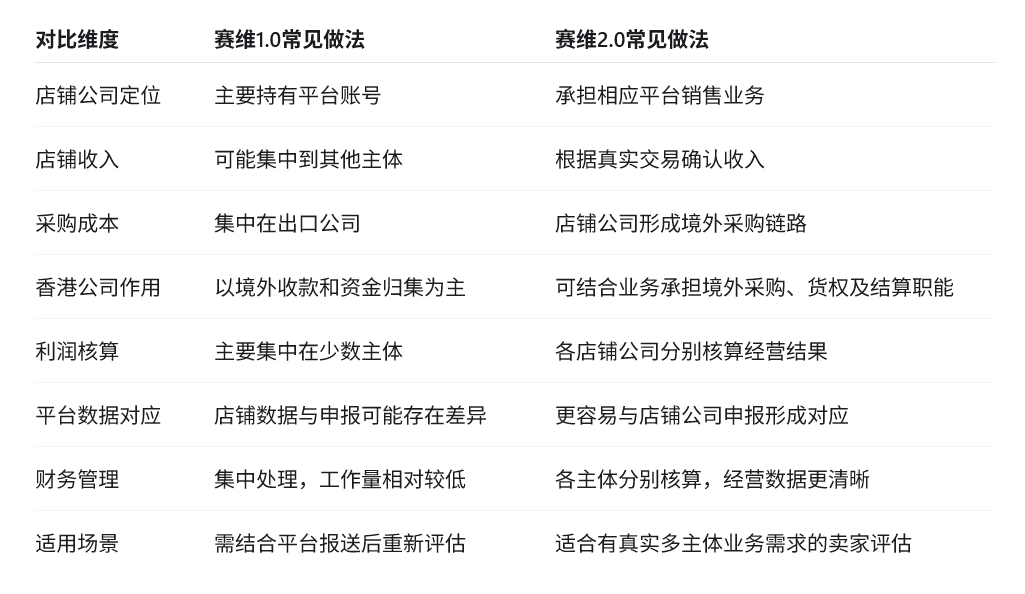
04 What is the difference between Savi 1.0 and 2.0?
Saiwei 2.0 is not simply a replacement for 1.0.
It is more like a reorganization of multi-store operations, procurement chains, and entity revenue within the context of tax information reporting on the platform.
.
05 Which sellers are best suited to evaluate Saiwei 2.0?
Saiwei 2.0 is particularly worth the attention of the following types of sellers.
1. There are discrepancies between the platform's revenue and the data reported by the store's company
If the platform continues to record sales revenue, but the store’s operating company consistently reports zero revenue or underreports revenue over a long period, the seller needs to reassess revenue recognition and business attribution.
2. A company that owns multiple domestic retail stores
Sellers with a large number of stores and a decentralized corporate structure need to establish a clearer correspondence between their stores, revenue, procurement, and tax filings.
3. Exports, collections, and platform operations are handled by different entities
If the export is handled by one domestic company, the online store is owned by another domestic company, and the proceeds are centralized through a Hong Kong company, the existing business relationships need to be further clarified.
4. The store’s company lacks the necessary procurement and cost data
If a platform store has a large amount of sales revenue but the store’s company lacks procurement and expense records that correspond to that revenue, it may be necessary to assess whether the procurement and cost chain needs to be reconstructed.
5. I have received a tax risk alert
If a seller has received a notification regarding discrepancies between platform revenue and reported data, rather than continuing with the current approach, it is better to assess the path to compliance as soon as possible.
6. Prepare for financing, attract investment, or restructure the equity structure
Sellers who need to clearly present the revenue, costs, and profits of each entity can also use organizational restructuring to reorganize their company’s financial data.
Now that the submission of tax-related information via the platform has become routine, compliance in cross-border e-commerce is no longer just a matter of whether export companies can obtain invoices or complete customs declarations.
A clearer correspondence needs to be established between platform stores, business entities, procurement costs, cash flow, and financial and tax filings.
If you're considering upgrading from Saiwei 1.0 to 2.0, or if you're already experiencing discrepancies between your platform revenue and your reported data, you can contact Qicaiying's online customer service 👉 (WeChat: jxhqcy890 / Mobile: 16625410105)
Based on the number of your stores, platform revenue, export methods, Hong Kong companies, mainland entities, and historical declarations, we will provide you with:
Diagnosis of the existing Savi architecture;
Comparison of SAIWEI 1.0, 2.0, and Other Paths;
Analysis of the Relationship Between Store Revenue and the Entity;
Overseas Procurement and Cost Chain Design;
Assessment of Discrepancies in Historical Data;
Implementation Plan for Compliance Adjustments;
Customize the implementation schedule.
First, determine which approach is best for your business, and then decide how to adjust it.
Tags:
Platform Data Reporting
Cross-border taxation
Safeway model
Amazon seller
export tax rebate
Financial and Tax Compliance
Hong Kong company
cross-border e-commerce
Recommended
Cross-border e-commerce B2B must see! Registered Hong Kong company stationed in the Ali International Station, really fragrant!
In today's globalized business environment, the cross-border e-commerce B2B model is rapidly emerging with its unique advantages. For many enterprises engaged in cross-border trade, choosing a suitable platform and registering an advantageous company are undoubtedly the key keys to open the door to the international market.
2024 Hong Kong Company Account Opening Tips! How to choose the right Hong Kong bank account?
Global anti-money laundering regulations are becoming more and more stringent, the banks to maintain an account of the sunk cost is getting higher and higher, not moving hundreds of millions of dollars in fines, so that the major banks to open an account threshold as well as the audit process high up, already have a Hong Kong company bosses, how to choose the Hong Kong bank to open a public account? How much does it cost and how to operate? Today to give you a detailed introduction to the Hong Kong company account how to choose, as well as the approximate costs required and other content.
Hong Kong company registration advantages + registration conditions + registration process to share!
If you want to start a business and develop overseas markets, registering a Hong Kong company is undoubtedly a very forward-looking choice. With its unique geographical location, sound legal system, low tax rate and open business environment, Hong Kong company has become a "sharp weapon" for many business owners to open up overseas markets. Why is it so important to register a Hong Kong company in 2024?