How Do You Pay Corporate Income Tax in Hong Kong? Not All Profits Are Taxed at 16.5%—The Tax Rate for the First 2 Million Is Only 8.25%, and Deductible Expenses Can Help You Legally Reduce Your Tax Burden
Published: July 23, 2026
When it comes to corporate taxes in Hong Kong, many people’s first thought is “16.5% profits tax.” But if you think that’s the actual amount of tax you’ll have to pay—you might be overpaying the Hong Kong Inland Revenue Department.
Hong Kong’s profits tax system is actually more sophisticated and flexible than many people realize—it features both “two-tier tax rates” and a wide range of “deductible expenses.” If you don’t understand these rules, you may end up paying far more in taxes than you actually owe.
💡 Not sure if your Hong Kong company’s actual tax burden is optimized? Add WeChat ID qcygscszk or call 18676749275 and send [Tax Burden Optimization] to receive a free one-on-one assessment.
Two-tier tax rate: The tax rate for the first 2 million is only 8.25%
Hong Kong implemented a “two-tier profits tax” system starting with the 2018/19 tax year. Simply put: the first HKD 2 million of your company’s annual assessable profits is taxed at a rate of only 8.25%; only the portion exceeding HKD 2 million is taxed at 16.5%.
For example: Suppose your Hong Kong company’s annual profit is 3 million HKD. In that case, your profits tax would be calculated as follows: The first 2 million × 8.25% = 165,000 HKD; the remaining 1 million × 16.5% = 165,000 HKD; for a total of 330,000 HKD. If you were to apply a flat rate of 16.5% across the board, you might mistakenly calculate the tax as 495,000 HKD—a difference of 165,000 HKD.
However, there are two points to note here: First, the “two-tier tax rate” applies only when no other affiliated companies have previously enjoyed tax incentives. If you own multiple Hong Kong companies, only one of them can use the two-tier tax rate; second, “profit” is not the same as “gross revenue”—your “assessable profit” is calculated by subtracting deductible costs and expenses from your operating revenue.
Tax-Deductible Expenses: Many People Aren’t Even “Keeping Track” of Them”
The logic behind calculating profits tax in Hong Kong is “profit = revenue – expenses,” and the range of deductible expenses is broader than you might think:
❶ Cost of Goods Sold: Expenses directly related to business operations, such as procurement costs, logistics expenses, and warehousing costs ❷ Employee Compensation: Includes wages, bonuses, and Mandatory Provident Fund (MPF) contributions ❸ Office Expenses: Rent, utilities, office equipment, and travel expenses ❹ Professional service fees: including accounting and auditing fees, legal consultation fees, and secretarial service fees ❺ Financing Costs: Interest on bank loans, etc.
However, the fundamental requirement for tax deductions is that you must have complete receipts and records. If you only have bank statements and lack the corresponding invoices, contracts, or receipts—even if these expenses were “actually incurred”—they may not be recognized by the tax authorities. This is why “bookkeeping” isn’t simply a matter of importing bank statements into accounting software; rather, it involves “matching” each expense with its corresponding documentation.
📌 Not sure which of your expenses are tax-deductible and which aren't? Add WeChat ID qcygscszk and send [Tax Deductions] to get a free review.
Provisional Tax Payment: A “Deposit” Paid in Advance for the Following Year”
Hong Kong also has a “provisional tax” system: When you file your profits tax return for the current year, the Inland Revenue Department will require you to prepay provisional profits tax for the following year—the amount is typically equal to your tax liability for the current year. When the final calculation is made the following year, any overpayment will be refunded, and any underpayment will be collected.
This means that in your first year, you’ll need to pay not only “this year’s taxes” but also “next year’s estimated taxes”—effectively paying two years“ worth of taxes in a single lump sum. Although the overpayment will be refunded after the second year’s tax settlement, the cash flow pressure in the first year is considerable. Many new companies are completely unaware of this ”hidden hurdle.”
True tax optimization starts with bookkeeping
Many people think that “bookkeeping” is just a way to comply with the tax authorities, but in reality, it is the most important way to legally reduce your tax burden. It’s not about evading taxes, but about “legally recording and reporting” your actual costs and expenses.
A team of professional accountants can help you determine which expenses are tax-deductible, which receipts are valid, and which structures are compliant—and these are precisely the things that most small and medium-sized enterprises are unable to handle on their own.
📞 Would you like a professional team to help you with a comprehensive tax optimization plan? Feel free to contact Qicaiying for a personalized solution. Just send 【Tax Optimization】 via WeChat to qcygscszk.
Why choose Enterprise Caiying
What Can We Do for You—
✔️ Hong Kong Company Registration: Full-service agency, registered office address, and a valid business address for bank KYC verification—not a virtual address
✔️ Fast-Track Bank Account Opening: We have established "whitelist" partnerships with banks such as HSBC, Overseas-Chinese Banking Corporation, Hang Seng, and Dah Sing, and pre-screen documents to increase the success rate of account openings.
✔️ One-stop, end-to-end support: From company registration to opening a bank account, annual reviews, bookkeeping, and audits—a dedicated representative will handle everything for you, so you don’t have to go through the process yourself.
✔️ Cross-border Tax Planning: Hong Kong Certificate of Residence (CoR) and CRS compliance strategies to help you prevent unnecessary exchange of tax information
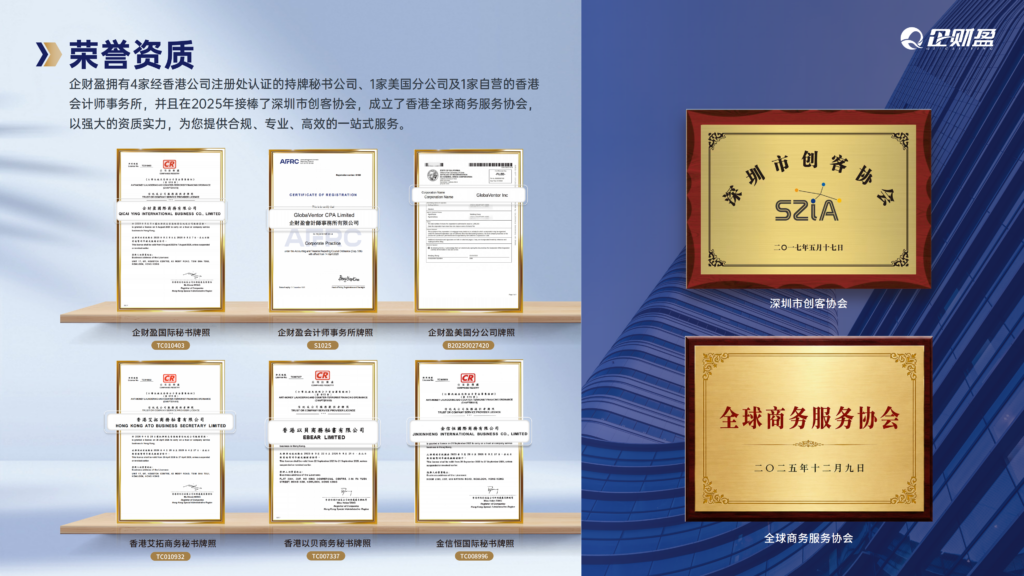
✔️ Local on-the-ground team in Hong Kong: 3 licensed secretarial firms + 1 in-house Hong Kong accounting firm; government correspondence and bank verifications are handled locally; bookkeeping and auditing are not outsourced
Why You Can Trust Us—
✔️ Hong Kong Licensing Qualifications: Three licensed secretarial firms certified by the Hong Kong Companies Registry—not ordinary agencies—that possess the qualifications of a statutory secretary
✔️ In-house accounting firms: 1 self-operated Hong Kong accounting firm + a Greater Bay Area accounting firm; audit reports are not outsourced
✔️ Endorsed by industry associations: Vice President of the Shenzhen Bookkeeping Services Association; Board Member of the Shenzhen Cross-Border E-Commerce Association
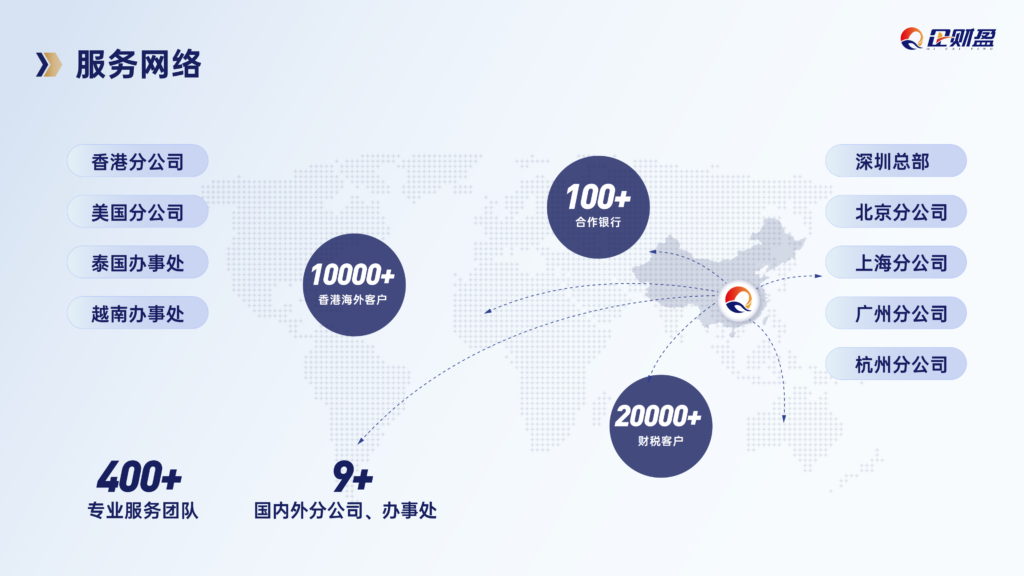
✔️ Founded in 2015, we have served over 500,000 small, medium, and micro enterprises with a team of over 400 professionals, including lawyers, CPAs, tax consultants, and cross-border compliance experts. Our core team members have an average of 8–15 years of industry experience.
✔️ Global Presence: Headquartered in Shenzhen, with branches in Beijing, Shanghai, Guangzhou, Hangzhou, Hong Kong, Southeast Asia, and the United States
If you're considering registering a company or opening a bank account in Hong Kong, feel free to reach out to us—
Tags:
Hong Kong Corporate Income Tax
Hong Kong Company Tax Compliance
Hong Kong company
Recommended
Cross-border e-commerce B2B must see! Registered Hong Kong company stationed in the Ali International Station, really fragrant!
In today's globalized business environment, the cross-border e-commerce B2B model is rapidly emerging with its unique advantages. For many enterprises engaged in cross-border trade, choosing a suitable platform and registering an advantageous company are undoubtedly the key keys to open the door to the international market.
2024 Hong Kong Company Account Opening Tips! How to choose the right Hong Kong bank account?
Global anti-money laundering regulations are becoming more and more stringent, the banks to maintain an account of the sunk cost is getting higher and higher, not moving hundreds of millions of dollars in fines, so that the major banks to open an account threshold as well as the audit process high up, already have a Hong Kong company bosses, how to choose the Hong Kong bank to open a public account? How much does it cost and how to operate? Today to give you a detailed introduction to the Hong Kong company account how to choose, as well as the approximate costs required and other content.
Hong Kong company registration advantages + registration conditions + registration process to share!
If you want to start a business and develop overseas markets, registering a Hong Kong company is undoubtedly a very forward-looking choice. With its unique geographical location, sound legal system, low tax rate and open business environment, Hong Kong company has become a "sharp weapon" for many business owners to open up overseas markets. Why is it so important to register a Hong Kong company in 2024?