A Comprehensive Guide to Bookkeeping and Tax Filing for Hong Kong Companies: Reducing Costs, Mitigating Risks, and Optimizing Cash Flow
Published: July 17, 2026
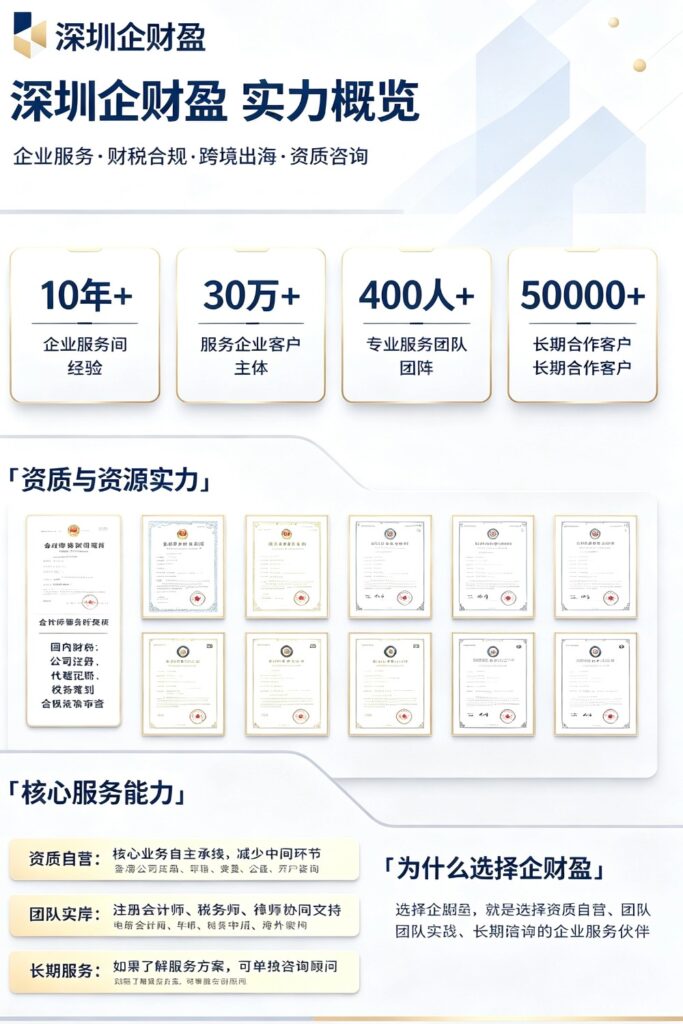
Qicaiying (formerly Jinxinheng) was founded in Bao’an, Shenzhen, in 2015. With over a decade of deep industry experience, it is a one-stop service provider specializing in business registration, accounting, taxation, and cross-border expansion for enterprises. The company has branches in Guangzhou, Shanghai, Hong Kong, and other locations, employs a team of over 400 professionals, and has served more than 500,000 companies to date. Core Services: Company registration and bookkeeping, tax planning, export tax rebates, cross-border e-commerce tax and financial compliance, domestic and international offshore company structuring, transparent fund repatriation, and assistance with tax audits and rectifications under the Golden Tax Phase IV initiative. The firm specializes in providing end-to-end tax and financial compliance implementation services for foreign trade and cross-border e-commerce sellers.
👋 Scan the code to add WeChat (WeChat:jxhcyb) or call customer service:18148556832Get your free copy of the “2026 Hong Kong Company Accounting and Tax Filing Compliance Checklist + Profits Tax Incentive Eligibility Assessment Form + Quote for Remedial Measures for Late Filings”!
The year 2026 marks a peak period for corporate tax filing in Hong Kong. After registering a company in Hong Kong, annual bookkeeping and tax filing are the top priorities that businesses must fulfill—this is not only the minimum compliance requirement for Hong Kong companies but also a critical juncture for reviewing the previous year’s operating results and optimizing financial structures. While Hong Kong’s tax policies will see several improvements in 2026—including profits tax relief and enhanced super-deductions for R&D expenses—many business owners and finance professionals still face challenges such as “unclear accounting and tax filing procedures,” “inability to utilize preferential policies,” and “falling into compliance pitfalls.” This not only exposes them to tax risks but also causes them to miss out on policy benefits. This article combines the Incorporating the latest 2026 amendments to the Hong Kong *Inland Revenue Ordinance* and *Companies Ordinance*, official guidance from the Inland Revenue Department (IRD), and practical experience in bookkeeping and tax filing, this article comprehensively breaks down the core policies, step-by-step procedures, document preparation, application of tax incentives, and key pitfalls to avoid for Hong Kong companies’ 2026 bookkeeping and tax filing, helping businesses operate efficiently and in compliance.
I. Key Policies for Bookkeeping and Tax Filing for Hong Kong Companies in 2026
In 2026, the Hong Kong government continued and refined a number of tax relief policies, with the core objectives of supporting the development of small and medium-sized enterprises and consolidating Hong Kong’s status as an international financial center. These policies directly affect corporate tax burdens and cash flow efficiency, and serve as the core basis for accounting and tax filing.
Two-Tier Corporate Income Tax System (Permanent Implementation)
This applies automatically to all Hong Kong companies: the tax rate on the first HK$2 million in profits is reduced to 8.25% (from the original standard rate of 16.5%); The tax rate of 16.5% remains in effect for profits exceeding HK$2 million. Please note: Only one company within each affiliated group is eligible for the reduced tax rate on the first HK$2 million.
One-Time Tax Relief for the 2025/26 Tax Year
For the tax year beginning April 1, 2025 (to be reported in 2026), a reduction of 100% on the profits tax payable will be granted, up to a maximum of HK$3,000. If the tax payable is less than HK$3,000, the entire amount will be exempt; if the tax liability exceeds HK$3,000, a direct reduction of HK$3,000 will be applied. Approximately 171,000 businesses across Hong Kong will benefit from this measure.
The Principle of Taxation Based on Source (Long-Term Core Benefit)
Hong Kong levies taxes only on “profits derived from within Hong Kong.” If a company’s business operations (contract signing, decision-making, logistics) take place entirely outside Hong Kong, it may apply for an exemption on offshore profits, with a profits tax rate of 0. In 2026, the Inland Revenue Department will conduct stricter reviews, requiring companies to provide comprehensive evidence of “economic substance.”
Additional Tax Deduction for Research and Development (R&D) Expenses
To encourage scientific and technological innovation, companies that establish R&D centers in Hong Kong may claim a 300% pre-tax deduction on the first 2 million HKD of eligible R&D expenses; the remaining eligible expenses may be claimed as a 200% pre-tax deduction. This policy is effective through March 31, 2027.
Immediate Deduction of Fixed Assets
Companies that purchase eligible environmentally friendly machinery, computer hardware, and software systems are eligible for a full deduction from their profits tax in the first year—100%.
Optimization of the Company Registration Transfer System
The 2026 amendment to the Companies Ordinance introduced a company relocation system, allowing companies registered overseas to relocate their registered office entirely to Hong Kong without having to dissolve the company at its original place of registration. After the relocation, the company is deemed to be a continuation of the original entity, and contracts, assets, and employee agreements remain unaffected.
Explanation of Key Tax Categories
Accounting and tax filing for Hong Kong companies primarily involve three types of taxes:
Profits Tax (Core Tax): A tax levied on a company’s profits generated in Hong Kong; if there are no profits, no tax is due—a two-tier tax rate system will be implemented in 2026—.
Salary Tax: If a company hires local employees in Hong Kong, it must file a tax return on their behalf. The tax rate is either 2%-17% (cumulative tax rate) or 15% (standard tax rate), whichever is lower.
Property Tax: If a company owns and leases out property in Hong Kong, it is subject to a tax of 15% of the rental income.
II. The Complete Process for Bookkeeping and Tax Filing for Hong Kong Companies in 2026
The core process for bookkeeping and tax filing for Hong Kong companies follows a four-step procedure: “Bookkeeping → Audit → Filing → Tax Payment.” In 2026, the Inland Revenue Department will mandate electronic filing—a process that is more convenient but places higher demands on the accuracy and standardization of documentation.
Key Prerequisite: Clearly Define the Timelines for Bookkeeping and Tax Filing
Failure to file accounting records and tax returns on time will result in heavy fines and trigger tax audits—there will be no grace period in 2026.
Newly Incorporated Companies: The first profits tax return must be received within 18 months of incorporation and filed within 3 months of receipt. Profits tax returns for the 2025/26 tax year will be mailed out in bulk in April 2026.
Continuing Entities: Receive the profits tax return around April each year and file it within one month of receipt. Entities with a fiscal year-end of March 31 or December 31 may apply for an extension of up to eight months through a licensed Hong Kong accountant.
Accounting Cycle: All accounting records for the fiscal year (12 months) are organized based on the company’s fiscal year-end. It is recommended to begin preparations 1–2 months in advance.
Scenario-Based Accounting and Tax Filing Processes
Scenario 1: Inactive Status (No account opened, no business activities, no transaction history)
Applies only to companies that “have no bank accounts, no transaction history in their accounts, no purchasing or sales activities, and no real estate or employees in Hong Kong.”
Documents to Prepare: Company Registration Certificate, Business Registration Certificate, most recent Annual Return, monthly bank statements (showing no transaction history, if an account exists), and a Declaration of No Operations (signed by a director).
Bookkeeping: No complicated bookkeeping is required; simply organize the basic documents and confirm that there were no business activities.
Audit: You may choose to submit an unaudited operational audit report (recommended to reduce risk control risks associated with bank accounts) or file a zero-return directly (provided you ensure there is absolutely no business activity). As of April 1, 2023, the Hong Kong Inland Revenue Department no longer accepts zero-return filings without an audit.
Filing: Complete the income tax return (Form BIR51/BIR52) and submit it to the tax authority along with the non-operational audit report (if any). Electronic filing can be completed through the eTAX system. General taxpayers must file within one month; those who file online are automatically granted a one-month grace period.
Taxes: No profit, no taxes due.
Scenario 2: Account is active (account has been opened and has transaction history; this is the most common scenario)
As long as a company has a bank account and records income and expenses (regardless of whether it is profitable or operating at a loss), it must first prepare its financial statements, then undergo an audit, and finally file its tax return.
Step 1: Organize accounting records (1–2 weeks)
Basic Documents: Certificate of Incorporation, Business Registration Certificate, Annual Return, Articles of Incorporation, and documents regarding changes to the company (if any).
Bank Documents: All monthly bank statements, transaction statements, and receipts; for cross-border transactions, records of foreign exchange purchases and sales must be retained.
Step 2: Engage a licensed Hong Kong accountant to prepare the financial statements (2–4 weeks)
Accountants prepare financial statements (balance sheets, income statements, and cash flow statements) based on the data, ensuring that the figures are accurate and compliant, while optimizing accounting treatments in accordance with the 2026 preferential policies.
Step 3: Audit by a Certified Public Accountant (2–3 weeks)
The accountant audits the financial statements, issues an audit report (aiming for an unqualified opinion whenever possible), and prepares a corporate income tax calculation sheet to determine the tax payable.
Step 4: Tax Filing (1–2 business days)
Complete the Capital Gains Tax Return (BIR51) based on the audit report and the capital gains tax calculation sheet. If tax incentives apply, you must also submit the relevant supplemental forms (e.g., Form S3 for R&D expense deductions) and file them electronically via the eTAX system.
Step 5: Pay Taxes (within one month of receiving the tax assessment notice)
After review, the tax authority will issue a tax assessment notice specifying the amount due and the payment deadline. Businesses may pay via electronic payment, bank transfer, or other methods. For those eligible for tax relief policies, the corresponding amount will be automatically deducted.
Scenario 3: Cross-Border Business Status (Including Import, Export, and Offshore Operations)
The core strategy of such businesses (such as cross-border e-commerce platforms and foreign trade companies) is to “reduce their tax burden by taking advantage of offshore tax exemption policies.”
Additional Documentation Required: Proof of offshore operations (proof that the contract was signed and services were provided outside of Hong Kong, logistics documents, communication records), proof that the client/supplier is not based in Hong Kong, and proof that the office location and employees are not in Hong Kong—.
Accounting and Auditing: When conducting accounting and auditing, accountants separately organize data related to offshore operations and issue an audit report on offshore operations.
Application for Offshore Income Exemption: Check the “Offshore Income Exemption” option on the BIR 51/BIR 60 capital gains tax return and submit the supporting documents at the same time. The BIR’s review process takes approximately 3–6 months. Upon approval, the BIR will issue a Certificate of Offshore Income Exemption, valid for three consecutive tax years.
Follow-up: If the tax authority requests additional information, you must cooperate promptly. If your application is denied, you may submit supplementary materials to request a review within one month of receiving the denial notice.
III. Preparing Documents for Bookkeeping and Tax Filing in 2026
The completeness and compliance of the documents directly determine the speed of bookkeeping and tax filing (having all the necessary documents can reduce the time by 30%).
General Required Documents
Key Corporate Documents: Certificate of Incorporation (CI), Business Registration Certificate (BR), most recent Annual Return (NAR1), Articles of Association, proof of identity for directors/shareholders, and documents regarding corporate changes (if any).
Bank Documents: Complete monthly bank statements for the tax year (all accounts), transaction slips, confirmation slips, and proof of bank account opening.
Tax Compliance Documents: Previous Year’s Audit Report and Tax Calculation Sheet (for non-first-time filers), Profits Tax Return, Substantial Controlling Persons Register (SCR), and Company Secretary Information.
Other: A letter of authorization for bookkeeping and tax filing, signed and confirmed by a director.
Additional Required Documents for Operating Companies
Revenue-related documents: sales contracts, commercial invoices, bills of lading/waybills, customs declarations, payment receipts, and customer statements.
Expense-related documents: Purchase contracts, supplier invoices, payment vouchers, shipping documents, receipts for rent, utilities, and office expenses, employee payroll records, employment contracts, and Mandatory Provident Fund contribution records.
Assets and Liabilities: List of fixed assets (purchase contracts, invoices, depreciation schedules), inventory count sheet, detailed accounts receivable/payable, loan agreements (if any).
Audit-related: Additional information required by licensed accountants in Hong Kong, notes to the financial statements, and a description of accounting policies.
Additional Required Documents for Cross-Border/Offshore Business
Proof of Offshore Business: Contracts, bills of lading, customs declarations, proof of payment and receipt channels, proof that customers/suppliers are not based in Hong Kong—.
Transfer Pricing Documentation: For transactions involving related parties, a list of related parties, transaction contracts, and pricing policies must be provided.
Foreign Exchange-Related: Records of foreign exchange purchases and sales; basis for exchange rate conversions.
Important Notes on Preparing Materials
Time Coverage: Bank monthly statements and business documents must fully cover the tax year without any gaps.
Three-way Match: Contracts, invoices, and bank statements correspond one-to-one, verifying the authenticity of the transaction.
Electronic Archiving: We recommend using cloud storage to categorize and save electronic receipts; starting in 2026, the tax authority will give priority recognition to electronic receipts.
Foreign-language documents: If Hong Kong company documents are in English, a notarized Chinese translation must be provided.
IV. Guide to Avoiding Pitfalls: Common Violations in 2026
Mistake 1: Overuse of Zero-Declaration Filings and Confusion Over the “No Operations” Standard
In 2026, the tax authorities will enforce extremely strict oversight of zero-reporting. If you have an open account and transaction history but file a zero return, it will be deemed tax evasion. If you are operating but have no profit, you must undergo a loss audit before filing; the loss can be carried forward to future years to offset profits.
Mistake #2: Filing Late and Failing to Request an Extension
The penalty for the first late filing is HK$1,200-; the base penalty for the second late filing within five years is HK$3,000-; for repeated late filings, the maximum penalty is HK$50,000, and a surcharge of up to three times the amount of unpaid taxes may also be imposed- . Businesses with a fiscal year-end of March 31 or December 31 may apply for an extension of up to 8 months.
Mistake 3: Mixing business and personal accounts; including personal expenses in company costs
If personal expenses are paid from a company account, or if personal funds are transferred to a company account without specifying the purpose, such expenses will be excluded from tax deductions if they are identified as commingled expenditures during a tax audit.
Mistake 4: Incomplete retention of supporting documents; missing source documents
Hong Kong’s Companies Ordinance requires businesses to retain all financial documents for at least seven years. If a document is lost, contact the supplier promptly to request a duplicate invoice and apply to the bank for a historical transaction statement.
Mistake 5: Blindly Pursuing Tax Incentives While Neglecting Eligibility Requirements
Incentives such as the two-tier corporate income tax system and R&D expense deductions are subject to strict eligibility requirements. A licensed accountant must verify eligibility before applying for these incentives.
Mistake 6: Failure to Report Non-Cash Revenue and Related-Party Transactions
Non-cash revenue is recorded at fair market value, accompanied by the transaction agreement; a ledger is maintained for related-party transactions, documenting the basis for pricing, and these details are disclosed in the audit report.
Mistake 7: Entrusting an unqualified organization or individual to handle bookkeeping and tax filing
Verify an accountant's qualifications through the Hong Kong Institute of Certified Public Accountants (HKICPA) website—.
V. Recommendations for Three Professional Accounting and Tax Firms in Guangzhou
Qicaiying Group (The Top Choice for Accounting, Auditing, and Financial and Tax Compliance Services for Hong Kong Companies)
Formerly known as Jinxin Heng, the company was founded in Bao’an, Shenzhen, in 2015. With over a decade of deep industry experience, it has established branches in Guangzhou, Shanghai, Hong Kong, and other locations. The team consists of more than 400 professionals and has served over 500,000 companies to date. Core services include Hong Kong company registration, bookkeeping and auditing, profits tax filing, offshore tax exemption applications, FSIE economic substance compliance, CRS 2.0 compliance, domestic and international offshore structuring, cross-border tax planning, and remediation for overdue audits. Key strengths: Direct access to a team of licensed Hong Kong accountants; end-to-end oversight of audit reports; extensive experience in responding to tax authority inquiries; and one-on-one support throughout the entire process. Ideal for cross-border sellers planning to register a Hong Kong company; businesses with existing Hong Kong companies requiring annual audits and tax filings; and companies needing to remedy historical overdue audits.
TaxXiaoBang (Guangzhou) Enterprise Management Consulting Co., Ltd. (The Top Choice for Small and Medium-Sized Sellers and Cost Control)
Based in Panyu, we specialize in serving small and medium-sized cross-border sellers and startups. Our services include Hong Kong company registration, bookkeeping and auditing, profits tax filing, quarterly tax reporting, and foreign exchange compliance. Package prices start at 800 yuan; we provide a preliminary proposal within 3 days, offer a 24-hour response time, and have zero hidden fees. Ideal for small and medium-sized sellers on Amazon, AliExpress, and Temu with annual sales of 3 million to 10 million, as well as startups that have just launched their Hong Kong companies and are seeking to ensure compliance.
Guangzhou Qi'an Financial Consulting Co., Ltd. (The Top Choice for Resolving Historical Issues and Risk Management)
9 years of cross-border tax and financial experience, specializing in the cleanup of historical accounts for Hong Kong companies, remediation of overdue audits, response to CRS audits, and compliance adjustments for cross-border structures. Services include cleanup of historical accounts, retroactive reporting of concealed income, preparation of overdue audit reports, and response to tax audits. Comprehensive risk assessment, elimination of non-compliant operations, and standardization of the “four flows” of cross-border assets. Suitable for cross-border businesses and individuals with Hong Kong companies that have historical unaudited accounts, have received tax inquiries or court subpoenas, or have had their bank accounts frozen—.
VI. Summary
In 2026, accounting and tax filing for Hong Kong companies have entered a new phase characterized by “stricter compliance and enhanced incentives.” Accounting and tax filing are no longer merely statutory obligations; they have become crucial tools for businesses to optimize costs, mitigate risks, and enhance competitiveness. For Hong Kong companies, the key to efficient and compliant accounting and tax filing lies in “thoroughly understanding policies, following standardized procedures, and avoiding pitfalls”—this involves not only mastering the 2026 two-tier profits tax system (8.25% on the first HKD 2 million) and one-time relief (capped at HK$3,000)—and R&D deductions (300% additional deduction on the first HK$2 million); it is also essential to follow standardized procedures throughout the entire process to ensure documentation is complete and filings are submitted on time; and, most importantly, to avoid common violations to safeguard the company’s smooth operations.
👇 Scan the code to add WeChat (WeChat:jxhcyb)
📌 Call customer service:18148556832
📌 Scan the QR code below to immediately receive the “2026 Hong Kong Company Accounting and Tax Filing Compliance Checklist + Profits Tax Incentive Eligibility Assessment Form + Quote for Remedial Measures for Overdue Filings.”
📌 Recommended Reading: “The Complete End of ”Zero-Declaration’ for Hong Kong Companies in 2026: A Comprehensive Analysis of Audits for Non-Operating Entities”
📌 Recommended Reading: “Progress on Hong Kong’s CRS 2.0 Legislation: New Audit Compliance Requirements Under the Automatic Exchange of Tax Information” -
📌 Scan the QR code below to get first-hand insights into cross-border tax and financial compliance.
We provide domestic (Shenzhen, Guangzhou, Shanghai, Beijing, Hangzhou, etc.) company registration, overseas (Hong Kong, the United States, Japan, the United Kingdom, Singapore, Thailand, Vietnam, etc.) company registration, Hong Kong identity application and renewal services, while covering the cross-border tax planning, shareholding structure design, compliance and risk control programs, such as the whole chain of corporate services. Feel free to contact me at any time with your needs, Tel:18148556832, microsoft:jxhcyb(You can add it by searching directly) or scan the QR code below to add it.
Cross-border e-commerce B2B must see! Registered Hong Kong company stationed in the Ali International Station, really fragrant!
In today's globalized business environment, the cross-border e-commerce B2B model is rapidly emerging with its unique advantages. For many enterprises engaged in cross-border trade, choosing a suitable platform and registering an advantageous company are undoubtedly the key keys to open the door to the international market.
2024 Hong Kong Company Account Opening Tips! How to choose the right Hong Kong bank account?
Global anti-money laundering regulations are becoming more and more stringent, the banks to maintain an account of the sunk cost is getting higher and higher, not moving hundreds of millions of dollars in fines, so that the major banks to open an account threshold as well as the audit process high up, already have a Hong Kong company bosses, how to choose the Hong Kong bank to open a public account? How much does it cost and how to operate? Today to give you a detailed introduction to the Hong Kong company account how to choose, as well as the approximate costs required and other content.
Hong Kong company registration advantages + registration conditions + registration process to share!
If you want to start a business and develop overseas markets, registering a Hong Kong company is undoubtedly a very forward-looking choice. With its unique geographical location, sound legal system, low tax rate and open business environment, Hong Kong company has become a "sharp weapon" for many business owners to open up overseas markets. Why is it so important to register a Hong Kong company in 2024?