Is the SAIWEI Model Still Viable? The Tax Authority’s Official Stance—It’s Not What You Think
Published: June 5, 2026
Is the SAIWEI model still viable? This is the question cross-border sellers have been asking most frequently lately.
The tax authorities have collected statistical forms on multi-store models, there are more and more notifications about audit-based taxation, and there are rumors that some competitors have been audited… Many business owners are starting to panic: Can I still use this business structure?
First, here’s a straightforward answer:
The Suntech model hasn't been shut down, but your past practices may no longer be sustainable.
These are two different things; it’s important to keep them separate.
I. The tax authorities have not put a stop to the Savi model
Based on Qicaiying’s recent practical experience serving a large number of cross-border sellers in Shenzhen, Guangzhou, Shanghai, Ningbo, and other locations, as well as the explicit statements in the latest Q&A document for 2026—
The tax authority's stance on the Suntech model is one of partial acceptance.
Specifically:
✔ Recognition of the single-entity, unified customs declaration approach used in the original Suntech model may serve as proof of the normal export of goods.
✔ Approve the mechanism whereby costs, expenses, and personnel are allocated among export companies and third-party operators within the Group based on revenue share
✘ We do not approve of the practice of consolidating all store revenues into a single entity (such as a Hong Kong company); we require each store company to file its tax return independently based on its revenue.
Simply put: There is nothing wrong with the structure itself, but the methods for pooling funds and filing reports must be adjusted.
II. Why isn’t the 1.0 approach working anymore?
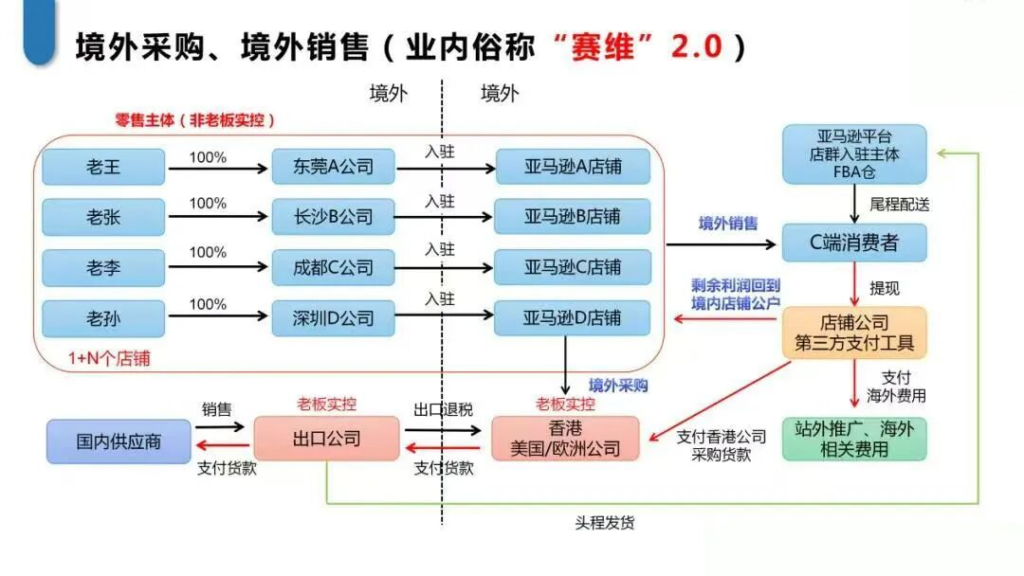
In the past, under the Saiwei 1.0 framework, many sellers had their stores and companies uniformly file zero tax returns; all revenue was nominally attributed to a Hong Kong company, keeping their mainland tax filings formally in order.
This line of reasoning still had some room for maneuver during the Golden Tax Phase III era, but it won’t work in 2026.
Data Penetration Capabilities of the Fourth Phase of the Golden Tax System
Platforms (such as Amazon, Walmart, TikTok Shop, etc.) have already submitted sales data to the tax authorities as required. The tax authorities’ system contains data on how much revenue your store’s company generates on these platforms each quarter.
Zero tax reporting for the store’s business + platform data showing several million in revenue = the system automatically flags it, and a risk notification is triggered.
This isn't the tax authority specifically targeting you; it was triggered by an automatic system comparison.
The Three Actions Most Likely to Give You Away
✘ The store’s company has consistently filed zero tax returns, which is significantly inconsistent with the revenue reported by the platform.
✘ The Hong Kong company is merely a shell company for receiving payments; it has no staff, contracts, or actual purchasing or sales functions.
✘ Funds have flowed back from Hong Kong to the mainland, but there are no corresponding sales contracts or service fee agreements to support them.
III. What is the tax authority’s official stance for 2026?
Based on our actual communications with local tax authorities, the regulatory focus for 2026 can be summarized in three points:
The problem isn't with the Suntech model itself, but rather with its improper implementation.
The problem isn't with the Hong Kong company itself, but rather with the lack of commercial substance.
The problem isn't with the multi-store structure itself, but rather with the discrepancy between reported figures and actual revenue.
In 2026, the tax authorities will be more inclined to recognize the overall cost structure of individual stores—that is, the direction of Saiwei 2.0—where each store operates as a separate entity with independent accounting, independent tax filing, and independent responsibility for its corresponding costs.
IV. Three Self-Assessment Questions: Where Do You Stand in Terms of Risk?
Use the following three questions to assess your current level of risk:
❓ Has your store’s company reported its platform revenue?
If you have been filing zero returns for an extended period, you should assess as soon as possible whether to file back taxes or apply for a fixed-rate tax assessment.
❓ Does your Hong Kong company have genuine purchase and sales contracts and bank statements?
If a Hong Kong company is merely a bank account for receiving payments and has no business documentation, it must establish substantive operations as soon as possible.
❓ Are there corresponding purchase contracts and service fee agreements for your capital inflows?
If there is no reasonable explanation for funds transferred from Hong Kong to the mainland, such transfers are likely to be deemed an unreasonable transfer of profits by related parties.
If you answer “no” to two of these three questions, we recommend conducting a comprehensive compliance assessment as soon as possible—don’t wait until you receive a notification from Risk Control to address the issue.
Scan the QR code to add a consultant and get a free one-on-one compliance assessment—we’ll cut to the chase and tell you exactly how to assess your situation right now.
Cell phone: 18676749275 | WeChat: qcygscszk
common problems
Q: The company behind the store has always filed zero tax returns. What should we do now?
A: First of all, don’t panic, and don’t rush to file a supplementary tax return. The first step is to review historical platform revenue, cash flows, export data, and domestic tax compliance. If the domestic export company or operating company has already paid the corresponding taxes, you’ll need to compile a chain of evidence to demonstrate that no tax revenue has been lost. If there is indeed a gap in tax filings, you should develop a corrective action plan in accordance with local tax regulations; the sooner you address the issue, the lower the cost will be.
Q: Is it actually okay to file a zero-report? Has the tax authority made a clear statement on this?
A: The tax authority hasn’t issued a blanket ban, but according to official guidance: the practice of consistently filing zero returns without corrections and waiting for risk control measures carries the risk of a tax audit, and the audit process may extend back to 2022. Cases flagged by risk control are generally not subject to retroactive audits; only cases subject to a tax audit may be audited retroactively and result in fines.
Q: Under what circumstances would tax evasion by related parties be deemed to have occurred?
A: The key criteria are whether the Hong Kong company has genuine business substance and whether there is a loss of tax revenue for mainland China. If the Hong Kong company is merely a shell entity, and funds only flow into it without flowing out, or flow into mainland China without a contractual basis, it is likely to be deemed an improper transfer of profits through related-party transactions.
Qicaiying: Why Choose Us for Compliance Assessments?
This article explains it very clearly: the Savi model isn’t unusable, but how it’s used—and whether it’s used well—boils down to a single word: the line between compliance and non-compliance. What you really need isn’t an answer to the question of ”can or cannot,” but a judgment that translates the tax authorities’ actual stance into concrete guidance on how to run your business.
✔️ Real-Time Policy Analysis:Qicaiying maintains close communication with tax authorities in various regions and continuously monitors the actual implementation guidelines in each area. What we provide you with isn’t just an interpretation of documents found online, but real-world feedback from frontline service counters in cities such as Shenzhen, Guangzhou, Shanghai, and Ningbo.
✔️ No fear-mongering, just practical advice:Is there really a risk associated with filing a zero-revenue tax return for your business, and if so, how significant is it?—Our answer won’t exaggerate the risk by claiming ”you’ll be audited tomorrow” just to get you to pay. To be honest: we’ll explain when it’s safe, when you need to be vigilant, and when we recommend taking proactive corrective action.
✔️ Diagnose First, Then Act:We don’t just tell you, ”You need to change everything” right off the bat. During a 30-minute phone consultation, we’ll first assess your store’s size, platform distribution, compliance status, and funding channels—then we’ll let you know whether you need to make changes, what to change, and how to go about it.
✔️ Practical Experience from Various Locations:Even for the same Savi model, the tax authorities in Shenzhen and Ningbo focus on different aspects; even for the same issue, risk control and audit departments handle it differently. The experience we’ve gained across different cities and case types directly serves as your reference framework.
We have assisted thousands of cross-border sellers in Shenzhen, Guangzhou, Shanghai, Ningbo, and other cities with compliance assessments and structural adjustments. Scan the QR code to add a consultant and get a free consultation. One-on-One Compliance Assessment—No beating around the bush; we’ll tell you straight up how to assess the situation right now.
Cell phone: 18676749275 | WeChat: qcygscszk
About Enterprise Caiying Group
Established in 2015 and headquartered in Shenzhen, Qicaiying Group specializes in providing one-stop financial, tax, and corporate compliance services to cross-border e-commerce companies and businesses expanding overseas. Its services include company registration in Hong Kong and overseas, bank account opening, cross-border financial and tax compliance, VAT/EPR registration, bookkeeping services, and corporate identity planning. Having served over 10,000 companies to date, it is a trusted financial and tax compliance partner for cross-border sellers. Qicaiying Group provides business registration and related commercial and tax services for companies in the United States, Singapore, Japan, Thailand, Malaysia, Canada, Mexico, Brazil, UK companies, French companies, New Zealand companies, Vietnamese companies, Indonesian companies, Philippine companies, and Dubai companies, among others. We also provide corporate services for domestic company registrations in Hong Kong, Shenzhen, Guangzhou, Shanghai, Hangzhou, Beijing, and Hainan, including annual reviews and audits, bookkeeping and tax filing, Mandatory Provident Fund (MPF) contributions, information updates, bank account openings, ODI filings, BVI registrations, tax compliance, and cross-border e-commerce support and management services. Please feel free to contact me if you need assistance. 📱 Mobile: 13045886252, 💬 WeChat: qcy20251218
Tags:
Multi-Store Compliance
Safeway model
Financial and Tax Compliance
Recommended
Cross-border e-commerce B2B must see! Registered Hong Kong company stationed in the Ali International Station, really fragrant!
In today's globalized business environment, the cross-border e-commerce B2B model is rapidly emerging with its unique advantages. For many enterprises engaged in cross-border trade, choosing a suitable platform and registering an advantageous company are undoubtedly the key keys to open the door to the international market.
2024 Hong Kong Company Account Opening Tips! How to choose the right Hong Kong bank account?
Global anti-money laundering regulations are becoming more and more stringent, the banks to maintain an account of the sunk cost is getting higher and higher, not moving hundreds of millions of dollars in fines, so that the major banks to open an account threshold as well as the audit process high up, already have a Hong Kong company bosses, how to choose the Hong Kong bank to open a public account? How much does it cost and how to operate? Today to give you a detailed introduction to the Hong Kong company account how to choose, as well as the approximate costs required and other content.
Hong Kong company registration advantages + registration conditions + registration process to share!
If you want to start a business and develop overseas markets, registering a Hong Kong company is undoubtedly a very forward-looking choice. With its unique geographical location, sound legal system, low tax rate and open business environment, Hong Kong company has become a "sharp weapon" for many business owners to open up overseas markets. Why is it so important to register a Hong Kong company in 2024?