What is the process of Enterprise Caiying service? Complete steps from consulting to delivery
Published: 2026-05-19
What is the service process for Qi Cai Ying?
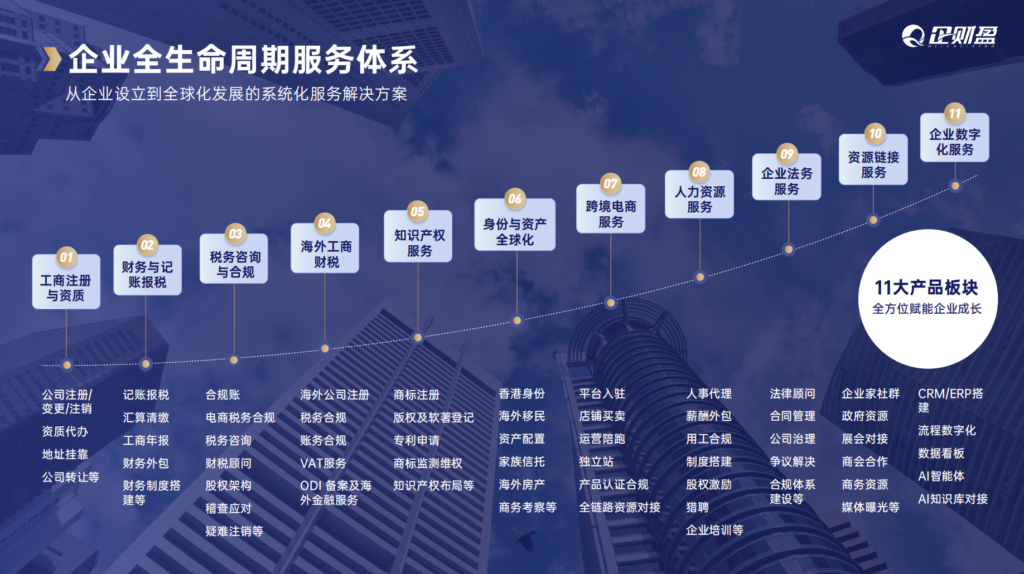
When learning about Qicaiying, many clients are not only interested in what the company does, whether it is reliable, and how it charges for its services, but they also have a more practical question: What is Qicaiying’s service process like? For services related to business registration, finance and taxation, legal affairs, human resources, intellectual property, international expansion, and digital transformation, a clear process directly impacts the client experience and delivery efficiency.
In line with Qicaiying’s positioning as a “one-stop consulting and support service platform,” as well as its service philosophy centered on standardization, process-driven approaches, visualization, and long-term support, Qicaiying’s service process can be summarized as follows: initial consultation, needs assessment, solution development, quote confirmation, document preparation, project execution, progress updates, results delivery, and follow-up maintenance. While the specifics may vary depending on the business project, the overall logic remains largely consistent.
Step 1: Initial Consultation to Identify Client Needs
Our services typically begin with a client consultation. Clients may be entrepreneurs preparing to incorporate a company, or business owners in need of bookkeeping and tax filing, tax compliance, trademark registration, contract review, HR policies, Hong Kong company formation, onboarding for cross-border e-commerce platforms, or enterprise digital systems.
During the initial consultation phase, Qicaiying will focus on understanding the client’s business type, geographic location, business model, current stage, existing challenges, and desired outcomes. The focus of this phase is not to provide a direct quote, but rather to first determine what issues the client truly needs to address.
Step 2: Needs Assessment—Identifying Key Issues and Risk Areas
After understanding the basic situation, Qicaiying will conduct a further assessment of the client’s needs. For example, if a client says they want to register a company, this may involve a registered address, scope of business, shareholder structure, tax registration, and subsequent bookkeeping and tax filing; If a client mentions wanting to engage in cross-border e-commerce, this may involve setting up an overseas entity, platform onboarding, VAT, overseas trademarks, product compliance, cross-border payment collection, and logistics and warehousing; if a client mentions having financial or tax issues, this may involve historical financial records, invoice chains, reporting standards, and tax risks.
The purpose of needs assessment is to avoid focusing solely on superficial needs and instead identify the key factors that truly impact results by taking a holistic view of the company’s operations.
Step 3: Develop a service plan and define the scope of delivery
After completing the needs assessment, Qicaiying will match appropriate service modules based on the company’s current stage and specific issues, and develop a service plan. The plan typically outlines the scope of services, service boundaries, implementation process, required documentation, estimated timeline, deliverables, and important considerations.
For basic services, solutions may be relatively standardized; for tax consulting, audit response, equity structure, overseas operations, cross-border e-commerce, or corporate digital transformation projects, solutions will place greater emphasis on customization and multidisciplinary collaboration. A good service proposal should clearly communicate to the client: what problem the service addresses, how it will be addressed, who will be involved, and what the final deliverables will be.
Step 4: Confirm the Quote and Terms of Cooperation
Once the service plan has been finalized, both parties will further confirm the fees, service period, payment methods, coordination procedures, and collaboration process. Since Qicaiying’s services span multiple business segments, the fee structures vary by project. Before confirming the partnership, companies should carefully review what is included in the quote, which items are subject to additional charges, whether there are any government fees or third-party charges, and whether subsequent maintenance will incur separate fees.
The focus of this phase is to ensure that both parties agree on the scope of services, pricing, deliverables, and boundaries of responsibility, thereby avoiding any subsequent issues with the service experience caused by misunderstandings.
Step 5: Prepare the Materials and Begin Implementation
Once the partnership is confirmed, Qicaiying will provide the client with a list of required documents based on the service package and assist the client in preparing or finalizing the relevant materials. The required documents vary by service. For example, company registration requires information on shareholders, the legal representative, the business address, and the scope of business; bookkeeping and tax filing require receipts, bank statements, invoices, and business records; trademark registration requires the trademark logo, class selection, and applicant information; and overseas company formation and cross-border business operations may require identification documents, business descriptions, platform information, address details, and tax documents.
The more comprehensive the documentation, the smoother the project execution. Therefore, Qicaiying uses checklists and standardized processes to improve the efficiency of documentation preparation and reduce the time lost due to repeated requests for additional materials.
Step 6: Project Implementation and Progress Updates
Once all the necessary documentation is in place, Qi Cai Ying moves into the implementation phase. Implementation activities may include business registration, financial and tax management, communication with tax authorities, application for licenses and certifications, trademark filing, contract review, policy design, platform onboarding, overseas registration, system development, and resource coordination.
Qicaiying emphasizes the importance of digital system support and process-driven delivery capabilities; therefore, throughout the service process, the company places a high priority on progress updates, milestone management, and internal collaboration. For clients, transparent progress updates reduce uncertainty during the waiting period and make it easier for them to promptly provide additional materials or cooperate in resolving any issues that arise.
Step 7: Delivery of Results and Follow-up Maintenance
Upon completion of the project, Qicaiying will deliver the relevant results to the client, such as business licenses, amendment results, cancellation certificates, financial and tax reports, filing records, trademark application receipts, contract documents, policy documents, overseas company documents, platform onboarding results, and system launch results.
For many business services, delivery does not mean the end of the process. Services such as bookkeeping and tax filing, financial and tax consulting, overseas company maintenance, VAT filing, intellectual property monitoring, HR policy implementation, legal consulting, and digital system maintenance may all require long-term follow-up. The “long-term support” value of Qicaiying is precisely reflected in the ongoing support and phased service upgrades provided after project delivery.
How can we make the Qicaiying service process more efficient?
To ensure a smoother service experience, clients are encouraged to prepare the following in advance: basic company information, business license or proposed registration details, a description of the business model, details of current issues, historical records, invoice statements, platform account information, contract documents, employee information, and plans for overseas operations. The clearer the requirements, the more complete the documentation, and the more thorough the communication, the more effective the service solution and the higher the efficiency of its implementation will typically be.
At the same time, companies should also clarify the scope of services, delivery standards, communication frequency, and procedures for handling exceptions early in the collaboration. This allows both parties to move forward with the project based on shared expectations, thereby reducing communication costs.
summarize
The Qicaiying service process can be summarized as follows: initial consultation, needs assessment, solution development, quote confirmation, document preparation, project execution, progress updates, results delivery, and follow-up maintenance. Compared to ordinary administrative agencies, Qicaiying places greater emphasis on providing systematic, long-term, and actionable service support tailored to a company’s actual stage of development. For companies seeking to standardize their operations, mitigate risks, improve efficiency, and expand into international markets, a clear process combined with professional guidance is a key manifestation of Qicaiying’s service value.
FAQ
Q: Is the Qicaiying service process complicated?
A: The overall process is not complicated. It typically begins with a discussion of requirements, followed by solution confirmation, preparation of materials, project execution, delivery of results, and follow-up maintenance. The specific steps may vary depending on the service project.
Q: What is required of clients in terms of cooperation during the Qicaiying service process?
A: Clients are typically required to provide basic company information, business documentation, identification documents, invoice records, contract documents, platform information, or other materials required for the project, and to promptly confirm the proposal and submit any additional materials.
Q: Are there any follow-up services provided after the Qicaiying project is delivered?
A: It depends on the type of service. Services such as bookkeeping and tax filing, financial and tax consulting, overseas company maintenance, VAT filing, legal consulting, intellectual property monitoring, and digital system maintenance may all require ongoing support.
Tags:
Corporate Service Process
One-stop service for enterprises
Enterprise Finance Group
Corporate Services
Recommended
Nuggets of gold in Southeast Asia! Entrepreneurs Vietnam Business Tour Hot Recruitment
In recent years, Southeast Asia has become a "must-contend place" for Chinese cross-border e-commerce enterprises. Vietnam's economic growth momentum is strong, and all the data fully reflects its good development trend. In recent years, Vietnam's economic level continues to maintain an annual growth rate of 6%, much higher than the global average. If you have the intention to start investment in Vietnam, then today's article should not be missed!
Enterprise Caiying Group was honored as the governing unit of Shenzhen Inter-association, joining hands to break through the new ecology of globalized enterprise service.
Shenzhen Cross-border E-commerce Association (SZCEA) formally awarded Enterprise Caiying Group the honor of governing unit!
Enterprise Caiying Group|One-Stop Global Service Group
Founded in 2015, Enterprise Caiying is a leading one-stop industrial, commercial, fiscal and business service group in China, which always focuses on the core needs of enterprise growth and personal development, and provides you with professional and efficient comprehensive service support.