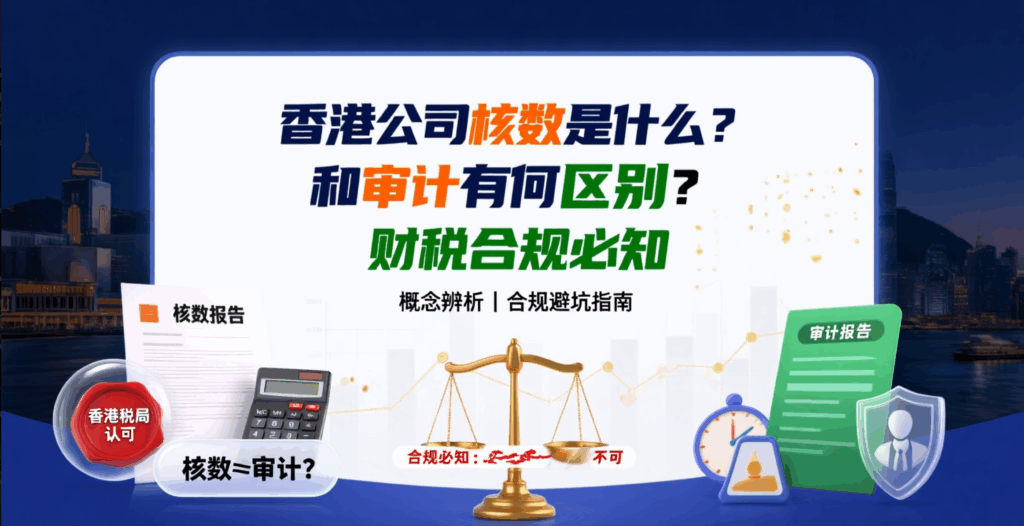
What is Audit of Hong Kong Company? What is the difference between audit and audit? Tax Compliance Must Know
Published: 2026-03-16
QCYAs a professional one-stop business service platform, we are committed to providing high-quality services such as mainland company registration in North China, Guangzhou, Shenzhen and Hangzhou, Hong Kong company registration, offshore company registration, bookkeeping and tax reporting, annual audits and audits, reconciliation of public accounts, financial and tax compliance, shareholding structure, ODI filing, cross-border e-commerce services, Hong Kong identity, immigration and study abroad, etc, which help enterprises to globalize and develop. Please contact me (WeChat/Telephone: 18620388671) for collateral + quotation.
A terminology that has been misunderstood for two decades and puts thousands of Hong Kong companies in a compliance crisis every year
“My Hong Kong company does ‘audits’ every year, so why is the bank still saying I'm not compliant?” “The secretarial firm asked me to do an ‘audit’, is this the same thing as ‘auditing” as they say in the Mainland? Is it trying to charge more money?"
This has been a perplexing issue in the minds of many Hong Kong company owners for many years. Behind the difference in terminology is the collision of two sets of legal systems and two business cultures. 2026, with the accelerated integration of the Guangdong-Hong Kong-Macao Greater Bay Area and the tightening of cross-border regulation, the correct understanding of the nature of “audit” and “audit” is no longer a matter of chewing on words, but a matter of the safety and health of a company's bank accounts and even its survival and development. It is no longer a matter of words, but a matter of life and death for a company's bank account security, tax health and even survival and development.
Today, we will thoroughly clarify this fundamental concept that has plagued the industry for years, and unveil the underlying logic of Hong Kong company tax compliance for you. Whether your company is a start-up or a veteran, this guide will be essential knowledge for you to avoid stepping into pits and operate safely.
Enterprise Caiying as a professional one-stop business services platform, is committed to providing customers with mainland company registration, Hong Kong company registration, offshore company registration, bookkeeping and tax reporting, annual audit, audit, open accounts, fiscal compliance, equity structure, ODI filing, cross-border e-commerce services, Hong Kong identity, immigration and study abroad and other high-quality services, to help the globalization of enterprises. (Phone with V: 18620388671) enterprise one-stop service, you can add my WeChat Consultation at any time ↓↓↓↓
01 Core findings front-loaded: audit = audit
First, to give you the most straightforward answer: in the business and legal context of Hong Kong, the“Audit” means “audit”.”. Both refer to the exact same statutory process - i.e., an independent third-party certified public accountant, who reviews the company's financial statements and issues a professional opinion report.
“Audit”: is the direct translation of the Cantonese word “Audit” in English. It is the most common and official local terminology in Hong Kong, and is used throughout the Companies Ordinance, Inland Revenue Department documents and all official expressions.
“Audit”: is the standard term in the Mainland, which also corresponds to the English word “Audit”. The use of this term has become more common in Hong Kong as business contacts between the Mainland and Hong Kong have become closer.
So why the two claims? This stems from historical and geographical differences. Hong Kong inherited the English common law system, and most of the terminology is directly translated from English or follows the Cantonese custom. The word “auditing” expresses the core work of “checking the numbers” in a figurative sense. The Mainland, on the other hand, adopts the Mandarin term “audit” as a standardization criterion.
Key point: Whether your service provider calls it an “audit” or an “audit”, the legal effect, the standard of performance, and the final output (the audit report) are exactly the same. The choice of which term to use is more a matter of habit than anything else.
But here's the real kicker: understanding why this program exists, how it performs, and what the consequences of ignoring it will be. Below, we break it down in depth.
As a professional one-stop business service platform, Enterprise Caiying is committed to providing customers with high-quality services such as mainland company registration, Hong Kong company registration, offshore company registration, bookkeeping and tax reporting, annual audit, reconciliation of public accounts, financial and tax compliance, shareholding structure, ODI filing, cross-border e-commerce services, Hong Kong identity, immigration and study abroad, etc., which can help enterprises to globalize and develop.Phone with V: 18620388671 Enterprise one-stop service, you can add my WeChat Any time to consult ↓↓↓↓
02 Why do Hong Kong companies need to be “audited”?
It is not optional but a statutory obligation for all Hong Kong limited companies. Its necessity is rooted in four pillars:
Pillar I: Legal Compulsory Requirements (Chapter 622 of the Companies Ordinance)
The Hong Kong Companies Ordinance clearly states that the financial statements of all limited companies must be audited (audited) by a qualified certified public accountant. This is a red line with no exceptions. Even if the company is not operating and not making profit, a “no-operation audit” must be conducted and a report issued.
Pillar II: Cornerstone of Tax Returns (Chapter 112 of the Inland Revenue Ordinance)
The Hong Kong Inland Revenue Department (IRD) requires companies to submit profits tax returns with audited financial statements (i.e. audit report). This report is the only authoritative basis for IRD to assess a company's assessable profits and determine its tax liability. Without the Audit Report, the tax return will not be accepted and may be considered as a late filing and incur a penalty.
Pillar III: “Passport” to banking and business credibility”
Banking Control: Banks worldwide follow strict Know Your Customer (KYC) and Anti-Money Laundering (AML) regulations. An up-to-date “unqualified” audit report from a licensed accountant is the most powerful document that proves a company's business is genuine, financially transparent and compliant. Without it, bank accounts may be restricted, frozen or even closed.
Business cooperation: Audited financial statements are the basis for building trust and demonstrating strength when doing business with partners, investors or financing.
Pillar IV: Corporate governance and protection of shareholders' rights and interests
Auditing is a form of external supervision of the management of a company. It ensures that the financial statements truly and fairly reflect the financial position and operating results of the company, protects the right to know and the interests of shareholders and creditors, and is a core aspect of modernized corporate governance.
Simply put: Audit is the lifeline of a Hong Kong company to maintain its legal existence, tax health, financial function and business reputation. If this thread is broken, the company will exist in name only.
03 How is a standard Hong Kong company audit done?
Having understood the “why”, let's look at the “how”. A complete audit is much more than just an accountant's stamp on a report; it is a rigorous systematic project.
Phase I: Preparation and planning (1-4 weeks)
Appointment of auditor: A certified public accountant (auditor) registered with the Hong Kong Institute of Certified Public Accountants (HKICPA) must be engaged. This is a statutory requirement and the qualification of an accountant from the Mainland or other regions is not valid.
Determine the scope and timing of the audit: specify the financial period to be audited (usually a fiscal year) and understand the nature of the company's business.
List of information preparation: the accountant will provide a detailed list of information, which usually includes:
- Basic company documents: certificate of incorporation, commercial register, by-laws, annual return. - Financial records: monthly bank statements (complete for the year), bookkeeping vouchers, sales/purchase invoices, contracts, expense vouchers, payroll records, fixed asset lists, etc. - Other documents: lease contracts, minutes of board meetings, etc.
Phase II: implementation of audit procedures (core phase, 2-8 weeks)
The auditor performs a number of procedures to obtain audit evidence, notably:
- Risk assessment: Understand the company and its environment (including internal controls) and assess the risk of material misstatement at the financial statement level and at the determination level. - Control testing: If reliance is placed on internal controls, their effectiveness is tested. - Substantive procedures: This is the main work, directly checking the truthfulness and accuracy of financial data, including: - Detailed test: check the bank flow and book records are consistent (bank inquiry is the most important); a sample of the authenticity and completeness of the transaction documents; inventory or fixed assets. - Analytical procedures: determine the reasonableness of statement data through financial ratio analysis, trend analysis, etc. - Communication with management: discussions on issues identified in the audit, selection of accounting policies, etc.
Phase III: Completion and Reporting (1-2 weeks)
Summarize audit findings: Collate all audit evidence and assess whether it is sufficient to support the audit opinion.
Issuance of an Audit Report: Based on the results of the audit, a final Audit Report is issued. The core of the report is the “Audit Opinion”, which is categorized into several types (see details below).
Preparation of audited financial statements: finalization of the company's financial statements together with the audit report.
Phase 4: Tax filing (within 1 month of audit)
Submit audit reports and audited financial statements to the Inland Revenue Department of Hong Kong as supporting documents for profits tax returns.
The whole process usually takes 2-6 months, depending on the complexity of the company's business and the timeliness and completeness of the information provided.
Enterprise Caiying as a professional one-stop business services platform, is committed to providing customers with mainland company registration, Hong Kong company registration, offshore company registration, bookkeeping and tax reporting, annual audit, audit, open accounts, fiscal compliance, equity structure, ODI filing, cross-border e-commerce services, Hong Kong identity, immigration and study abroad and other high-quality services, to help the globalization of enterprises. (Phone with V: 18620388671) enterprise one-stop service, you can add my WeChat Consultation at any time ↓↓↓↓
04 The heart of the audit report: reading the four “audit opinions”
The value of the audit report is centered on the “audit opinion” in the last few paragraphs. It is like a company's “financial medical report”, which is categorized into four levels:
unqualified opinion
In the opinion of the auditors, the financial statements have been prepared, in all material respects, in accordance with the applicable financial reporting framework, such as Hong Kong Financial Reporting Standards, and present fairly the financial position of the Company.
Best results. It is the “gold standard” of financial health and compliance that is most recognized by banks and partners.
reservation
The financial statements are presented fairly, except for certain specific matters. Those specified matters may be limitations on the scope of the audit or disagreement with certain accounting treatments.
Warning Signs. Indicates that the company is having problems in some areas (e.g., some documents are missing, improper accounting policies) and needs to improve. The bank may ask for an explanation.
negative opinion
The auditor is of the opinion that the financial statements as a whole do not present fairly the financial position of the company.
Serious issues. Means that the financial statements are materially misstated and have very low credibility. Would seriously affect banking relationships and business reputation.
unable express an opinion
The scope of the audit was severely limited, resulting in the auditors being unable to obtain sufficient and appropriate audit evidence and therefore not expressing an opinion on the financial statements.
One of the worst-case scenarios. Usually means extremely disorganized or missing financial records. There is an extremely high risk of bank accounts being frozen or closed.
Your goal: always get an “unqualified” audit report. This requires regular bookkeeping, proper documentation, and good communication with your auditor.
As a professional one-stop business service platform, Enterprise Caiying is committed to providing customers with high-quality services such as mainland company registration, Hong Kong company registration, offshore company registration, bookkeeping and tax reporting, annual audit, reconciliation of public accounts, financial and tax compliance, shareholding structure, ODI filing, cross-border e-commerce services, Hong Kong identity, immigration and study abroad, etc., which can help enterprises to globalize and develop.Phone with V: 18620388671 Enterprise one-stop service, you can add my WeChat Any time to consult ↓↓↓↓
05 Right by company status: which audit do you need?
Not all companies are audited the same. There are two main categories based on operations:
Category A: audits with operating companies (the vast majority of companies fall into this category)
Applicable: The company's bank account has funds in it and has business income or expenses.
Process: i.e. the standard process described above, complete business documents and bank records are required.
Result: A standard audit report is issued, calculating the taxable profit or loss.
Category B: Audit without operating company (i.e., “zero filing” compliance path)
Applicable conditions (extremely strict):
- Not having any bank account, or having an account with zero flow for the entire year (no record of any inward or outward movement). - There is no business income (sales, service fees, etc.). - There are no operating expenses (purchases, rent, salaries, etc., except for the basic costs of maintaining the company only, such as registered address and secretarial fees). - No assets (inventory, equipment, property, etc.) are held.
Process: An auditor will still need to be appointed, who will review the company documents, bank statements (if any), etc. to confirm that it meets the “non-operational” status.
Result: No Operational Audit Report was issued. The report concludes that the company had no operating activities during the financial year and therefore did not generate assessable profits. Note: This is still a formal audit report and must be submitted with the tax return.
Important: The so-called “zero return” service, which simply means checking “no business” on the client's tax form without an audit, is illegal and high-risk from April 2023 onwards. To be compliant, an audit process must be undertaken to obtain a Nil Operational Audit Report.
Enterprise Caiying as a professional one-stop business services platform, is committed to providing customers with mainland company registration, Hong Kong company registration, offshore company registration, bookkeeping and tax reporting, annual audit, audit, open accounts, fiscal compliance, equity structure, ODI filing, cross-border e-commerce services, Hong Kong identity, immigration and study abroad and other high-quality services, to help the globalization of enterprises. (Phone with V: 18620388671) enterprise one-stop service, you can add my WeChat Consultation at any time ↓↓↓↓
06 In-depth analysis: five common misconceptions about auditing and auditing
Myth 1: “Audit” and “audit” are two different things and you can do only one.
Correct: They are two designations for the same process. There is no such thing as “audit only”. The service you commissioned is an “audit”, which is known locally in Hong Kong as an “audit”.
Myth #2: If the company isn't making money (losses), it doesn't have to do an audit/audit.
Correct: Big mistake! Regardless of whether a company makes a profit, a loss or zero profit, an audit must be conducted and a report issued at the end of each financial year as long as the company is incorporated. The audit report of a loss is equally important as it can be carried forward to future years to offset future profits and thus save tax legally.
Myth 3: Hiring an accountant to do an audit report in the Mainland is also recognized in Hong Kong.
Explanation: Not recognized. The Hong Kong Companies Ordinance clearly stipulates that an audit must be conducted by a certified public accountant (CPA) practicing in Hong Kong. Audit reports issued by Mainland accountants have no legal effect in Hong Kong and are not recognized by the Inland Revenue Department and banks.
Myth 4: Audit is to “find fault”, make the accounts perfect will be fine.
Correction: The core of an audit is “assurance”, not “fault-finding”. The role of the accountant is to obtain reasonable assurance, in accordance with standards, that the statements are free from material misstatement. Standardized and truthful accounts are the foundation, but the audit process itself is independent and objective. Maintaining open and professional communication with the auditor is far more important than trying to “cover up” problems.
Myth 5: Audit reports are submitted once and for all.
Positive: The audit is an annual obligation. At the end of each financial year, a new audit must be conducted and a new report issued. The company's operations and financial position are dynamic and require continuous audit oversight.
As a professional one-stop business service platform, Enterprise Caiying is committed to providing customers with high-quality services such as mainland company registration, Hong Kong company registration, offshore company registration, bookkeeping and tax reporting, annual audit, reconciliation of public accounts, financial and tax compliance, shareholding structure, ODI filing, cross-border e-commerce services, Hong Kong identity, immigration and study abroad, etc., which can help enterprises to globalize and develop.Phone with V: 18620388671 Enterprise one-stop service, you can add my WeChat Any time to consult ↓↓↓↓
07 Compliance Action Guide: How to Ensure Your Company's Audit is Hassle-Free
Standardized bookkeeping and retention of vouchers: From the first day of the business, use professional software or entrust bookkeeping to an agent to ensure that every receipt and expenditure is supported by compliant documents (invoices, contracts, bank water bills). This is the cornerstone of a smooth audit.
Timely closure of unused bank accounts: If the company is really not operating, it should take the initiative to close the bank accounts to avoid generating unnecessary running water records and increasing the complexity of the audit.
Choose a professional, licensed service provider: appoint a team qualified as certified public accountants in Hong Kong to handle the audit. Be wary of low price traps to ensure service quality.
Plan ahead and communicate proactively: 1-2 months before the end of the financial year, you should start organizing information and communicating with the auditor. The more timely and complete the information is provided, the more efficient the audit will be and the lower the cost is likely to be.
Understand and utilize audit findings: Read the audit report carefully, especially the “management letter” (if any), and make improvements in response to identified internal control weaknesses. Consider the audit as a tool to improve the management of the company.
Enterprise Caiying as a professional one-stop business services platform, is committed to providing customers with mainland company registration, Hong Kong company registration, offshore company registration, bookkeeping and tax reporting, annual audit, audit, open accounts, fiscal compliance, equity structure, ODI filing, cross-border e-commerce services, Hong Kong identity, immigration and study abroad and other high-quality services, to help the globalization of enterprises. (Phone with V: 18620388671) enterprise one-stop service, you can add my WeChat Consultation at any time ↓↓↓↓
08 Our Service: Being the “night watchman” of your Hong Kong company's compliance”
Audit/auditing is highly specialized work with very low tolerance for error. A single negligence of detail may lead to a qualified opinion on the report or even trigger a tax audit.
Our team consists of senior Hong Kong practicing accountants and compliance consultants with deep understanding of Hong Kong accounting standards and auditing practices. We are committed to standardizing and making transparent the complex compliance process for you:
Audit health pre-screening
Free evaluation of your company's past accounts, anticipation of problems that may be encountered during the audit, and provision of solutions.
Full process audit hosting
We provide one-stop service from data compilation and counseling, adjusting accounts, communicating with auditors, to final report issuance and tax filing, so that you can save your effort.
Remediation of historical accounts
For companies that have not been audited for many years or whose accounts are in disarray, we provide professional remediation programs to help companies get back on the compliance track and resolve potential risks.
Tax Planning Combination
During the audit process, we identify tax optimization points in a legal and compliant manner, and provide overall tax planning advice in light of the company's business substance.
Transparency of costs and progress
Provide clear project quotes with phased fees. Synchronizes audit progress in real time through a proprietary system that keeps you in the loop.
Enquire now and get free access to "Hong Kong Company Audit Required Information Checklist (2026 Latest Edition)" and "Guidelines for Responding to Common Audit Issues".
Compliance is not a cost, but the most valuable asset of a company. Let us guard this asset for you, so that your company can walk steadily and farther on the road to globalization.
Phone with v: 18620388671
Share, Watch & Like, I'll have at least one of those!
-- E N D -- Featured Articles from Previous Issues
QCYAs a professional one-stop business services platform, is committed to providing the majority of customers with mainland company registration, Hong Kong company registration, offshore company registration, bookkeeping and tax reporting, annual audit audit, open accounts, fiscal compliance, equity structure, ODI filing, cross-border e-commerce services, Hong Kong identity, immigration and study abroad and other high-quality services, to help the globalization of the enterprise, enterprise one-stop service. You can add my WeChat (phone with V: 18620388671) Consult at any time!
Tags:
Hong Kong Company Annual Audit
Hong Kong company
Hong Kong Company Registration
Recommended
Cross-border e-commerce B2B must see! Registered Hong Kong company stationed in the Ali International Station, really fragrant!
In today's globalized business environment, the cross-border e-commerce B2B model is rapidly emerging with its unique advantages. For many enterprises engaged in cross-border trade, choosing a suitable platform and registering an advantageous company are undoubtedly the key keys to open the door to the international market.
2024 Hong Kong Company Account Opening Tips! How to choose the right Hong Kong bank account?
Global anti-money laundering regulations are becoming more and more stringent, the banks to maintain an account of the sunk cost is getting higher and higher, not moving hundreds of millions of dollars in fines, so that the major banks to open an account threshold as well as the audit process high up, already have a Hong Kong company bosses, how to choose the Hong Kong bank to open a public account? How much does it cost and how to operate? Today to give you a detailed introduction to the Hong Kong company account how to choose, as well as the approximate costs required and other content.
Hong Kong company registration advantages + registration conditions + registration process to share!
If you want to start a business and develop overseas markets, registering a Hong Kong company is undoubtedly a very forward-looking choice. With its unique geographical location, sound legal system, low tax rate and open business environment, Hong Kong company has become a "sharp weapon" for many business owners to open up overseas markets. Why is it so important to register a Hong Kong company in 2024?