Behind the $550 million in back taxes for Stranger: the end of the Hong Kong shell company dividend, is your cross-border structure still safe?
Published: 2026-03-05
A Hong Kong "paper company", so that strangers overnight to pay 550 million dollars in back taxes. This is not an exclusive problem for large companies, but a stern warning to all cross-border operators.
In March 2026, a piece of news in the cross-border circle exploded - Zhiwen Group (formerly Stranger) was required by the tax authorities to pay 547.9 million yuan of withholding tax. The reason was straightforward: its Hong Kong company was recognized as a "shell", not eligible for tax incentives, and the tax it used to pay at 5% now has to be made up at 10%.
Over half a billion dollars and it's gone.
This is still only a listed company. Those bosses who are clutching Hong Kong shell companies in their hands, who have neither made ODI filings nor operated substantially, are you panicking?
I. What did Stranger do wrong?
The structure of Stranger is a typical red-chip VIE model: Cayman Islands top company → Hong Kong holding company → domestic WFOE (Wholly Foreign Owned Enterprise) → domestic operating entity.
Beijing Stranger, as the operating entity, has been enjoying the preferential 5% withholding income tax rate under the Mainland/Hong Kong tax arrangement when distributing dividends to Hong Kong Stranger.
However, the tax authorities penetrated the examination and found that: this Hong Kong companyNo actual office staff, no substantive business, just a "paper shareholding" shellThe
According to IRS Announcement No. 9 of 2018, a company that does not constitute a substantial business activity does not have the status of "beneficial owner" and is not entitled to the preferential tax rate of the agreement.
What's the result?356.1 million has been paid back and the remaining $191.8 million is on its way.
Simply put, Stranger used a form of compliance without the substance of compliance - the Hong Kong company had nothing but shareholdings.
II. What is "beneficial ownership"? Why is it so critical?
Under the Mainland-Hong Kong Tax Arrangement, if a Hong Kong company directly holds 251 TP3T or more of equity interest in a Mainland company, a preferential withholding income tax rate of 51 TP3T (the standard rate is 101 TP3T) can normally be applied to the payment of dividends by the Mainland company to it.
However, there is a core prerequisite for this offer: the recipient, a Hong Kong company, must be recognized as the recipient of the dividend income."For the benefit of all"The
State Administration of Taxation (SAT)Bulletin No. 9 of 2018The criteria for determining "beneficial ownership" were clarified, centering on the following.Substantive business activities::
Have a physical place of business
Employment of local staff
Dominion and control over income and assets
Assume appropriate business risks
At the same time, the announcement lists a "negative list" - in the following cases, it is very easy to be recognized as a conduit company and lose the qualification for preferential treatment:
Upon receipt of proceedsWithin 12 monthswill50% and abovePayment of proceeds to residents of third countries (territories)
Operating activities do not constituteSubstantive operations
Mismatch between assets, size, staffing and amount received
To proceeds or counterpart property/rightsNo control, no disposal rights
Stranger's Hong Kong company has stepped on a number of negative lists: it has no substantial place of business, no local employees, no independent decision-making power, and transfers dividends to its Caymanian parent company as soon as it receives them. The tax authorities recognized it as a "conduit company", which is fully in line with the logic of anti-avoidance regulation.
Third, not only strangers, the regulatory sword has been fully sheathed
Don't think it's a "big company thing". Read on for a couple of messages:
Shenzhen logistics company fined 3.9 million
Shenzhen Vitec Supply Chain concealed revenue of RMB 17.44 million by setting up a shell company in Hong Kong and opening a Hang Seng Bank account to receive overseas logistics payments. In the end, the company was fined 3.21 million yuan in value-added tax (VAT) and enterprise income tax (EIT), plus late payment fees and a fine of one times the amount of VAT and EIT; and 690,000 yuan in individual income tax and a fine of 1.5 times the amount of EIT.
Amazon cracks down on virtual addresses
More than 70% shell Hong Kong companies were blocked, the source are pointing to theShared Virtual AddressThe "multiple companies at one address" is becoming the number one reason for account bans. "Multiple companies at one address" is becoming the number one reason for account closures.
Guangdong Taxation Bureau Mapping "Safeway Model"
Some sellers have received a text message from the Tax Bureau about the "Safeway model", asking for confirmation of whether to use the model to operate.
Amazon reports sellers' tax-related information to Chinese tax authorities
From October 2025, every penny you make on Amazon will be visible to the IRS.
These cases show that the tentacles of regulation have extended to every corner, and regardless of the size of a company, it will face scrutiny if there is a non-compliant shell structure.
If you need professional cross-border compliance services, including ODI filing, Hong Kong company economic substance landing, accounting audit, tax planning, etc., welcome to add customer service WeChat: qcygscszk, or call the cell phone: 18676749275. our industry experts will be your one-on-one answer to help you comply with the business, the line is stable and far.
IV. Three major regulatory tools form a "combined fist", with no place for empty shells to hide
Stranger's tax reimbursement case is not an isolated incident, but an inevitable result of China's tax authorities' implementation of the OECD's Base Erosion and Profit Shifting (BEPS) action plan and the strengthening of cross-border anti-avoidance supervision. At present, the regulatory system with "substance over form" as the core principle has been fully formed.
Tool 1: Golden Tax Phase IV to achieve penetrating regulation
The core breakthrough of Golden Tax Phase IV lies in the realization of the transformation from "tax management by votes" to "tax management by numbers", which realizes the transformation of the operation of enterprises, capital flow and cross-border transactions by connecting the data of tax, industry and commerce, banks, foreign exchange and other departments.Full dimensional penetrating regulationThe
For red-chip structured enterprises, the dividend payment from the domestic operating body to the overseas holding company is no longer an isolated transaction behavior, but is included in the whole chain of data monitoring system. The profit transfer operation of the shell subject has nothing to hide under big data analysis.
Tool II: CRS Global Exchange of Information
CRS (Common Reporting Standard) realizes the automatic exchange of financial account information in more than 100 countries and regions around the world. The account information and flow of funds of shell companies set up by red-chip structured enterprises in tax havens such as Cayman and British Virgin Islands can be accurately grasped by tax authorities.
The Inland Revenue Department knows exactly how much money is in your Hong Kong company's bank account, where it comes from and where it goes.
Tool III: Hong Kong FSIE mechanism
Hong Kong's FSIE (Foreign Sources Income Exemption) regime to be implemented in 2023 requires that Hong Kong enterprises enjoying the foreign source income tax exemption must fulfill the following requirementsEconomic substance requirementOtherwise, tax will be payable in Hong Kong on the relevant income.
These three form a cross-border supervisory synergy, completely blocking the profit transfer loophole of "domestic profits → Hong Kong shells → tax havens", so that there is no room for the tax avoidance operation of shell structures.
V. Who's at risk? Collective industry-wide exposure
The impact of the Stranger's back tax case is not limited to a single company, but affects all overseas companies with red-chip VIE structures.
Currently.Tencent, Alibaba, Jingdong, Huya, B StationA large number of Internet companies, such as Stranger, have adopted a highly similar red chip structure: Cayman top company → Hong Kong holding company → domestic WFOE → domestic operating entity.
Its domestic entities all face the exact same withholding tax rate application as Stranger when paying dividends to the Hong Kong holding company. As soon as the Stranger case came to light, theThe tax risk of the entire red chip structured business has been fully exposedThe
In terms of disclosure by the headline companies, Tencent and Alibaba have taken the lead in revealing this risk to investors:
Ali Baba, character from The Arabian NightsIn the 20-F Annual Report, it was clarified that dividend payments by domestic subsidiaries to non-resident enterprises are subject to withholding income tax of 5%-10%, and corresponding tax has been provided on distributable profits other than permanent reinvestment.
Tencent (name)On the other hand, it was disclosed in the 2024 annual report that no withholding income tax had been provided for the retained earnings of NT$131,379 million of the mainland subsidiaries because the portion of profits was planned to be retained in the territory for a long period of time. If cross-border distributions are made in the future, there will be pressure to make large tax provision.
VI. Three core risks, all of which are fatal
Combined with the recent intensive policies and cases, bosses doing cross-border operations need to be alert to the following risks:
Risk 1: Hong Kong shell companies are penetrated and tax rates are doubled
Hong Kong companies without economic substance cannot enjoy the preferential tax rate of 5% on dividends and are subject to the standard tax rate of 10%. The difference needs to be paid in full and there are late payment fees.
Stranger makes up the 5%, and if your company has been filing under 5% for the past few years but has been found to be a shell, the make up is the entire difference for the past few years.
Risk 2: Failure to make ODI filings, blocking the return of funds
Enterprises that fail to file ODIs face warnings, fines and orders to rectify. Profits repatriated without filing may be regarded as "abnormal cross-border receipts and expenditures", facingFreeze of fundsEven make up the difference in corporate income tax. Failure to refile a capital increase can result in a fine of up to 2 million yuan.
Many bosses registered Hong Kong companies, but did not apply for domestic ODI filing, thinking that "the money went out and went out". Now, the profits want to come back, but found that the road is blocked.
Risk 3: No place to hide with CRS + Golden Tax Phase IV
CRS reporting expanded in 2025, shell companies need to submit proof of beneficial ownership. The mainland tax authorities have implemented penetrating supervision of structures utilizing BVI shell companies to hold Hong Kong accounts through the linkage of Golden Tax IV and CRS.
In the old days of "register a shell, keep the books and pay no taxes".It's all over.The
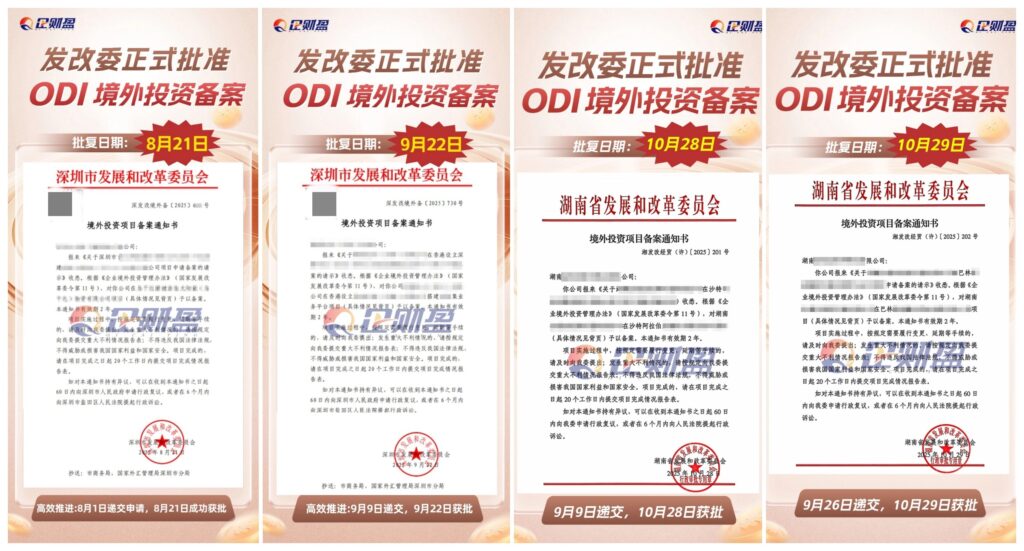
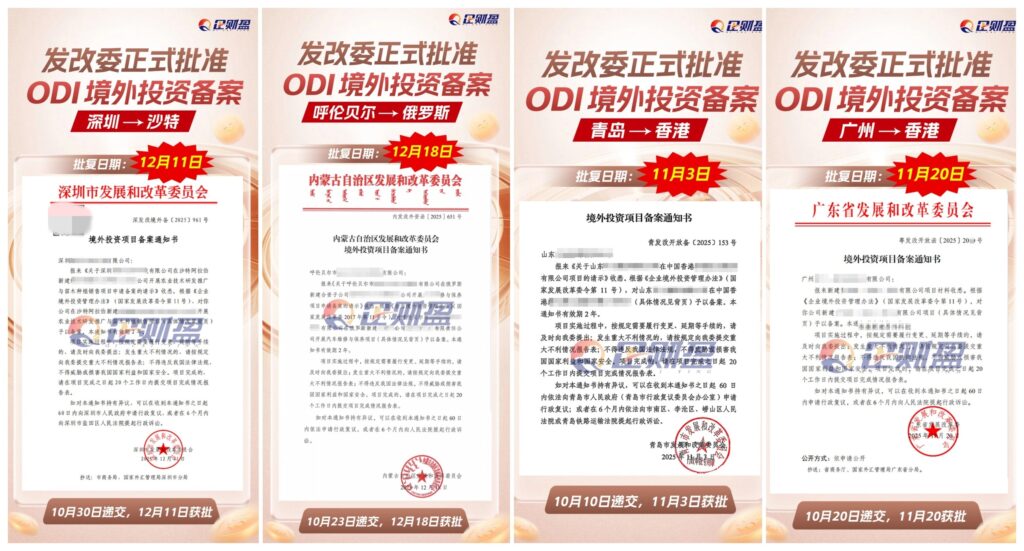
If you need professional cross-border compliance services, including ODI filing, Hong Kong company economic substance landing, accounting audit, tax planning, etc., welcome to add customer service WeChat: qcygscszk, or call the cell phone: 18676749275. our industry experts will be your one-on-one answer to help you comply with the operation of the line steady to the future. The following are some of the odi filing cases of enterprise financial surplus
VII. What to do? Four paths to help you comply and avoid risk
If you are still in one of the following states, it is recommended to act as soon as possible:
A Hong Kong company has only a secretarial address and no physical office space
Company has no employees, no business contracts and no bank flow records
Domestic company investing abroad without ODI filing
No compliant tax filing path for dividends, profit repatriation
You need to do it:
First, apply for ODI filing as soon as possible
ODI filing is the "passport" for the legal exit of funds and the compliant return of profits. Without this license, your offshore profits may never be able to return to the territory in a compliant manner.
Second, make up the economic substance of the Hong Kong company
Establishment of substantive business activities for Hong Kong companies in accordance with the "beneficial owner" determination requirement:
Lease a real office address, not just a secretarial address
Staffing of local professional employees commensurate with the size of the revenue base
Retain complete business contracts, bank flows, audit reports
Allow Hong Kong companies to truly participate in cross-border business management and bear the corresponding risks
Thirdly, good compliance maintenance of offshore companies
Ensure that company information, UBO (Ultimate Beneficiary) filing and tax declaration are complete. Hong Kong companies must have their accounts audited every year, whether they are operating or not.
Fourth, reorganize the structure and divest the shell subjects
For shell entities in the red chip structure that only undertake the function of profit transfer without any substantive operation, the structure should be gradually divested to simplify the tiers of cross-border shareholding, so as to avoid being recognized as "profit reversal" due to the multi-layered structure.
VIII. Compliance transformation: from "cost" to "competitiveness"
The lesson of Stranger's $550 million tells us that:Compliance is not a cost, non-compliance is.
The IRS doesn't care if you're a big company or a small seller, the three knives are already at your neck with the data-penetrating ability of Golden Tax IV, the global information exchange of CRS, and the tax-related information reporting of Amazon.
In the past, the tax authorities lacked strong enough incentives for collection and management on the one hand, and were constrained by insufficient data on the other, and most of the planning schemes at the formal level were under relatively lax supervision.
Now the situation has been completely reversed:
On the one hand, fiscal pressures continue to increase, and the collection and managementUnprecedented power.;
On the other hand, data support is fully in place - cross-sectoral information sharing, cross-border information exchange, and chain-wide data penetration - so that shell structures and conduit arrangements have nowhere to hide.
Future.Insubstantial, pure channel, pseudo-structureof tax risk that will only get higher and more costly.
For overseas enterprises, this regulatory upgrade is not simply an increase in tax costs, but also an opportunity for enterprises to realize compliant development. Only by abandoning the thinking of tax avoidance and relying on real business substance for structural design and cross-border operation can we avoid tax risks and realize long-term stable development of enterprises in the era of strict regulation.
The Stranger's back tax case will eventually become a landmark warning case in the history of cross-border tax regulation in China. It reminds all businesses:There are no shortcuts to tax compliance; business substance is fundamental.
Instead of waiting to get your hands dirty when you're being pursued, it's better to get the paperwork done and the filing done now.
Enterprise Caiying is deeply engaged in cross-border corporate services, has its own licensed secretarial company and accounting firm in Hong Kong, and is familiar with the whole process of ODI filing, Hong Kong company compliance maintenance, and economic substance landing business. We can provide you with one-stop services from risk identification, structure optimization to compliance program development. If you have any questions about Hong Kong company compliance, or want to do a comprehensive "health check" for your cross-border structure, please feel free to contact us.
If you need professional cross-border compliance services, including ODI filing, Hong Kong company economic substance landing, accounting audit, tax planning, etc., welcome to add customer service WeChat: qcygscszk, or call the cell phone: 18676749275. our industry experts will be your one-on-one answer to help you comply with the business, the line is stable and far.
Tags:
Tax Compliance
Hong Kong company
Recommended
Cross-border e-commerce B2B must see! Registered Hong Kong company stationed in the Ali International Station, really fragrant!
In today's globalized business environment, the cross-border e-commerce B2B model is rapidly emerging with its unique advantages. For many enterprises engaged in cross-border trade, choosing a suitable platform and registering an advantageous company are undoubtedly the key keys to open the door to the international market.
2024 Hong Kong Company Account Opening Tips! How to choose the right Hong Kong bank account?
Global anti-money laundering regulations are becoming more and more stringent, the banks to maintain an account of the sunk cost is getting higher and higher, not moving hundreds of millions of dollars in fines, so that the major banks to open an account threshold as well as the audit process high up, already have a Hong Kong company bosses, how to choose the Hong Kong bank to open a public account? How much does it cost and how to operate? Today to give you a detailed introduction to the Hong Kong company account how to choose, as well as the approximate costs required and other content.
Hong Kong company registration advantages + registration conditions + registration process to share!
If you want to start a business and develop overseas markets, registering a Hong Kong company is undoubtedly a very forward-looking choice. With its unique geographical location, sound legal system, low tax rate and open business environment, Hong Kong company has become a "sharp weapon" for many business owners to open up overseas markets. Why is it so important to register a Hong Kong company in 2024?