August 13: Hong Kong Banks Tighten Regulations—Online-Only Account Openings Shut Down. Can You Still Set Up a Hong Kong Company?
Published: August 21, 2026
On August 13, 2026, the Hong Kong Monetary Authority tightened requirements for banks’ compliance self-inspections. All online account-opening channels were shut down, leaving video verification and in-person interviews in Hong Kong as the only options. If your Hong Kong company is still using registered addresses in other people’s names or falsified bank statements to get through the process, the next step will be permanent placement on the rejection list.
Let’s start with the bad news. On August 13, the Hong Kong Association of Banks, in conjunction with the Hong Kong Monetary Authority, issued the latest compliance guidelines—all three channels—online account opening, document submission via app, and KYC via email—have been closed.
Starting today, there are only two ways to open a corporate bank account in Hong Kong: either fly to Hong Kong for an in-person interview, or undergo a video verification process in a designated city in mainland China, during which the director must appear on camera and have their ID and business premises verified on the spot.
💡 If you already own a Hong Kong company and are planning to secure platform funding in the second half of the year, add the Qicaiying customer service WeChat account: qcygscszk, or call 18676749275 to complete a 15-minute compliance self-assessment and get an early indication of your account opening prospects.
I. What Are the Three Key Issues Behind This Round of Tightening?
This isn’t a case of regulatory red tape; rather, it’s the combined effect of the next round of upgrades to the global Common Reporting Standard (CRS) in 2026 and the Hong Kong Monetary Authority’s (HKMA) strengthened customer due diligence (CDD) requirements, which are forcing banks to thoroughly verify whether you are a real person, a legitimate company, and actually conducting business. Three key areas are being strictly enforced:
First,The director must appear on camera personally.. The video verification isn’t just about showing your ID—it requires you to sit in front of the camera and answer business-related questions: where your goods come from, who you sell them to, and how funds are recovered. Questions are asked by AI and reviewed by a human; if you don’t pass, your application is rejected on the spot.
Second,Both addresses and both orders must be accurate.. A registered address in Hong Kong must be able to receive mail, and a mainland office address must be accessible via video call. Registered addresses for the sake of registration, shared offices, and nominal secretary services are now all on the gray list.
Third,The flow of funds must add up.. Contracts, invoices, shipping documents, and platform disbursement records—these four data streams must match. If any of them don’t match, the bank’s AI model will flag them in red, triggering manual risk control.
📌 If you break these three issues down, you’ll find that Hong Kong companies that previously relied on “affiliation” or “fictitious transaction records” to meet requirements now almost all need to resubmit documentation to restart the process. Add “Qi Cai Ying” on WeChat (qcygscszk), and we’ll send you a copy of the “Hong Kong Company Compliance Self-Check List.”
II. Two Real Challenges Faced by Sellers in Shenzhen
Over the past six months, we have spoken with 14 Shenzhen sellers whose visa applications were denied, and the reasons for denial were largely concentrated in two categories.
Category 1,Using an Individual Account as a Business Account. The business owner uses his personal Hong Kong bank account to receive payments from Amazon, TikTok Shop, and Shopee, then transfers the funds to an affiliated company in mainland China. In 2026, following cross-border data verification by banks, this type of account—100%—will be flagged as a suspicious transaction, resulting in restrictions on transfers at best and permanent account closure at worst.
The second category,Traces Left by Conveyor Belt Packaging. Making large one-time deposits or withdrawals, inflating transaction volumes, or linking accounts to others to create ”proof of performance”—these types of activities will leave permanent risk control records under the 2026 CRS data exchange. Even if you switch banks or change your business entity, AI models will still be able to identify them.
In plain English: The logic behind opening and maintaining an account has been reversed.In the past, we opened accounts first and then managed them; now, we ensure compliance before opening accounts.. If you're on the wrong path, the harder you try, the harder it gets.
III. Differences in the Review Processes of Three or Four Banks: How Should You Choose?
It’s not necessarily true that the bigger the bank, the better, nor that the smaller the bank, the more lenient it is. What matters is finding a bank that fits your business needs.
From a practical standpoint,Cross-border e-commerce businesses in Shenzhen, Foshan, and Dongguan have the highest success rate when using Huaqiao Yongheng....because this bank is familiar with business models in South China, has extensive experience in the region, and is less likely to make misjudgments. For companies with annual revenue exceeding 50 million that wish to conduct large-scale foreign exchange purchases and sales, HSBC remains the top choice, but you must allow at least four weeks to prepare the necessary documentation.
IV. From Now Until the End of the Year: A 4-Step Guide to Opening a Compliant Account
Step 1,Conduct a compliance review before deciding whether to open an account. Compile a list of the registered addresses, secretarial firms, business registrations, and annual review statuses of existing Hong Kong companies, and conduct a gap analysis against the account opening requirements of the four banks. Do not submit any documents yet.
Step 2,”Complete the ”Two Addresses, Two Invoices + Business Evidence Chain'". Prepare records for the “four flows”—contracts, invoices, logistics, and platform payments—covering a period of at least six months; rehearse the script in advance for the director to appear on camera and answer business-related questions; and replace the nominal secretary and registered address with compliant service providers by September.
Step 3,Off-Peak Preliminary Review. September is traditionally a busy season for banks, and December is the audit period, so try to avoid those months. October, November, and January of next year are periods when the review of materials is relatively less stringent.
Step 4,User Logic Preprocessing. Do not make any large-scale deposits or withdrawals within the first 30 days after the account is opened. Instead, start by making 3–5 normal transactions involving the return of goods payments and foreign exchange settlements and sales to give the AI model an initial impression of a ”clean account.”
V. Five Self-Checks: Can Be Completed Tonight
Can I receive bank correspondence at a Hong Kong registered address? Are secretarial companies merely service providers?
Can the director personally answer five business-related questions (where the goods come from, who they are sold to, and how the money is recovered) in Mandarin or Cantonese within 30 minutes?
Can you pull up and reconcile the contracts, invoices, shipping documents, and platform disbursement records from the past 6 months?
Are there any signs in your current Hong Kong accounts that personal and corporate accounts are being used interchangeably, that large sums are being temporarily deposited or withdrawn, or that transactions are being routed through accounts linked to other individuals to inflate transaction volumes?
Can the CRS, Certificate of Tax Residency (CoR), and Substantive Activity Report be prepared within two weeks?
If you are unsure about any one of the above:
→ Add Qicaiying Customer Service on WeChat qcygscszk, Get a free 15-minute compliance checkup + matching recommendations from four banks
→ Or call us directly 18676749275, Qicaiying Consulting’s One-on-One Breakdown
Qicaiying Group | Cross-Border E-Commerce Financial and Tax Compliance Service Provider
Specializing in end-to-end financial and tax compliance for cross-border e-commerce companies: compliance reviews of Hong Kong companies’ substantive operations; analysis and mapping of cross-border capital flows; compliance assessments of related-party transactions in multi-entity structures; CRS and tax residency planning; and pre-review and on-site assistance with bank account opening documentation.
Cell Phone:18676749275
WeChat:qcygscszk
Enterprise Finance Group
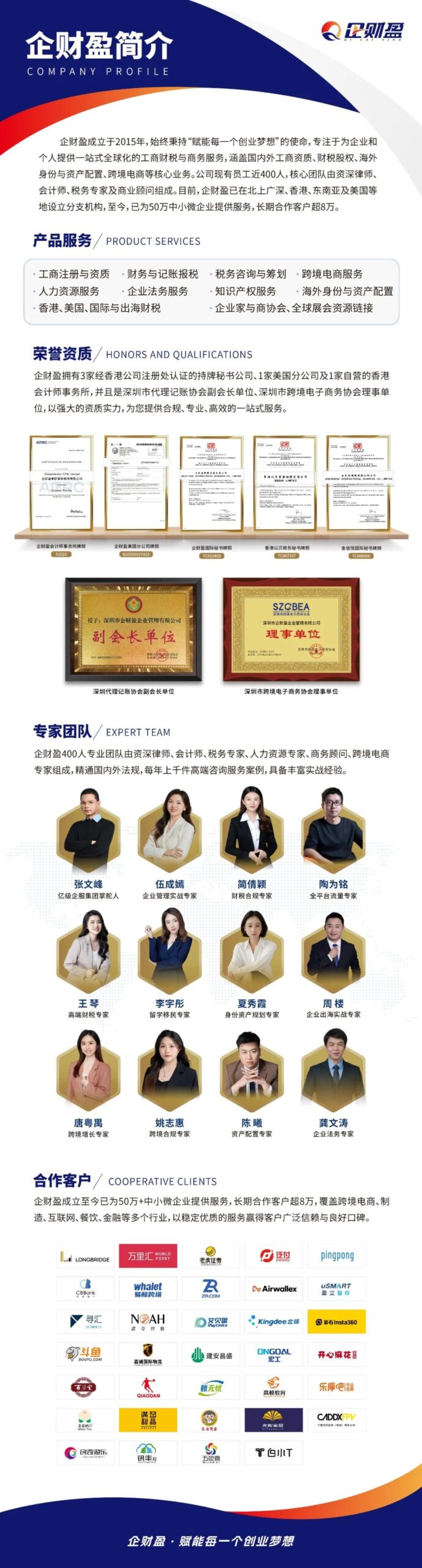
Founded in 2015 and headquartered in Shenzhen, Qicaiying Group is a leading provider of business services and tax and financial compliance services in China.
The Group has established a comprehensive portfolio of services covering the entire lifecycle of a business, including cross-border financial and tax compliance consulting, Hong Kong company registration and annual filing, assistance with opening bank accounts, ODI (Overseas Direct Investment) filing, 9810 export tax exemption filing, and identity planning consulting.
Over the past decade, Qicaiying has served more than 10,000 corporate clients, covering key cross-border e-commerce hubs such as Shenzhen, Guangzhou, Foshan, Dongguan, Ningbo, and Shanghai. It is the preferred compliance service partner for cross-border businesses in South China.
Tags:
Hong Kong Banks
Hong Kong Bank Account Opening
Recommended
Cross-border e-commerce B2B must see! Registered Hong Kong company stationed in the Ali International Station, really fragrant!
In today's globalized business environment, the cross-border e-commerce B2B model is rapidly emerging with its unique advantages. For many enterprises engaged in cross-border trade, choosing a suitable platform and registering an advantageous company are undoubtedly the key keys to open the door to the international market.
2024 Hong Kong Company Account Opening Tips! How to choose the right Hong Kong bank account?
Global anti-money laundering regulations are becoming more and more stringent, the banks to maintain an account of the sunk cost is getting higher and higher, not moving hundreds of millions of dollars in fines, so that the major banks to open an account threshold as well as the audit process high up, already have a Hong Kong company bosses, how to choose the Hong Kong bank to open a public account? How much does it cost and how to operate? Today to give you a detailed introduction to the Hong Kong company account how to choose, as well as the approximate costs required and other content.
Hong Kong company registration advantages + registration conditions + registration process to share!
If you want to start a business and develop overseas markets, registering a Hong Kong company is undoubtedly a very forward-looking choice. With its unique geographical location, sound legal system, low tax rate and open business environment, Hong Kong company has become a "sharp weapon" for many business owners to open up overseas markets. Why is it so important to register a Hong Kong company in 2024?