Weekly Cash Collections vs. Cash Collections Every 14 Days: The Difference in Cash Flow Is More Than Just Money
Published: August 19, 2026
A seller once said something to me that has stayed with me for a long time:
“I'm not worried about not getting orders; I'm worried about not getting paid after I place an order.”
He’s been selling on Amazon for two years, with monthly sales of around $80,000. The business looks good, but every time we talk, he complains about being broke. The reason is simple—all his money is tied up in the platform.
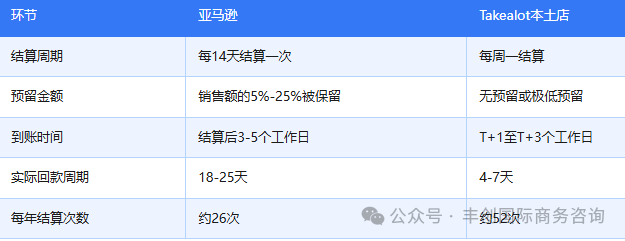
Amazon settles payments every 14 days, but when you factor in the held funds, it often takes more than 20 days for the money to actually reach your account. During those 20 days, you need to restock inventory, run ads, and pay suppliers. The money sits idle in the platform’s account, while your own account remains empty.
Later, he switched to a local Takealot store. Payments are settled every Monday, with funds arriving between T+1 and T+3. When he received his first payment, he posted on his Moments: ”Finally, I don’t have to wait 14 days anymore.”
Today, let's talk about:The speed of payment collection differs by a factor of two—what exactly is the difference?The——
I. Amazon’s Payment Schedule: 14 Days Is Only a Nominal Timeframe
First, let’s clarify exactly how Amazon’s payment process works.
Amazon's payment cycle is14 days. However, ”14-day settlement” does not mean ”funds are received within 14 days.”
Here's how the process actually works:
On the settlement date, the system calculates your sales for the past 14 days.
After deducting platform commissions, FBA fees, advertising costs, refunds, etc.
After deducting the reserved amount—Amazon retains a portion of the proceeds as a ”returns/refund deposit,” typically ranging from 5% to 25% of the sales amount—
The remaining amount will then be transferred to your bank account
Bank processing time: 1–3 business days
So, from the time a product is sold until the payment is received, the actual timeframe is often18–25 days. If you're a new seller,Higher reservation ratio, longer processing timeThe
The payment cycle was nearlythreefold. This isn't just a matter of ”waiting a few days”; it'sCapital Utilization EfficiencyThe fundamental difference. ——
II. With a monthly turnover of 100,000, how much capital is tied up?
Let's calculate this using a real-life scenario.
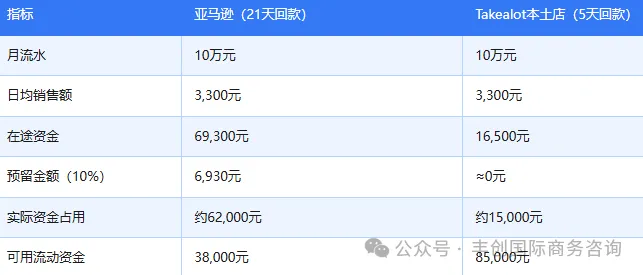
Let's say your monthly revenue is 100,000 RMB (approximately $14,000), with an average daily sales figure of about 3,300 RMB.
1. On Amazon (21-day payment cycle):
Here is the status of your funds in transit: The 3,300 yuan you sell each day will take 21 days to be credited to your account. Total funds in transit over 21 days = 3,300 × 21 = 69,300 yuan.
After deducting the reserved amount (assuming 101 TP 3T), the actual funds tied up are approximately62,000 yuanThe
In other words, you have 60,000 yuan just sitting in your Amazon account, unable to use it. That 60,000 yuan could be the funds for your next batch of inventory, your advertising budget, or the money you need to pay your employees.
2. On Takealot's local store (payment cycle: 5 days):
Assuming the same average daily sales of 3,300 yuan, funds are received in 5 days. Funds in transit = 3,300 × 5 = 16,500 yuan.
No reserves or very low reserves; the actual funds tied up amount to approximately15,000 yuanThe
With the same monthly revenue, 62,000 is tied up under the Amazon model, while only 15,000 is tied up under the Takealot model. This results in a difference of 47,000 yuan in your available working capital.
What can you do with 47,000 yuan?Being able to stock up on more inventory, run ads for an extra week, or launch one more SKUThe
(Contact +csdrcc12345)
——
III. Working Capital Efficiency: Doing Twice as Much Business with the Same Principal
The impact of payment collection speed isn’t just about ”how much money” but rather ”how many times the money can circulate.”
Let’s illustrate this with a simple model:
Suppose you have 100,000 in principal, with a gross profit margin of 30% and a take-profit level of 3T.
The Amazon Model (21-Day Payment Cycle):
Day 1: Purchase 100,000 in inventory and list items for sale
Day 21: Payment received; recovered 130,000 (100,000 in costs + 30,000 in gross profit)
Day 22: Restocked with 130,000
Day 42: Recovered 169,000
Day 63: Recovered 220,000
Number of cycles per year (365 days): approximately 17
Year-End Balance: 100,000 × (1.3)¹⁷ ≈ 517,000
Takealot Model (5-Day Payment Cycle):
Day 1: Purchase 100,000 in inventory and list items for sale
Day 5: Payment received; 130,000 recovered
Day 6: Restock with 130,000
Day 10: Recovered 169,000
Number of rotations per year (365 days): approximately 73
Year-End Funds: 100,000 × (1.3)⁷³ ≈ Cannot be calculated (exponential growth; actually limited by inventory and sales volume)
Of course, in actual operations, it’s impossible to achieve the theoretical turnover efficiency—it takes time to stock inventory, logistics have time constraints, and sales have a ceiling. But the core logic holds true:Cash flow is four times faster, capital turnover is four times more efficient, and the same amount of capital can leverage a much larger business scale.The
What does this mean for small and medium-sized sellers?
This means you don't need 5 million to do 5 million in business.
If you have 500,000, on a platform with fast payment cycles, you could generate an annual GMV of 2 million through efficient cash flow management. On a platform with slow payment cycles, however, 500,000 might only generate 800,000. ——
IV. Who Needs to Pay the Most Attention to Payment Collection Speed?
Category 1: Small and medium-sized sellers who use cash flow from sales to fund their inventory on a rolling basis.
Your business model is ”sell a batch → receive payment → use the proceeds to purchase the next batch.” The speed at which you receive payment directly determines how large your business can grow. A 14-day payment cycle means you can only restock once every 14 days, while a weekly payment cycle means you can restock every week—the difference in restocking frequency is twofold, the difference in inventory turnover is twofold, and the risk of stockouts is twofold.
Category 2: Sellers operating across multiple platforms.
If you’re selling on both Amazon and Takealot, Takealot’s fast cash flow can ”feed back into” your Amazon operations—use the weekly payments from Takealot to restock Amazon inventory, and leverage Amazon’s traffic to move SKUs that aren’t selling well on Takealot. The cash flows from the two platforms complement each other, maximizing overall capital efficiency.
Category 3: Sellers with supply chain advantages but limited funds.
You have great products and competitive pricing, but you don’t have enough capital to stock too many SKUs. On platforms with fast cash flow, you can quickly turn over inventory with minimal capital and focus your limited resources where they matter most. You don’t have to wait 14 days to restock—you can complete the entire cycle of ”purchasing → selling → receiving payment → restocking” in just one week.
(Contact +csdrcc12345)
——
V. Fast Payment Collection Isn’t Just About Money—It’s About Mindset
Finally, here’s something that’s hard to quantify but very real:MindsetThe
Every Amazon seller knows this feeling—those two weeks of waiting for payment are the most nerve-wracking. Ads are running, inventory is dwindling, and suppliers are demanding payment, but the money just won’t show up in your account. Every day, you log into your dashboard to check your ”Available Balance”—the number is going up, but you just can’t click ”Disburse.”
This anxiety can affect your decision-making.. When it's time to restock, they hesitate—”Let's wait until the payment comes in”; when it's time to increase the advertising budget, they hesitate—”Let's hold off until the money comes back”; when it's time to expand the SKU lineup, they hesitate—”We don't have enough funds, so let's wait a little longer.”
Every time you say, ”Let’s wait a little longer,” you’re missing out on an opportunity.
What’s it like to receive payments once a week? On Monday morning, you log into your dashboard and see the funds have been deposited. You can restock when needed, run ads when necessary, and expand your SKUs as required. No more waiting, no more anxiety—decision-making is streamlined, and you can act faster.
The biggest fear in e-commerce isn't losing money—it's“Wait”. By the time that window of opportunity you were waiting for passes, your competitors will have already taken the spot. ——
VI. Our Own Experiences
We're selling on both Amazon and Takealot at the same time. To be honest,Takealot’s fast payment processing was one of the first things that made us realize, ”This platform is different.”The
The first time I received a payment from Takealot, it took just two days from last week’s sales to Monday’s deposit. That feeling was—the money’s back, so I can keep fighting. It’s not like Amazon, where the money just sits in your account and you can’t get it out.
Later, we helped many sellers set up local stores, and this was the most common feedback we received from them:“When cash flow picks up, you gain the confidence to stock up on inventory, and business really takes off.”
Cash flow is the lifeblood of e-commerce.
Many sellers don't go out of business because they aren't making sales; they go out of business because they can't collect payment.
If you’d like to learn about Takealot’s payment processing procedures and requirements for joining as a seller, feel free to reach out to us anytime. Since we handle payments on this platform every day, the information we provide is more practical than any guide out there. (Contact us at +csdrcc12345)
Tags:
Take-A-Lot stores in South Africa
South Africa takealot
Local Stores in South Africa
Takealot Local Store
Recommended
Cross-border e-commerce B2B must see! Registered Hong Kong company stationed in the Ali International Station, really fragrant!
In today's globalized business environment, the cross-border e-commerce B2B model is rapidly emerging with its unique advantages. For many enterprises engaged in cross-border trade, choosing a suitable platform and registering an advantageous company are undoubtedly the key keys to open the door to the international market.
2024 Hong Kong Company Account Opening Tips! How to choose the right Hong Kong bank account?
Global anti-money laundering regulations are becoming more and more stringent, the banks to maintain an account of the sunk cost is getting higher and higher, not moving hundreds of millions of dollars in fines, so that the major banks to open an account threshold as well as the audit process high up, already have a Hong Kong company bosses, how to choose the Hong Kong bank to open a public account? How much does it cost and how to operate? Today to give you a detailed introduction to the Hong Kong company account how to choose, as well as the approximate costs required and other content.
Hong Kong company registration advantages + registration conditions + registration process to share!
If you want to start a business and develop overseas markets, registering a Hong Kong company is undoubtedly a very forward-looking choice. With its unique geographical location, sound legal system, low tax rate and open business environment, Hong Kong company has become a "sharp weapon" for many business owners to open up overseas markets. Why is it so important to register a Hong Kong company in 2024?