The Second Half of 2026: Amazon Doubles Its Advertising Budget, Temu Snatches Traffic—Where Is the Third Path for Chinese Sellers?
Published: July 29, 2026
In recent years, the e-commerce markets in Europe and the United States have gradually become saturated:Amazon sellers are caught in a vicious cycle of soaring advertising costs, while Temu is squeezing the profit margins of cross-border sellers to the absolute limit with its ultra-low prices.As competition in mature markets intensifies, where exactly can new growth be found? The answer lies in Africa—more specifically, South Africa. South Africa is Africa’s largest and most mature digital economy, with rapidly growing internet penetration, a young population, and a middle class accounting for nearly 35%,The demand is real, but there is a severe shortage of supply from Chinese sellers.
As South Africa’s largest domestic e-commerce platform, Takealot plays a pivotal role: with a market share exceeding 50% in 2025 and over 21 million monthly visitors, and it was the top choice among 61% of South African online shoppers during the Christmas season, far surpassing SHEIN (29%) and Temu (19%).
Backed by capital from Naspers/Prosus, the platform boasts some of the highest levels of stability and fulfillment capability in Africa—making it an essential hub for any seller looking to expand into the African market.
However, for Chinese sellers new to the South African market, Takealot’s complex store types can often be confusing. The three models—”Cross-Border Direct Shipping Stores,” ”Cross-Border Official Warehouses,” and ”Local Stores”—differ significantly in terms of entry requirements, shipping times, platform traffic, operating costs, and compliance requirements. Choosing the right one pays off, but choosing the wrong one can be a pitfall.
Today, Qicaiying will explain this once and for all—why ”the third path” isTakealot, a local South African retailerTheIf this is helpful to you, don’t forget to bookmark and share it.
01First, some background: The old road is visibly getting narrower.
Take a look at some hard data from 2025:
The CPC for Amazon’s core high-volume keywords will rise from $0.75–$1 in 2020 to $1.50–$2.50 in 2025. To maintain the same level of exposure, you’ll need to increase your daily budget from $50 to over $80;
That same year, the number of new seller registrations on Amazon plummeted by 44% year-over-year, falling to 165,000—a new record low (Marketplace Pulse).
Many sellers find themselves caught in a cycle where "without ads, they get no orders, and with ads, they make no profit."
Meanwhile, Temu has grown its global cross-border market share from less than 1% to 24% in just three years, directly catching up to Amazon. However, the logic behind the low-price segment is “sacrificing profit for scale”—the good old days of simply stocking products for cross-border sales are essentially over.
While everyone is crammed into North America and Europe, locked in a fierce battle on low-cost platforms,The real growth is actually in Africa.The strategy is also very clear:Using "a local South African company + a local Takealot store"Secure preferential traffic from the platform, then choose a ”blue ocean” category to avoid intense competition—with the same products and the same operations, you’ll already have a head start. Below, we’ll break down the “local store” market for you from top to bottom.
.
02Takealot in South Africa: A Severely Underrated Blue Ocean
Takealot is the undisputed leader in South Africa, backed by capital from Naspers and Prosus. The platform’s stability and fulfillment capabilities rank among the best in Africa, and it naturally enjoys a high level of buyer trust—something that other emerging platforms will find difficult to replicate in the short term.
More importantly, it’s all about competition. There are fewer than 3,000 Chinese sellers on Takealot, accounting for less than 3% of the total. This means that once you enter the market, you’ll rarely face “price undercutting by fellow countrymen”—with the same level of operational expertise, you might only rank in the middle of the pack in North America, but in South Africa, you’ll likely shoot straight to the top.
-The platform's overall return rate is only 1%–2.5% (compared to double-digit rates common in Europe and the U.S.), which significantly reduces the pressure on after-sales service. -Commission: 4%–15%; no deposit required; monthly fee of approximately R300 (≈$18); extremely seller-friendly for small and medium-sized sellers -Local stores benefit from platform traffic prioritization, and new stores also have opportunities for consistent visibility. -Middle-class families prioritize value for money rather than extreme price comparisons, which aligns perfectly with the strengths of China’s supply chain. -Investment promotion efforts in China began in September 2025; the window of opportunity is still open, and early entrants will reap the first wave of benefits.
What's the safest thing to sell on Takealot?
The demographics of South African buyers determine the product selection strategy: middle-class families are the main customer base, and they prefer products that are “practical, attractive, and not too expensive.” Based on the platform’s bestsellers and the practical experience of cross-border sellers, the following categories offer the most stable returns: -3C Digital Accessories (Charging, Audio, Car Accessories): Standardized, Low After-Sales Service Needs, High Repeat Purchase Rate -Home Storage and Small Appliances: Essential for Middle-Class Households, with Attractive Average Order Values -Beauty, Personal Care, and Wigs & Hair Extensions: Strong Demand in South Africa, Significant Room for Price Premiums -Outdoor and Sports Gear: Pleasant climate, plenty of outdoor activities, and minimal seasonal variation
In a nutshell: Choose “Products that are accessible to the South African middle class, leverage domestic supply chain advantages, and are not oversized"… has the highest success rate."
Why does it have to be a "local South African store"?
You can also test the waters by directly shipping products to South Africa, but there are clear limitations: long shipping times, low buyer trust in “overseas sellers,” and complications with payment collection and after-sales service.
When a South African-based retail business (Pty Ltd) joins the platform, it receives higher exposure weighting, buyers place greater trust in “local merchants,” and payment settlements through local accounts proceed more smoothly. The difference isn’t in effort, but in status—once you take this step, your starting point is completely different.
What are the barriers to entry for opening a South African-based store?
The Three Essential Items:
① South African company (Private Company, Pty Ltd);
② South African Income Tax Number;
③ A local South African bank account for receiving payments.
It sounds complicated, but as long as you have all the necessary documents and find the right local service provider—...The process of registering a company and obtaining a tax ID number usually takes just a few weeks.
Our Qicaiying team has an office in Johannesburg, South AfricaFull-Service Tax and Accounting Firm, Provided by:
Company Registration (CIPC)
Registered Address (Business Address, Mail Receiving)
FNB Video Interview (Card Sent Directly to the Customer)
Official Assistance for Joining Takealot
No domestic business license required, no transaction history from other platforms required—all you need is a Chinese passport.
120 Days to Make This Approach Work
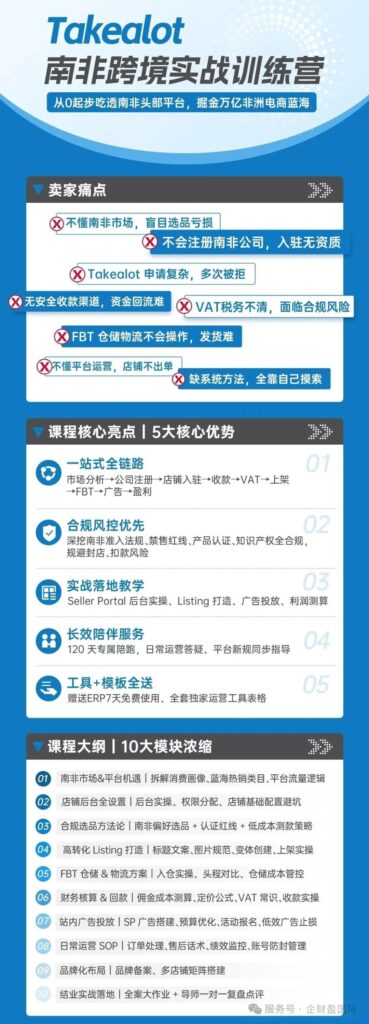
The process is actually quite straightforward: Register a South African Pty Ltd → Apply for a tax ID → Set up a local store on Takealot → List products → Receive operational support. Our one-stop service guides you through this entire process from scratch until you start making sales. Most clients receive their first order within 90 days and achieve a steady sales rhythm within 120 days.
Currently, Take-A-Lot in South Africa operates on an invitation-only basis for Chinese sellers. If you’d like to learn more, feel free to scan the QR code to add our online customer service representative at any time.(Micro-signal: jxhqcy890 / Mobile: 16625410105)We will arrange professional managers to answer your questions and provide professional advice andFull one-on-one service ↓↓↓
Our Services and Advantages
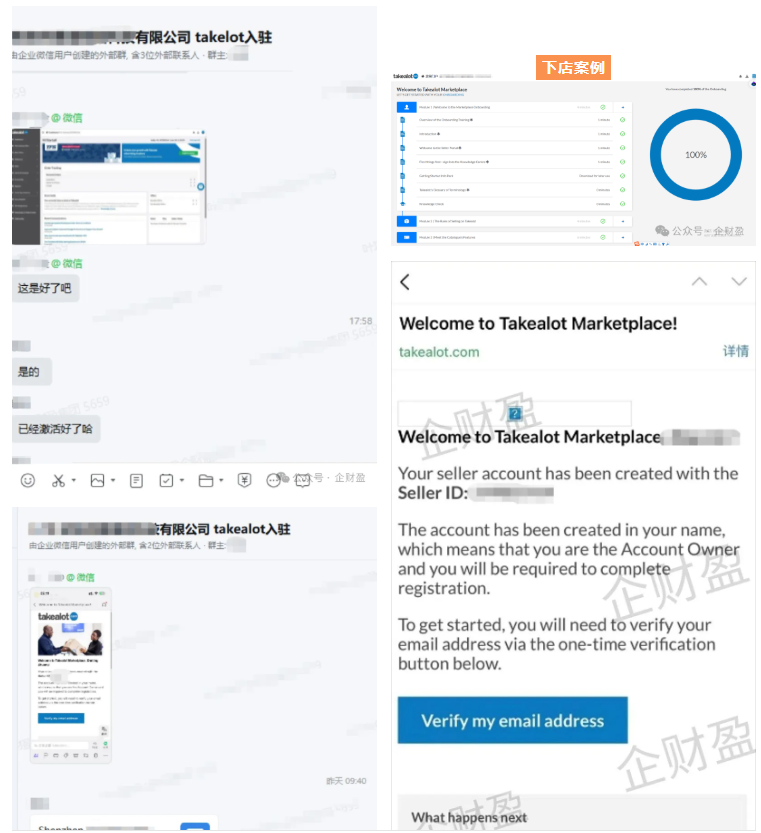
Official Channel, Guaranteed Downstore.Takealot is currently limited to official service providers on board, self-registration can not be passed. We, as a cooperative service provider, have a pass rate of >95% and 7 days of extremely fast store.
One-stop service, save your energy.From qualification audit, store registration, XT account opening to operation guidance, the whole process is handled on behalf of the customer, without the need to research on their own.
Professional team, full accompaniment.Provide 1 to 1 exclusive customer service to solve the problems of enrollment, activation, payback, etc., to avoid account risk.
Security of funds, low rates of return.With XTransfer collection, the rate is as low as 3%, no risk of freezing, support for compliant foreign exchange settlement, and fast flow of funds.
Operational Enablement for Quick Starts:Complimentary "Takealot Operation Practical Manual", including the whole chain guide of product selection, shelving, advertising and logistics.
📌 For more information Takealot's latest on-boarding policy, South African tax compliance program, FX repatriation routes, Feel free to scan the QR code to add our online customer service representative (WeChat ID:jxhqcy890 / Mobile: 16625410105), where a professional manager will answer your questions and provide one-on-one service throughout the entire process ↓↓↓
Tags:
Takealot Operations
Takealot Platform
A New Blue Ocean in Cross-Border E-Commerce
Takealot inbound
Takealot, South Africa
Amazonian
cross-border e-commerce
Recommended
Cross-border e-commerce B2B must see! Registered Hong Kong company stationed in the Ali International Station, really fragrant!
In today's globalized business environment, the cross-border e-commerce B2B model is rapidly emerging with its unique advantages. For many enterprises engaged in cross-border trade, choosing a suitable platform and registering an advantageous company are undoubtedly the key keys to open the door to the international market.
2024 Hong Kong Company Account Opening Tips! How to choose the right Hong Kong bank account?
Global anti-money laundering regulations are becoming more and more stringent, the banks to maintain an account of the sunk cost is getting higher and higher, not moving hundreds of millions of dollars in fines, so that the major banks to open an account threshold as well as the audit process high up, already have a Hong Kong company bosses, how to choose the Hong Kong bank to open a public account? How much does it cost and how to operate? Today to give you a detailed introduction to the Hong Kong company account how to choose, as well as the approximate costs required and other content.
Hong Kong company registration advantages + registration conditions + registration process to share!
If you want to start a business and develop overseas markets, registering a Hong Kong company is undoubtedly a very forward-looking choice. With its unique geographical location, sound legal system, low tax rate and open business environment, Hong Kong company has become a "sharp weapon" for many business owners to open up overseas markets. Why is it so important to register a Hong Kong company in 2024?