Are Hong Kong Bank Accounts Still Safe Under CRS 2.0? The Real Concern Isn’t Information Exchange, but Reporting Discrepancies—the CoR Tax Residency Certificate Is Key
Published: July 23, 2026
For many people with Hong Kong bank accounts, the term “CRS” (Common Reporting Standard) has become a source of great fear. CRS 2.0—the latest framework for the automatic exchange of information—has indeed led to a more extensive global sharing of tax information, but you may be mistaken about where the real risks lie.
💡 Not sure if your Hong Kong account is at risk under CRS 2.0? Add WeChat ID qcygscszk or call 18676749275, and send [CRS Assessment] to receive a free one-on-one risk assessment.
What exactly is “exchanged” under the CRS?
The core mechanism of the CRS is simple: information about your Hong Kong bank accounts (account balances, interest income, dividend income, etc.) will be automatically exchanged by the Hong Kong Inland Revenue Department with the tax authorities in your country of tax residence—that is, the Chinese tax authorities.
Many people focus on the fact that “information is being exchanged,” but in reality, what you should really be concerned about isn’t “whether information is being exchanged,” but rather “whether the exchanged information matches what you’ve reported yourself.” If the information in your Hong Kong account fully matches what you’ve reported to the mainland tax authorities, the CRS exchange will have virtually no negative impact on you.
The problem lies in the “discrepancy”—you reported an income of 1 million yuan in mainland China, but your Hong Kong account shows that you have 5 million Hong Kong dollars in assets and income. This is the root cause of the tax audit.
What should we really be worried about?
It’s not that “information was exchanged,” but rather that “you failed to file a compliant return.” A common mistake made by many Hong Kong account holders is assuming that income earned in Hong Kong has no connection to the mainland. This is a serious misconception. Under China’s Individual Income Tax Law, Chinese tax residents are required to report and pay taxes on their worldwide income to Chinese tax authorities—this is not a new obligation “created” by the CRS, but rather your inherent legal obligation.
CRS simply makes it technically possible to fulfill this “inherent legal obligation.” In the past, you might have harboured the false hope that “it wouldn’t be detected,” but now automatic cross-checking is technically feasible. So the question comes back to the most fundamental point: Are you filing your cross-border tax returns in compliance with the law?
CoR Tax Residency Certificate: Preventing Unnecessary Information Exchange
If your Hong Kong company is indeed conducting substantive operations in Hong Kong, then its “tax residency” should be Hong Kong, not mainland China. In this case, you can apply for a Certificate of Residence (CoR) issued by the Hong Kong Inland Revenue Department to clearly “anchor” the company’s tax residency in Hong Kong.
The purpose of a CoR is not to “evade taxes,” but to “avoid double taxation” and “clarify tax jurisdiction.” If your Hong Kong company has already paid taxes in accordance with Hong Kong’s profits tax regulations, then that portion of income should not be taxed again in mainland China—this is the fundamental principle of tax treaties. The CoR is precisely the legal document that helps you prove that “this company has already paid taxes in Hong Kong.”
Many business owners are still unaware of the CoR, or assume it’s something “only large companies need.” However, under the CRS 2.0 framework, the value of the CoR to small and medium-sized Hong Kong companies is rapidly increasing—it gives you an opportunity to “set the record straight.”
The Underlying Logic Behind the Response to CRS
It’s not about “hiding”—because you can’t hide anything. It’s about “disclosing”—clearly disclosing your sources of income and tax compliance in a manner that adheres to regulations. Key steps include: completing the Hong Kong company’s annual audit and profits tax return on time; ensuring every transaction in the company’s accounts is properly documented; applying for a Certificate of Residence (CoR) if the company operates substantively in Hong Kong; and consulting with professional tax advisors to develop a comprehensive cross-border tax planning strategy.
📞 Need a comprehensive CRS compliance solution? Contact Qicaiying for one-on-one tax planning. Simply send 【CRS Solution】 via WeChat to qcygscszk.
Why choose Enterprise Caiying
What Can We Do for You—
✔️ Hong Kong Company Registration: Full-service agency, registered office address, and a valid business address for bank KYC verification—not a virtual address
✔️ Fast-Track Bank Account Opening: We have established "whitelist" partnerships with banks such as HSBC, Overseas-Chinese Banking Corporation, Hang Seng, and Dah Sing, and pre-screen documents to increase the success rate of account openings.
✔️ One-stop, end-to-end support: From company registration to opening a bank account, annual reviews, bookkeeping, and audits—a dedicated representative will handle everything for you, so you don’t have to go through the process yourself.
✔️ Cross-border Tax Planning: Hong Kong Certificate of Residence (CoR) and CRS compliance strategies to help you prevent unnecessary exchange of tax information
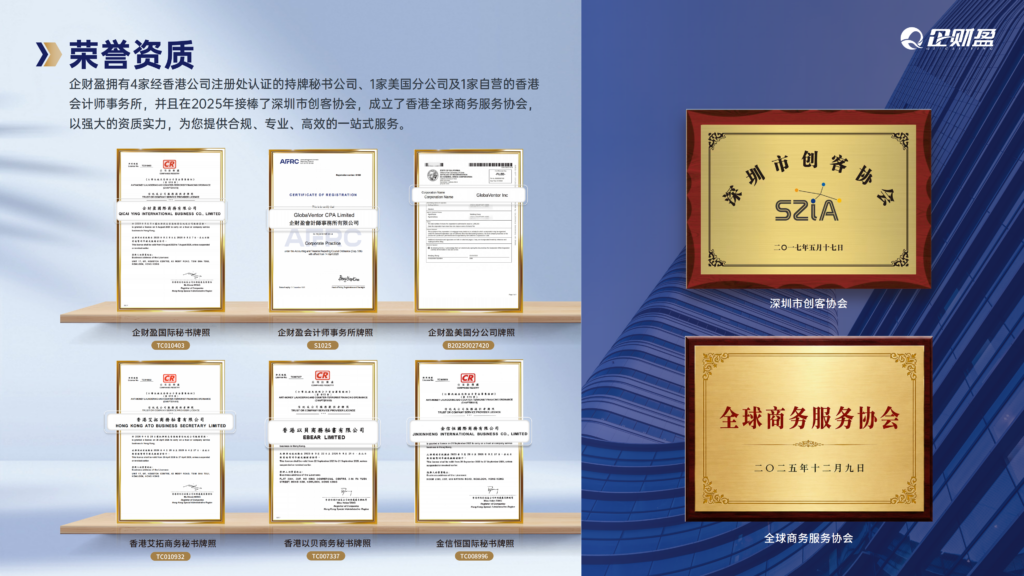
✔️ Local on-the-ground team in Hong Kong: 3 licensed secretarial firms + 1 in-house Hong Kong accounting firm; government correspondence and bank verifications are handled locally; bookkeeping and auditing are not outsourced
Why You Can Trust Us—
✔️ Hong Kong Licensing Qualifications: Three licensed secretarial firms certified by the Hong Kong Companies Registry—not ordinary agencies—that possess the qualifications of a statutory secretary
✔️ In-house accounting firms: 1 self-operated Hong Kong accounting firm + a Greater Bay Area accounting firm; audit reports are not outsourced
✔️ Endorsed by industry associations: Vice President of the Shenzhen Bookkeeping Services Association; Board Member of the Shenzhen Cross-Border E-Commerce Association
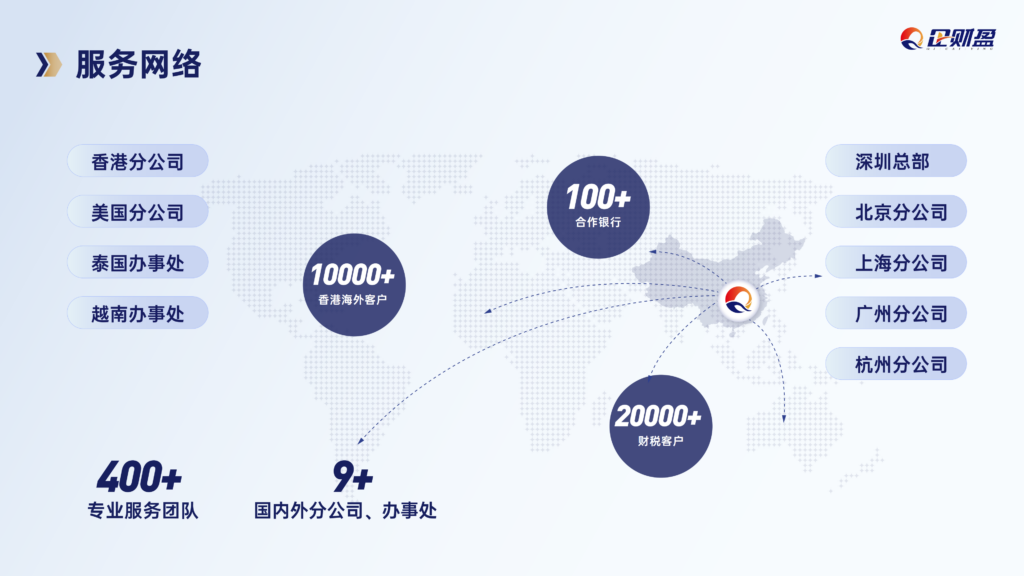
✔️ Founded in 2015, we have served over 500,000 small, medium, and micro enterprises with a team of over 400 professionals, including lawyers, CPAs, tax consultants, and cross-border compliance experts. Our core team members have an average of 8–15 years of industry experience.
✔️ Global Presence: Headquartered in Shenzhen, with branches in Beijing, Shanghai, Guangzhou, Hangzhou, Hong Kong, Southeast Asia, and the United States
If you're considering registering a company or opening a bank account in Hong Kong, feel free to reach out to us—
Tags:
CRS 2.0
CRS Information Exchange
COR
Hong Kong Bank Accounts
Recommended
Cross-border e-commerce B2B must see! Registered Hong Kong company stationed in the Ali International Station, really fragrant!
In today's globalized business environment, the cross-border e-commerce B2B model is rapidly emerging with its unique advantages. For many enterprises engaged in cross-border trade, choosing a suitable platform and registering an advantageous company are undoubtedly the key keys to open the door to the international market.
2024 Hong Kong Company Account Opening Tips! How to choose the right Hong Kong bank account?
Global anti-money laundering regulations are becoming more and more stringent, the banks to maintain an account of the sunk cost is getting higher and higher, not moving hundreds of millions of dollars in fines, so that the major banks to open an account threshold as well as the audit process high up, already have a Hong Kong company bosses, how to choose the Hong Kong bank to open a public account? How much does it cost and how to operate? Today to give you a detailed introduction to the Hong Kong company account how to choose, as well as the approximate costs required and other content.
Hong Kong company registration advantages + registration conditions + registration process to share!
If you want to start a business and develop overseas markets, registering a Hong Kong company is undoubtedly a very forward-looking choice. With its unique geographical location, sound legal system, low tax rate and open business environment, Hong Kong company has become a "sharp weapon" for many business owners to open up overseas markets. Why is it so important to register a Hong Kong company in 2024?