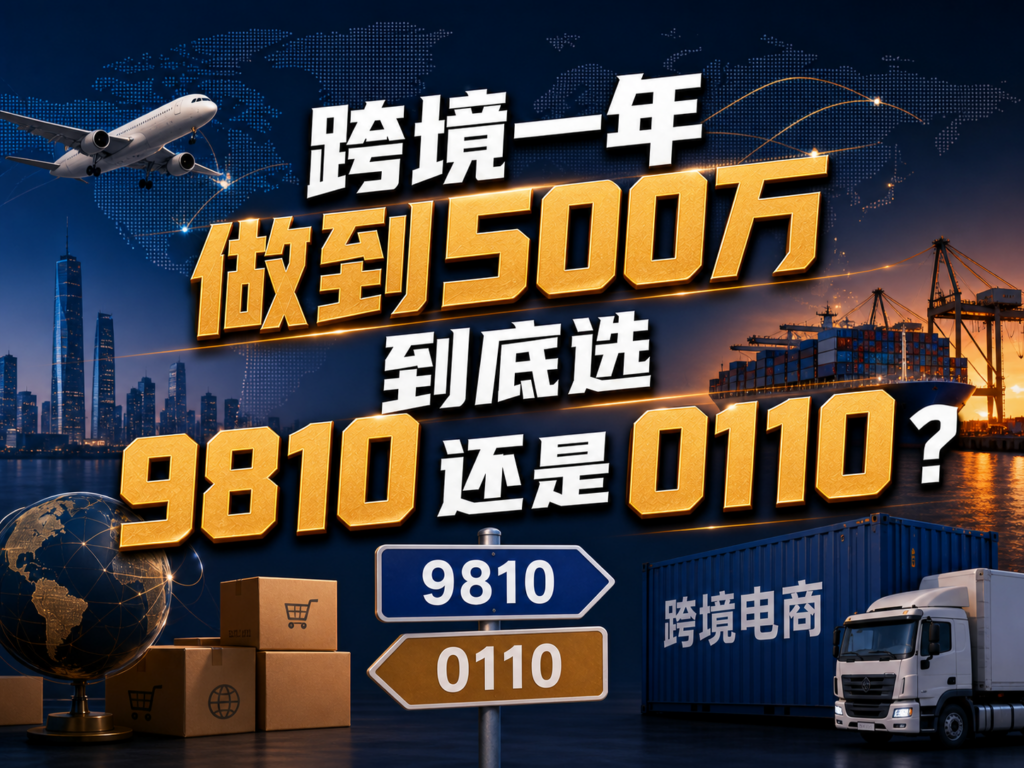
How to Reach 5 Million in Cross-Border Sales in One Year: Should You Choose the 9810 or the 0110?
Published: July 14, 2026
As the cross-border e-commerce sector continues to expand, more and more sellers are beginning to focus on a key issue:
Once a company reaches a certain size, should it choose the 9810 model or the 0110 model?
Many business owners believe that export models are merely different customs clearance procedures, but in reality, each model corresponds to distinct business scenarios, tax treatment methods, and corporate development strategies.
If you choose a model that isn't right for your business, it could increase operating costs down the line and even impact your company's profit margins.
To receive information + quotation, please contact me (WeChat/telephone inquiry: 1304348584).
I. The 9810 Model: Better Suited for Sellers Who Stock Overseas Warehouses 📦
The 9810 model, whose full name is “Cross-Border E-Commerce Export to Overseas Warehouses,” operates on the following core principle: Domestic companies first export their goods to overseas warehouses and then fulfill sales based on orders from overseas consumers.
In a nutshell:
Domestic Procurement and Stocking
⬇️
9810 Export Customs Declaration
⬇️
Ship to an overseas warehouse for storage
⬇️
Orders Placed by Overseas Consumers
The greatest advantage of this model is:
✅ Better suited to the overseas warehouse stocking model
✅ The export process is relatively flexible
✅ Suitable for certain cross-border B2C sellers looking to set up overseas warehouses
For those just starting out in cross-border e-commerce, or currently:
1. There are relatively few stores
2. Sales volume is not large
3. Primarily targets consumer-facing customers
For sellers like this, the 9810 is a good choice.
II. However, as the company expands, 9810 will also face new challenges⚠️
As a company's sales volume continues to grow—especially after it becomes a general taxpayer—problems may gradually emerge.
Example:
📌 How should procurement costs be handled?
📌 How do you match input invoices?
📌 How do we map overseas sales data?
📌 How should future financial accounting be standardized?
In particular, sellers who operate across multiple platforms and stores will face significantly increased management pressure later on if they do not plan their business workflow in advance.
Therefore, 9810 is not the only option for the long-term development of all cross-border businesses.
III. The 0110 Model: Why Are More and More Experienced Sellers Taking Notice? 🌏
0110 falls under the general trade export model. Its key advantage is that eligible enterprises can apply for export tax rebates in accordance with the general trade export procedures.
For companies with the following characteristics:
✅ Has a stable supply chain
✅ Facing procurement cost pressures
✅ Large sales volume
✅ We hope to further increase our profit margins
The 0110 model may be better suited to long-term development needs.
This is because following standardized export procedures allows you to:
1. Reduce the tax burden on the procurement side
2. Optimize the company’s cost structure
3. Increase Overall Profit Margins
For cross-border businesses that have already reached the stage of large-scale operations, it is often worth planning for 0110 in advance.
IV. 9810 or 0110—which one should you choose? 🤔
① B2B foreign trade companies
If your customers are primarily:
✅ Overseas Companies
✅ Bulk Purchases.
⚠️ We strongly recommend giving priority to the 0110 mode.
② Small-scale B2C sellers
If your situation is:
✅ There are relatively few stores
✅ Limited sales volume
✅ We recommend using the overseas warehouse model.
You might want to consider the 9810 mode.
⚠️However, please note: Compliance management must be properly maintained for the exporting entity, customs declaration documents, and sales data.
③ Retail sellers operating multiple stores
If you are currently:
✅ There are multiple platforms
✅ Managing Multiple Stores
✅ Sales volume continues to grow
⚠️Especially for sellers who stock their own inventory: We recommend planning ahead for the 0110 export consolidation model.
By consolidating export operations under a single entity, we can manage business operations, finances, and tax matters holistically, thereby reducing operational complexity in the long run.
V. Once cross-border expansion reaches a certain stage, the choice is no longer limited to export models
There is no absolute "good" or "bad" when it comes to 9810 and 0110; it all depends on: ⚠️ the scale of your business, your customer base, your supply chain model, and your future direction.
During the small-scale phase, the focus is on flexible operations;
Now that the scale has expanded, what’s even more important is:
✅ Compliance with Regulations
✅ Cost Optimization
✅ Tax Planning
✅ Long-term development capabilities
Choosing the right model early on is the key to ensuring your business stays on a stable course.
If you're involved in cross-border e-commerce:
1. Annual sales have reached approximately 5 million.
2. Multi-platform, multi-store operations
3. Currently planning to set up overseas warehouses or expand the brand into international markets
4. I'm not sure if I'm better suited for 9810 or 0110
Feel free to scan the QR code below (you can contact us via WeChat or phone) to reach out to us at any time—we’ll create the solution that best suits your needs! To request materials or a quote, please contact me (WeChat or phone: 1304348584).
Tags:
9810 Tax Refund Model
9810 Export Tax Refunds
Cross-border e-commerce 0110 model
0110 mode
0110 Export model
9810
Recommended
Cross-border e-commerce B2B must see! Registered Hong Kong company stationed in the Ali International Station, really fragrant!
In today's globalized business environment, the cross-border e-commerce B2B model is rapidly emerging with its unique advantages. For many enterprises engaged in cross-border trade, choosing a suitable platform and registering an advantageous company are undoubtedly the key keys to open the door to the international market.
2024 Hong Kong Company Account Opening Tips! How to choose the right Hong Kong bank account?
Global anti-money laundering regulations are becoming more and more stringent, the banks to maintain an account of the sunk cost is getting higher and higher, not moving hundreds of millions of dollars in fines, so that the major banks to open an account threshold as well as the audit process high up, already have a Hong Kong company bosses, how to choose the Hong Kong bank to open a public account? How much does it cost and how to operate? Today to give you a detailed introduction to the Hong Kong company account how to choose, as well as the approximate costs required and other content.
Hong Kong company registration advantages + registration conditions + registration process to share!
If you want to start a business and develop overseas markets, registering a Hong Kong company is undoubtedly a very forward-looking choice. With its unique geographical location, sound legal system, low tax rate and open business environment, Hong Kong company has become a "sharp weapon" for many business owners to open up overseas markets. Why is it so important to register a Hong Kong company in 2024?