From Saiwei 1.0 to Saiwei 2.0: 5 Essential Guidelines for Restructuring Business Workflows for Multi-Store Sellers (Includes Architecture Diagram)
Published: July 7, 2026
Before many business owners learn about Saiwei 2.0, they first need to clarify one issue:
Saiwei 2.0 didn’t come out of nowhere; it’s an adjustment to the business workflow based on the existing store cluster operating model.
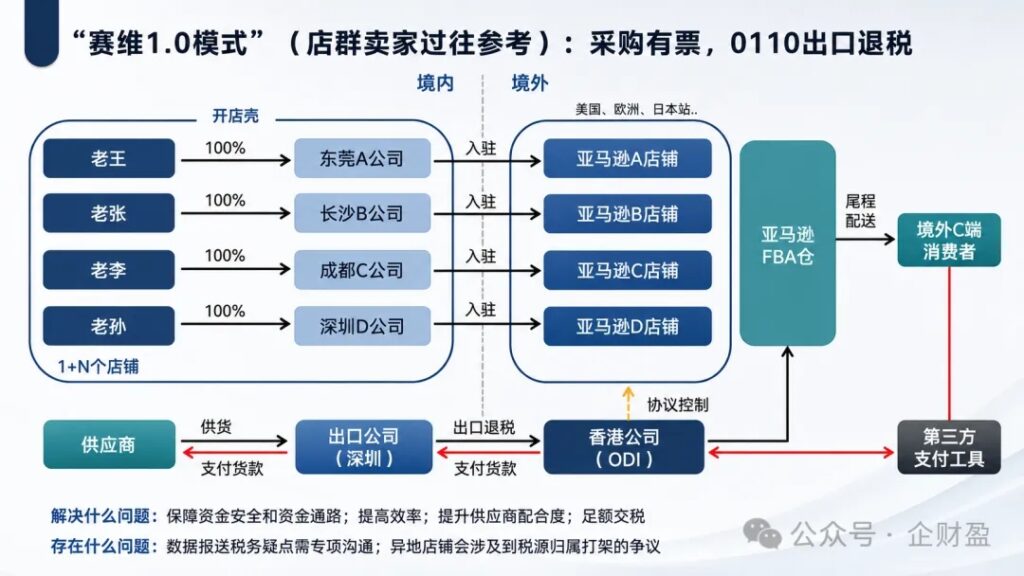
Over the past few years, many multi-store sellers have adopted business models similar to “Saiwei 1.0.” The Saiwei model originated from the publicly traded company Saiwei Times (301381) and is a practical solution—combining “centralized customs declaration” with “coordination through an overseas company”—developed by cross-border sellers who distribute products across multiple platforms to address compliance issues across their store networks and improve operational efficiency.
However, with the implementation of new regulations on the reporting of tax-related information by platforms, the regulatory approach has shifted from “formal oversight” to “substantive verification,” meaning that approaches that worked in the past may no longer be viable.
So, what exactly is Savi 1.0? Why has the Savi 1.0 model come under renewed scrutiny following the submission of platform data? What changes does Savi 2.0 bring? And how exactly can compliance be achieved?
In today’s article, Qicaiying will provide a detailed explanation. If you have any questions regarding financial and tax compliance...If you have any questions, feel free to add our Qicaiying customer service WeChat account for assistance.(Micro-signal: jxhqcy890 / Mobile: 16625410105)
01Saiwei Model 1.0: Addresses the issue of operational efficiency in multi-store management
In the past, the typical business model for many sellers operating multiple store clusters was:
Multiple individuals or shareholders each control different corporate entities;
Register stores on overseas platforms such as Amazon under different business entities;
Formation:1 Controlling Party + N Business Entities
Example:
Old Wang controls Dongguan Company A;
Old Zhang controls Company B in Changsha;
Old Li controls Company C in Chengdu;
Lao Sun controls Company D in Shenzhen.
These companies correspond to different platform stores. .
In its early stages, this model primarily addressed the following issues:
First, reduce platform-related risks
Since platforms such as Amazon typically require that “a company may only open one store,” sellers are forced to register a large number of domestic companies to operate their cross-border e-commerce businesses in order to expand their operations and diversify risk.
Second, improve the operational efficiency of store networks
A single team can manage multiple stores simultaneously, including product development, advertising, operations management, and supply chain management.
Third, addressing issues related to cash flow and the efficiency of tax refunds
Under the traditional model: Domestic suppliers provide goods → Export companies purchase them → Customs clearance is completed via the 0110 procedure → Revenue is generated from overseas sales. Some sellers conduct overseas business through entities such as Hong Kong-based or overseas companies to reduce operating costs by consolidating export tax rebates.
From a business perspective, SAIWEI 1.0 did indeed address some of the practical needs that sellers had faced in the past. However, as the regulatory environment changes, new problems are emerging in rapid succession.
.
02Why is the Savi 1.0 model being re-evaluated after the platform data was submitted?
In the past, many sellers focused on the question: “Can the store operate stably?”
But the focus now is more on:“Is there a correlation between platform data, business entities, cash flows, and tax filings?”
In June 2025, the “Regulations on the Reporting of Tax-Related Information by Internet Platform Enterprises” (State Council Order No. 810) officially took effect, requiring internet platform enterprises to report tax-related data—such as identity information and income data—regarding business operators and employees on their platforms to tax authorities. Starting in October 2025, Amazon began submitting information related to Chinese sellers to Chinese tax authorities on a quarterly basis, including seller identities, transaction volumes, revenue, and commission and service fees.
What does that mean?
This means that tax authorities can accurately track the sales data for every store.
For example: A store’s backend system shows annual sales of several million or even tens of millions. However, the corresponding business entity has shown no matching income for a long time, its reported data is significantly lower, and funds are being consolidated through other entities.
At this point, there are a few questions that need to be answered:
Who is credited with the sales revenue?
Who is the actual business operator?
Who purchased the goods?
Who handled the export?
Where do profits ultimately show up?
Following the implementation of the new regulations, tax authorities across the country have launched large-scale data verification efforts. Many cross-border e-commerce companies have been receiving text messages or phone calls from tax authorities asking them to explain discrepancies between the data reported by their platforms and their own tax filings. Some companies have already been summoned for interviews and asked to submit written explanations.It’s no longer a question of “whether they’ll investigate,” but rather “when they’ll come knocking on your door.”
.
03Saiwei 2.0 Model: The core change is the redesign of the business workflow
The core concept behind Savi 2.0,It's not simply a matter of adding a company or changing the legal entity.TheInstead, we have redesigned the following five areas based on the actual workflow of cross-border operations:
flow of goods.;
financial flows.;
contract flow.;
Document Flow.;
Tax Declaration
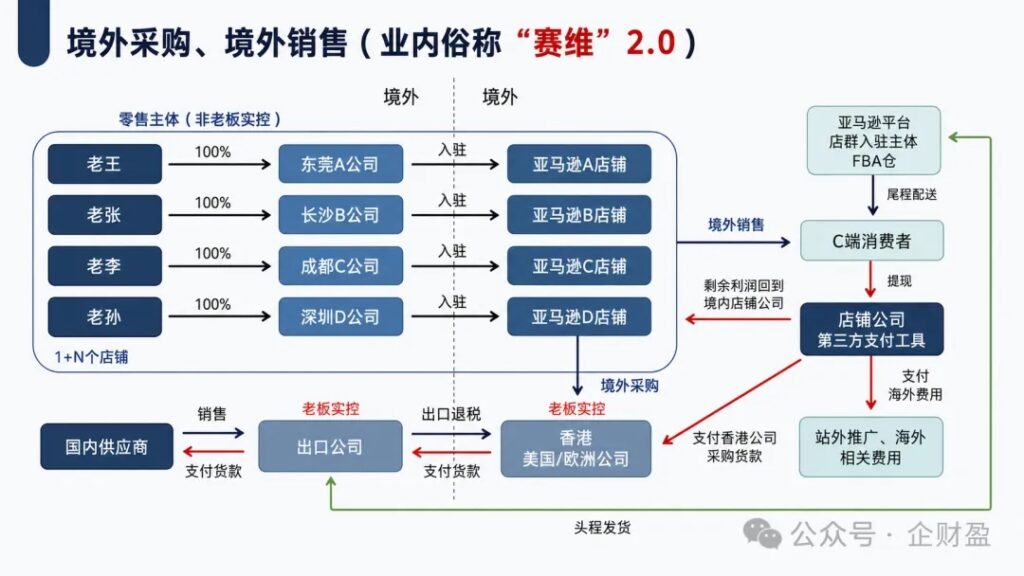
Under the SEVI 2.0 model, the Hong Kong company acts as a fund consolidation center,Transform into a genuine trading entity with full ownership of the goods. The domestic supply chain and overseas sales operations were reorganized.
The core logic of Savi 2.0 is:As an independent purchaser, the Hong Kong company places purchase orders directly with mainland suppliers, and ownership of the goods is transferred from the suppliers to the Hong Kong company. The Hong Kong company then resells the goods to various online storefronts.. All key stages of the “purchasing-sales” process are completed overseas, creating an independentClosed-Loop Overseas OperationsThe
Simple to understand:
Saiwei 1.0: Additional Solutions—“How to Manage Multiple Stores.”
Saiwei 2.0, on the other hand, primarily addresses: “How can the business relationships behind multiple stores withstand a thorough investigation? "
However, it is important to note that:Sevi 2.0 is not a panacea.Although Savi 2.0 can resolve the issue of zero reporting without altering the business practices of the original Savi 1.0 model,There are issues such as disputes over VAT exemption status and cost matching deductions; it is recommended for use only in special circumstances where local tax authorities have zero tolerance for the 1.0 model.The
.
04Five Key Business Chains Focused on in the SAIWEI 2.0 Model
When many business owners see an architecture diagram, they ask, “Would switching to a different architecture solve the problem?”
Actually, that's not the case. What really matters is:Is the business behind the architecture real?The
Key Points to Note:
1. Supply Chain: Where do goods actually come from?
It is important to clarify: Who is the supplier? Who is the purchasing entity? How are the goods exported? How do overseas warehouses or FBA integrate into the process? If the logistics flow cannot be explained, all subsequent stages will be affected.What the tax authorities are really looking at is: Did this shipment actually leave the country? Did it arrive at an overseas warehouse? Was it sold to consumers outside the country? .
2. Cash Flow: How is revenue recognized?
Points to Note: The financial relationships among the platform’s payment recipient, overseas accounts, domestic companies, and Hong Kong companies. It’s not that funds cannot flow; rather,It must be based on sound business logic.The .
3. Contract Flow: Are the transactional relationships clear?
These include: purchase contracts, sales contracts, service agreements, and cooperative relationships between parties.Contracts are an important foundation for the authenticity of business transactions. .
4. Document Flow: How Are Costs Reflected?
A common challenge for many cross-border sellers: While their revenue continues to grow, they lack complete invoices for their purchases, making it impossible to accurately track their costs.Can a single overseas invoice be used to claim expenses? The tax authorities don’t look at a piece of paper—they look for genuine transactions.. We need contracts, payment records, shipping tracking information, overseas warehouse receiving slips, and platform sales records. .
5. Tax Filing: Do the figures match?
There must be a logical correspondence between platform data, bank statements, export documentation, and corporate filings. Currently, platform sales data, corporate reporting data, customs export data, and bank transaction records are gradually being integrated,The days of rough estimates are over.The
We have helped thousands of cross-border sellers in Beijing, Shanghai, Guangzhou, Shenzhen, Hangzhou, Ningbo, and other cities complete Saiwei architecture diagnostics and 2.0 upgrades. Scan the QR code to add Qicaiying’s online customer service (WeChat ID: jxhqcy890 / Mobile: 16625410105).), arranging professional managers to answer queries and provideFull Process Compliance ProgramOne-to-one service ↓↓↓
.
05The SAIWEI Model 2.0 isn't suitable for all sellers
This is an issue that many business owners tend to overlook.It's not about simply copying what others do.
In particular, the following types of sellers,Risks that require special attention:
1. Sellers with multiple stores and a large scale of operations
For example: dozens or even hundreds of stores. In a store cluster model, with operations spanning multiple stores, multiple business entities, and multiple cities, every step of the process can become a trigger for tax risks.
2. Sellers with complex historical sales data
For example: In the past, multiple entities were involved in operations, revenue consolidation methods were relatively complex, and accounting records were incomplete.
3. Sellers with discrepancies between platform data and reported data
For example: While the platform's sales volume continues to grow, the company's reported figures have not been adjusted accordingly for a long time.Starting in late October 2025, a large number of sellers received tax alert text messages—notifying them that there were significant discrepancies between their third-quarter VAT-reported revenue and the amounts reported by the platform—and were required to verify and correct the information, or even pay back taxes.The
4. Sellers looking to build a long-term business
Many issues aren't apparent when the business is still small. However, once sales reach the tens of millions,The cost of resolving historical issues will continue to rise. A Shenzhen-based company with annual revenue exceeding 100 million was ordered to pay over 95 million in back taxes and fines for concealing income through methods such as hidden transaction flows and receiving payments via personal accounts.
.
06How to Implement the Saisi Model 2.0 in Compliance with Regulations
Before implementing Saiwei 2.0, the first step isn’t to set up the framework, but to conduct a risk assessment. When many business owners seek advice, their first question is, “How much does Saiwei 2.0 cost?” But in reality,The situations vary greatly from seller to seller.
Some need to adjust their business processes; others need to first organize their historical financial records; still others need to restructure their corporate relationships; and for some, direct adjustments may not be the right approach.
So the first step should be to take stock of the current situation: ✅ Number of stores ✅ Company Overview ✅ Payment Routes ✅ Procurement Method ✅ Export Mode ✅ Historical Filing Status
Then decide on the next course of action.
Saiwei 2.0 is attracting the attention of an increasing number of sellers. The fundamental reason for this is not that a particular business model has suddenly become popular, but rather that, as platform data becomes more transparent, cross-border businesses are transitioning from a “phase of scale growth” to a “phase of standardized operations.”
In the past, it was all about: Number of stores; operational capabilities; supply chain efficiency.
In the future, success will depend on: whether the business is legitimate; whether the transaction chain is complete; and whether the data matches.The
The year 2026 will be a pivotal year in the transition of cross-border e-commerce tax regulation from “formal oversight” to “substantive verification.” Tax authorities have made it clear that while they do not reject the “Saiwei model” itself, they will resolutely rule out “shell company operations.”The
If you are currently operating stores on multiple platforms, or if you are already experiencing:
Growth in platform sales;
There are quite a few subjects;
Complex accounting;
I'm not sure how to adjust things in the future;
We recommend reviewing your business processes in advance. Don’t wait until you receive a tax alert text message to take action—by then, your options will be much more limited.
Understanding what the Savi model is is only the first step. The real key lies in the second step: Are you currently at version 1.0 or 2.0? Which areas are already at risk? Where should you start making improvements? — You won’t find the answers to these questions simply by checking off boxes in an article.
✔️ One-on-One Architecture Assessment:We’ll review each company’s registration information, filing status, and capital flow to generate a comprehensive risk list, identifying which issues are ”red lines that will definitely cause problems if not addressed immediately” and which are ”buffer items that can be gradually optimized.”
✔️ 2.0 Compliance Upgrade Plan:It’s not just about telling you that ”it’s time for a change”—it’s about providing you with a concrete roadmap for upgrading: which company to tackle first, how to adjust equity relationships, and how to redesign the funding structure, with a timeline for each step.
✔️ Dual-Track Structure Combining a Hong Kong Company and a Mainland Entity:With a three-tier structure comprising an export company, an operating company, and a Hong Kong company, Qi Cai Ying handles everything from registration to account opening to bookkeeping in a single, streamlined process, ensuring that the flow of goods, cash, and taxes align from the very beginning.
✔️ Ongoing Compliance Maintenance:Setting up your corporate structure isn’t the end of the process. Annual reviews, audits, corporate income tax filings, and VAT filings—Qicaiying helps you compile compliance records for each reporting period, building a chain of evidence of business operations recognized by the tax authorities.
We have helped thousands of cross-border sellers in Beijing, Shanghai, Guangzhou, Shenzhen, Hangzhou, Ningbo, and other cities complete Saiwei architecture diagnostics and 2.0 upgrades. Scan the QR code to add Qicaiying’s online customer service (WeChat ID: jxhqcy890 / Mobile: 16625410105).), arranging professional managers to answer queries and provideFull Process Compliance ProgramOne-to-one service ↓↓↓
Tags:
Multi-Store Sellers
Cross-Border Tax Compliance
Safeway model
Corporate Compliance
Cross-border e-commerce compliance
export tax rebate
E-commerce compliance
Financial and Tax Compliance
Recommended
Cross-border e-commerce B2B must see! Registered Hong Kong company stationed in the Ali International Station, really fragrant!
In today's globalized business environment, the cross-border e-commerce B2B model is rapidly emerging with its unique advantages. For many enterprises engaged in cross-border trade, choosing a suitable platform and registering an advantageous company are undoubtedly the key keys to open the door to the international market.
2024 Hong Kong Company Account Opening Tips! How to choose the right Hong Kong bank account?
Global anti-money laundering regulations are becoming more and more stringent, the banks to maintain an account of the sunk cost is getting higher and higher, not moving hundreds of millions of dollars in fines, so that the major banks to open an account threshold as well as the audit process high up, already have a Hong Kong company bosses, how to choose the Hong Kong bank to open a public account? How much does it cost and how to operate? Today to give you a detailed introduction to the Hong Kong company account how to choose, as well as the approximate costs required and other content.
Hong Kong company registration advantages + registration conditions + registration process to share!
If you want to start a business and develop overseas markets, registering a Hong Kong company is undoubtedly a very forward-looking choice. With its unique geographical location, sound legal system, low tax rate and open business environment, Hong Kong company has become a "sharp weapon" for many business owners to open up overseas markets. Why is it so important to register a Hong Kong company in 2024?