How Exactly Do You Ensure Compliance in Cross-Border E-Commerce? Choose the Right Model from These Three Options—Don’t Pick the Wrong One
Published: June 9, 2026
If you’ve been thinking about compliance lately, you’ve probably already realized that there’s no such thing as a ”one-size-fits-all” solution.
The compliance paths for sellers operating 1–2 premium stores and those running 50 stores as part of a store network are completely different. The operational structures for sellers using Amazon FBA and those handling TikTok small-package shipments are also entirely different.
This article breaks down and explains the three main compliance models currently recognized by the tax authorities. The number of stores you operate, your shipping methods, and your suppliers’ capabilities—these three factors determine which path you should take.
Model 1: Single-Store Boutique Model
Who it’s for: Sellers with 1–2 stores, a small number of SKUs, a focus on premium products, and whose manufacturers can issue full-amount special VAT invoices.
How to do it:
✔️ Ship inventory to overseas warehouses (such as FBA) → Export via the 9810 customs clearance procedure, and apply for a tax refund or tax exemption
✔️ Direct shipping of small packages → Via the 9610 model, compliant export of small packages
✔️ Funds: Funds collected through third-party payment tools are deposited into the corporate bank account and used to pay for purchases and to process reimbursement claims.
✔️ Taxes: File corporate income tax returns as usual and claim input tax credits based on valid invoices
Key Requirement: The factory must be able to issue invoices → This is a prerequisite for the single-store boutique model. If the factory cannot issue invoices, your input tax will be zero, you won’t be able to claim VAT credits, and this approach won’t work.
Model 2: SAIWEI 2.0 · Overseas Procurement and Overseas Sales
Who it’s for: Sellers with 5 or more stores, those operating a network of stores, those with a large number of SKUs (ranging from dozens to hundreds), and those whose manufacturers may not be able to issue invoices. This is currently the compliance structure most strongly promoted by Qicaiying.
First, a note: SAIWEIWhy was the 1.0 model rejected by the tax authorities?
Under the 1.0 model, all store revenue is consolidated into the Hong Kong company, while the mainland stores file zero tax returns. The tax authorities categorically reject this approach—because the goods are sourced domestically, yet all profits are transferred to Hong Kong to pay very low taxes, while not a single penny is paid in mainland China. Furthermore, since platform data is now pushed to mainland stores, filing zero tax returns directly contradicts the data reports, triggering automatic system alerts.
How does Savi 2.0 address this? The core logic can be summed up in one sentence: Hong Kong companies are no longer merely fund collection centers, but genuine trading entities with full ownership of the goods.
Complete Process:
① Domestic factories → Centralized procurement by a supply chain company owned by the boss
② Supply chain companies apply for tax-exempt or tax-refunded exports and ship all goods to FBA or overseas warehouses
③ The supply chain company sells the goods to the Hong Kong company (a genuine transaction, with a contract and transaction records)
④ Hong Kong companies obtain the rights to the goods and then sell them to various retail entities in mainland China
⑤ When stores sell on the platform, the proceeds are deposited into the store’s corporate third-party payment account.
⑥ The store pays the Hong Kong company for the goods, and the remaining income is reported for corporate income tax in mainland China.
⑦ A Hong Kong company issues a pro forma invoice to the store for tax credit purposes in mainland China
The biggest advantage of this model: centralized exports under a single entity, eliminating the need for each store to file customs declarations individually (filing under the 9810 code for individual stores is simply unfeasible when there are many SKUs); The source of profits aligns with the tax jurisdiction (store profits are fully taxed domestically without profit shifting, which is recognized by the tax authorities); the tax process is extremely streamlined (the VAT chain for procurement and sales is completed overseas, while only corporate income tax is filed domestically).
Model 3: Purely Overseas Sourcing / Local Store Model
Who it's for: Sellers who source directly from overseas suppliers and do not need to ship from China; or sellers who operate local stores (such as a local store on Mercado Libre in Mexico).
This model is the simplest—your goods do not pass through Chinese customs in the first place, so there is no need for Chinese export customs clearance. Funds can be routed according to the 2.0 model: overseas revenue → Hong Kong company → supply chain company or other compliant entity. For domestic stores, simply set up an additional Hong Kong company to act as a financial intermediary, thereby meeting the compliance requirements for domestic stores.
If you have any questions, please feel free to contact me.
Cell phone: 18676749275 | WeChat: qcygscszk
How do you figure out which path to take? Ask yourself these three questions
First: How many stores do you have? 1–2 → See if Model 1 is viable (the key factor is whether the factory can issue invoices). 5 or more → Model 2 is generally the best option.
Second: Are you using FBA or small-package shipping? FBA (or similar) → The architecture design should focus on unified export via the 9810 procedure. Small-package shipping → Focus on the 9610 or 2.0 model for a closed-loop overseas sales process.
Third: To what extent can your suppliers cooperate? If they can issue special invoices for the full amount → Option 1 is feasible. If they cannot, or can only issue partial invoices → Option 2 is the better choice, because Option 2.0 does not rely on each supplier to issue invoices.
Once you’ve answered these three questions, the general direction will become clear. However, when it comes to the specifics—such as where to register your supply chain company, which bank to choose for opening a Hong Kong company account, and how to structure your capital flow—these details need to be tailored to your specific circumstances; there is no one-size-fits-all template.
Why Choose Qicaiying for Compliance Structuring?
It’s not hard to find a compliance solution; the challenge lies in finding a team that can actually implement it—one that understands your business model, is familiar with the tax authorities’ requirements, knows how to coordinate between Hong Kong and mainland China structures, and has the resources to help you secure the necessary qualifications and complete the procedures at every stage.
A Professional Team—Customization Is More Than Just a Slogan
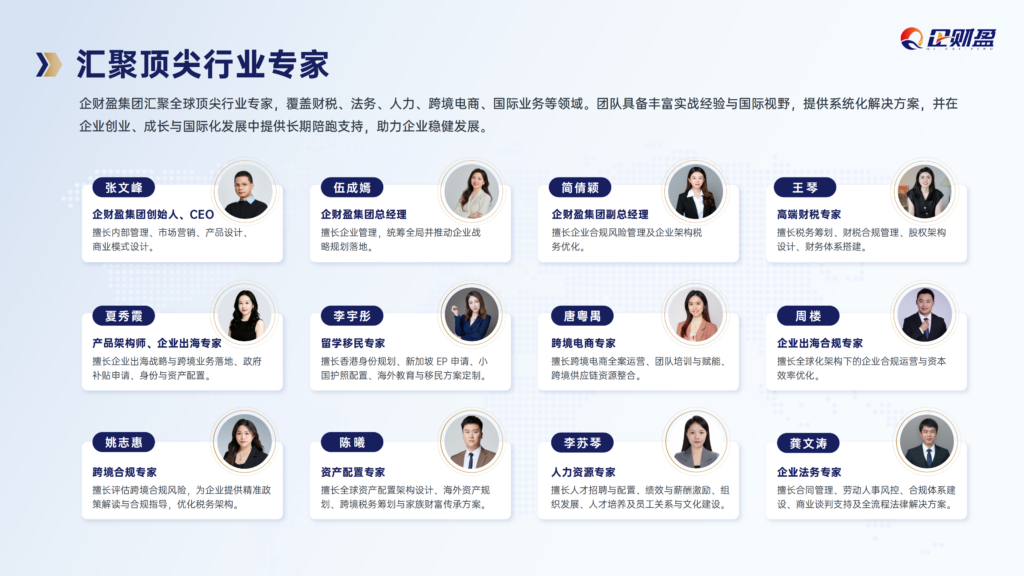
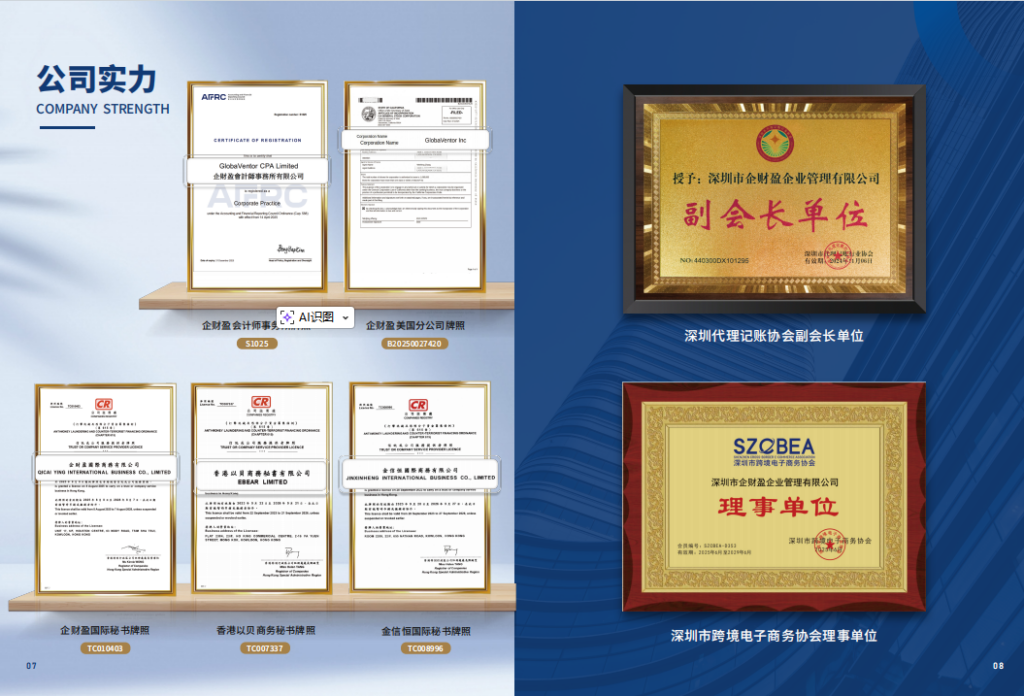
Qicaiying’s professional team of nearly 400 people consists of certified public accountants, tax agents, cross-border tax and finance consultants, and Hong Kong-licensed secretaries. The firm holds three TCSP-licensed secretary licenses and operates its own Hong Kong accounting firm. On-site due diligence is standard practice—we first assess the scale of your store network, fulfillment model, and supply chain structure before developing a customized solution. No two clients receive the exact same framework, because no two clients’ businesses are alike.
Digital Systems: Ensuring Architecture Implementation Remains True to the Original Design
We’ve invested tens of millions to develop our own digital management system, standardizing all key execution points of the compliance framework and making progress visible. From processing import and export licenses to filing for tax refunds and exemptions, and from establishing Hong Kong companies to standardizing capital flows, the completion status of every step can be tracked in real time. We don’t just give you a PDF proposal—we guide you step by step to make it a reality.
Ecological Resources: Solving the Problem of ”Who to Turn to Next After the Solution Is Complete”
Qicaiying connects with over 500,000 entrepreneurs and domestic and international association platforms, including the Shenzhen Cross-Border E-Commerce Association. By establishing a compliance structure through Qicaiying, you don’t just receive a set of solutions—you also gain simultaneous access to a fast-track for opening Hong Kong bank accounts (through multiple channels such as HSBC, Overseas-Chinese Banking Corporation, Dah Sing, and CBI), cross-border payment resources, overseas warehouse integration, and supporting audit and tax services, thereby resolving the question of ”who to turn to next” once your compliance structure is in place.
The quality of a compliance framework depends on whether it is actually implemented effectively. Choosing the right team ensures that the plan doesn’t remain merely on paper.
Not sure which compliance model is right for you? Scan the QR code to add a Qicaiying consultant, who will help you analyze your store’s structure and provide preliminary guidance.
Cell phone: 18676749275 | WeChat: qcygscszk
Tags:
Cross-Border Tax Compliance
Cross-border e-commerce fiscal compliance
Financial and Tax Compliance
Recommended
Cross-border e-commerce B2B must see! Registered Hong Kong company stationed in the Ali International Station, really fragrant!
In today's globalized business environment, the cross-border e-commerce B2B model is rapidly emerging with its unique advantages. For many enterprises engaged in cross-border trade, choosing a suitable platform and registering an advantageous company are undoubtedly the key keys to open the door to the international market.
2024 Hong Kong Company Account Opening Tips! How to choose the right Hong Kong bank account?
Global anti-money laundering regulations are becoming more and more stringent, the banks to maintain an account of the sunk cost is getting higher and higher, not moving hundreds of millions of dollars in fines, so that the major banks to open an account threshold as well as the audit process high up, already have a Hong Kong company bosses, how to choose the Hong Kong bank to open a public account? How much does it cost and how to operate? Today to give you a detailed introduction to the Hong Kong company account how to choose, as well as the approximate costs required and other content.
Hong Kong company registration advantages + registration conditions + registration process to share!
If you want to start a business and develop overseas markets, registering a Hong Kong company is undoubtedly a very forward-looking choice. With its unique geographical location, sound legal system, low tax rate and open business environment, Hong Kong company has become a "sharp weapon" for many business owners to open up overseas markets. Why is it so important to register a Hong Kong company in 2024?