After the new regulations take effect on July 1, will Hong Kong companies still be able to make direct overseas investments?
Published: June 5, 2026
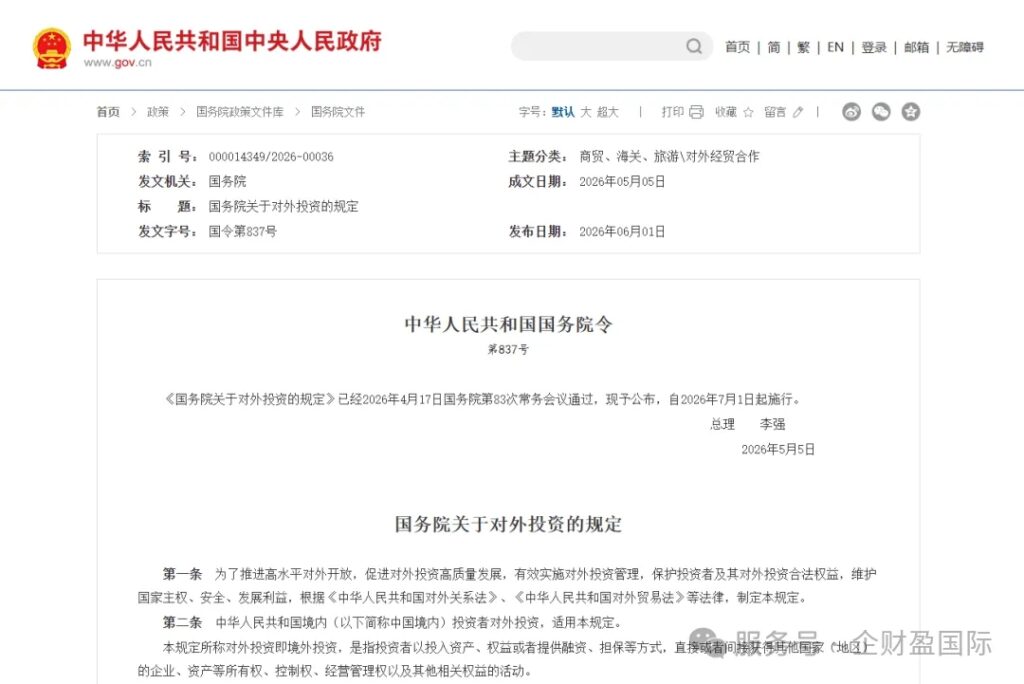
On May 5, 2026, Premier Li Qiang signed State Council Decree No. 837, and the “State Council Regulations on Foreign Investment” were officially promulgated and will take effect on July 1, 2026.
As soon as the news broke, many entrepreneurs who were using Hong Kong companies to expand overseas began to feel anxious:“Can Hong Kong companies still make direct overseas investments?” “Will Hong Kong shell companies be subject to scrutiny?” “Do I need to retroactively file for ODI registration?”
This article will help you get all these questions answered once and for all. For business inquiries, please contact our online customer service.(WeChat: jxhqcy890 / Mobile: 16625410105)Arrange for a manager to answer questions, provide professional advice and one-on-one service throughout the process.
01Key Changes in the New Regulations: Three Firsts
This is in the field of China's foreign investmentThe First Systematic Administrative RegulationPreviously, the management of outbound investment was primarily governed by departmental regulations issued by the National Development and Reform Commission, the Ministry of Commerce, and other agencies; the new regulations consolidate these into a single administrative regulation at the State Council level, significantly elevating its legal status.The changes are primarily reflected in three areas:
Change 1: Individuals have been included in the regulatory scope for the first time
In the past, ODI (foreign direct investment) regulations primarily covered “domestic enterprises,” while individuals registering companies in Hong Kong and the United States had long operated in a regulatory gray area. Article 2 of the new regulations explicitly stipulates that “investors” include enterprises and other organizations within China, as well asIndividual ResidentsThe
That means:Hong Kong companies you’ve registered in your own name, business entities held in someone else’s name on your behalf, and SPVs registered under your personal name may all fall under regulatory scrutiny; you can no longer hide behind the old argument that “the ODI applies to companies but not to individuals.”
.
Change 2: End-to-End Regulatory Oversight
The new regulations clarify that any acquisition of control, ownership, or operational management rights over an overseas enterprise—whether through assets, equity interests, financing, or guarantees—is considered an outward investment, provided it is obtained “directly or indirectly.” Indirect control models, such as multi-tiered SPV structures, reinvestment overseas, and cross-border allocation of entrusted funds, are all assessed based on whether actual control over the overseas entity has been obtained.
Regulators require that the equity structure be traced back to the ultimate natural person and prohibit multi-layered, nested shell SPVs.
.
Change 3: Penalties Have Been Significantly Strengthened
Article 27 of the new regulations establishes a tiered penalty system: Failure to complete the required approval and filing procedures may result in the confiscation of illegal gains and a fine ranging from 1‰ to 5‰ of the investment amount; refusal to rectify the violation may result in a fine ranging from 5‰ to 10‰ of the investment amount; and in serious cases, new applications will not be accepted for three years, or the entity may be prohibited from engaging in foreign investment activities for one to three years. The cost of noncompliance has risen significantly.
.
02Three Major Impacts on Hong Kong Companies
New regulations clarify: The management of investments made by investors in the Hong Kong Special Administrative Region, the Macao Special Administrative Region, and the Taiwan region,Implement in accordance with these regulations.. This sends a clear signal—Hong Kong companies are no longer in a “gray area.”
Impact 1: It’s Becoming Harder for Hong Kong Shell Companies to Operate Without Proper Registration
In the past, many companies used Hong Kong shell companies to receive payments and secretly transfer funds out of the country. Now that tax, banking, and customs data are fully shared, this route will become increasingly difficult to navigate.
Overseas entities must demonstrate genuine business operations, including a permanent office location and at least two full-time employees, and must submit a business investment plan covering a 12-month period; otherwise, they may face deregistration and be required to repatriate their funds.
.
Impact 2: The HK-US Multi-Tiered Structure Faces Penetration Audits
Many companies typically use a multi-tiered structure consisting of a “Hong Kong subsidiary—U.S. operating entity” for their cross-border operations. Under the new regulations, regulatory authorities will look through such structures to verify the ultimate ownership. The compliance costs associated with multi-tiered structures will increase significantly.
.
Impact 3: Overseas Reinvestment Is No Longer “Free”
Under the new regulations, the loophole previously used by some companies to circumvent ODI filing requirements—by “reinvesting overseas profits” (which was previously subject to ex post reporting)—has been closed. Reinvestments by overseas entities are now also subject to unified management.
.
03Can Hong Kong companies still make overseas investments?
The answer is: Yes, but compliance requirements have become significantly stricter.
As a key hub connecting China with global markets, Hong Kong offers unique advantages in areas such as taxation, finance, and law. The purpose of the new regulations is not to restrict legitimate and compliant cross-border business operations, but rather to bring investment activities that previously fell into a gray area under standardized regulation. .
Currently, ODI filing is a three-department compliance process that mainland enterprises must complete before conducting direct investment in Hong Kong. Generally, they must file for approval or obtain authorization from the development and reform authorities, the commerce authorities, and the foreign exchange authorities. The filing process for non-sensitive projects takes approximately 15 to 30 business days; specific details are subject to the latest official announcements. .
In practice, companies must consult with professional advisors or cross-border compliance firms to develop compliance plans tailored to their specific business circumstances.You can also contact our online customer service (WeChat: jxhqcy890 / Mobile: 16625410105) to have a professional account manager address your questions and provide end-to-end one-on-one service ↓↓↓
04Three Things You Must Do Before July 1
With less than a month to go before the new regulations take effect, we recommend that you immediately begin the following self-assessment:
First, conduct a comprehensive review of the overseas equity structure.
Whether reinvesting in Europe and the United States through a Hong Kong subsidiary or establishing independent e-commerce platforms or overseas warehousing entities, any investment ultimately controlled by domestic individuals or organizations must apply to the National Development and Reform Commission and the Ministry of Commerce for retroactive ODI filing in accordance with the law.
.
Second, assess the actual operations of overseas business entities.
Does the Hong Kong entity have actual office space and business operations? Does its staffing meet the requirements? Shell companies lacking substance need to adjust their structure as soon as possible to ensure compliance with the look-through compliance review standards.
.
Third, assess the risks associated with the cross-border transfer of technology and data.
If a company is involved in the cross-border transfer of core technologies—such as independently developed systems, algorithmic models, and industrial drawings—it must complete a compliance assessment by July 1.
Effective July 1, 2026,Outbound investment has entered a new era of “full-process supervision and comprehensive compliance”The
This is not intended to restrict Chinese companies from expanding overseas, but rather to guide them away from “unregulated growth” toward a healthy development path characterized by “high quality, end-to-end management, and strong compliance.” The bar has shifted from simply “obtaining approval” to a test of “systematic compliance capabilities” that span the entire investment lifecycle.
For the vast majority of cross-border businesses, identifying compliance risks and completing filing procedures as early as possible before July 1 will be key to maintaining a competitive edge in the era of the new regulations.
With less than a month to go before the new regulations take effect on July 1, the window for compliance is narrowing.
.
For inquiries regarding Hong Kong company registration, ODI filing, opening a Hong Kong bank account, Hong Kong company compliance, Hong Kong company offshore exemption, Hong Kong tax residency certification, Hong Kong residency, and more, please scan the QR code to add our online customer service representative (WeChat ID:jxhqcy890 / Mobile: 16625410105), where a professional manager will answer your questions and provide one-on-one service throughout the entire process ↓↓↓
Tags:
# Overseas Investment
#odi Filing
Advantages of registering a Hong Kong company
Hong Kong company registration process
cross-border e-commerce
Register Hong Kong Company
Hong Kong Company Registration
Hong Kong Company Account Opening
Recommended
Cross-border e-commerce B2B must see! Registered Hong Kong company stationed in the Ali International Station, really fragrant!
In today's globalized business environment, the cross-border e-commerce B2B model is rapidly emerging with its unique advantages. For many enterprises engaged in cross-border trade, choosing a suitable platform and registering an advantageous company are undoubtedly the key keys to open the door to the international market.
2024 Hong Kong Company Account Opening Tips! How to choose the right Hong Kong bank account?
Global anti-money laundering regulations are becoming more and more stringent, the banks to maintain an account of the sunk cost is getting higher and higher, not moving hundreds of millions of dollars in fines, so that the major banks to open an account threshold as well as the audit process high up, already have a Hong Kong company bosses, how to choose the Hong Kong bank to open a public account? How much does it cost and how to operate? Today to give you a detailed introduction to the Hong Kong company account how to choose, as well as the approximate costs required and other content.
Hong Kong company registration advantages + registration conditions + registration process to share!
If you want to start a business and develop overseas markets, registering a Hong Kong company is undoubtedly a very forward-looking choice. With its unique geographical location, sound legal system, low tax rate and open business environment, Hong Kong company has become a "sharp weapon" for many business owners to open up overseas markets. Why is it so important to register a Hong Kong company in 2024?