With the European and U.S. markets saturated and profits hitting rock bottom, Brazil is the true blue ocean for cross-border sellers.
Published: August 26, 2026
A friend of mine who sells on Amazon US said something to me last month:
“Last year, I spent 400,000 RMB on advertising and made 80,000 RMB in profit. This year, I’ve already spent 300,000 RMB on advertising and made 30,000 RMB in profit. If this keeps up, I won’t be selling products—I’ll be working for Amazon.”
Another friend of mine who sells on Shopee in Southeast Asia has had it even worse—in the same product category, there were 200 competing listings when he first listed his product, but three months later, that number had jumped to 2,000, and prices had plummeted from $15 to $6. Profit? He makes 8 mao per order—barely enough to cover shipping costs.
In Europe and the U.S., prices have fallen to the point where profits have hit rock bottom, while in Southeast Asia, price wars have driven margins down to zero.
But there is one market with a population of 214 million, where e-commerce penetration stands at only 14%, cross-border packages under $50 are now duty-free, and Mercado Libre has invested 57 billion reais in infrastructure—BrazilianThe
Let's take a thorough look at it today.——
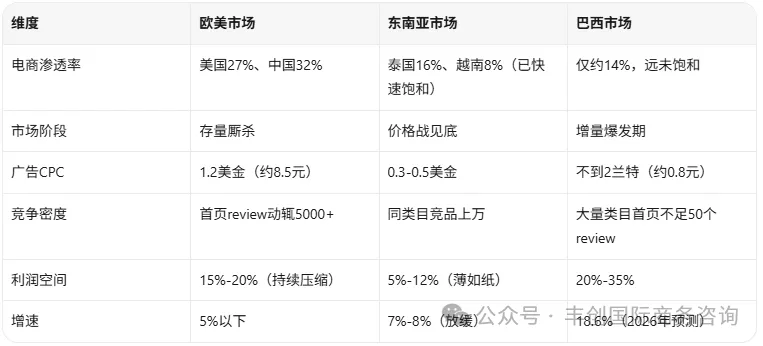
I. Just How Diverse Are Europe, the U.S., and Southeast Asia? Look at the data first; don't go by your gut feeling.
To sum it up in one sentence: Europe and the U.S. have shifted from ”competition for new growth” to ”fierce competition over existing markets,” while Southeast Asia has gone from a ”blue ocean” to a ”red ocean within a red ocean.”
And Brazil? It’s still in the stage where ”a massive number of offline users are continuing to shift online.”The market is far from saturated, and there is enormous room for growth.——
II. Why Is Brazil a True Blue Ocean?
1. What does a penetration rate of 14% mean?
E-commerce penetration in Latin America is only about 14%, far below the 27% in the United States and the 32% in China, and also lower than the global average of 23%.
What does 14% mean? It means that out of every 100 consumers, 86 still shop in brick-and-mortar stores. These consumers” shopping habits are rapidly changing due to smartphones and mobile payments—it’s not that they ”don’t want to shop online,” but rather that they’re ”just starting to shop online.”
The e-commerce transaction volume in Latin America is projected to exceed $760 billion in 2026, representing a year-over-year increase of 12%. Brazil and Mexico, the two key markets, will account for 60 percent of the region’s total transaction volume.
Brazil is Latin America’s largest e-commerce market: with a population of 214 million, e-commerce sales of nearly 500 billion RMB in 2025, and 120 million monthly active users. Full-year e-commerce sales in 2026 are projected to reach 462.5 billion reais, representing year-over-year growth of 18.6%.
214 million people, a 141 TP3T penetration rate, and an 18.61 TP3T growth rate—when taken together, these three figures define a blue ocean.
2. Policy benefits are taking effect
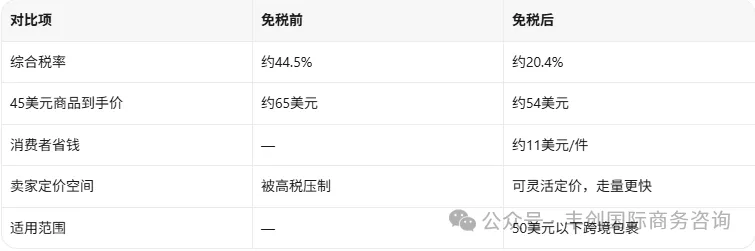
In May 2026, Brazilian President Lula signed an executive order eliminating the 20% federal import duty on cross-border packages valued at less than $50.
Previously, the combined tax rate on cross-border packages in Brazil was as high as 44.51 TP3T. It has now been reduced to around 20.41 TP3T.
For a $45 item, the price consumers pay drops directly from $65 to $54—a reduction of $11. For Chinese cross-border sellers whose average order value is typically under $50, this represents real room for price reductions.
Coupled with Brazil’s temporary exemption from tariffs on 191 electronic products starting in March, the policy window has now opened.
Against the backdrop of global tightening of policies on cross-border small packages (such as the EU’s IOSS and the U.S. de minimis reforms), Brazil has embraced cross-border e-commerce with a rare degree of openness. AliExpress has already designated Brazil as one of its three major new growth engines for 2026.
3. The platform is pouring money into infrastructure development
The biggest risk in a blue-ocean market is that infrastructure can’t keep up. But Brazil is different—platforms are investing heavily there.
In 2026, Meike Duo announced an investment of 57 billion reais (approximately $10 billion) in Brazil, representing a year-over-year increase of nearly 50%. Shopee was Brazil’s fastest-growing market in 2025 and expanded its number of distribution centers from 16 to 26 in 2026.
The market share of Asian e-commerce platforms (Shopee, SHEIN, AliExpress, Temu, TikTok Shop) in Brazil has surged from 32% to 41.5%.
Platforms are being established, infrastructure is being improved, and consumers are being educated—when these three things happen simultaneously, that’s the best time to enter the market.——
III. What Sells Well in Brazil? A Detailed Look at the Five Major Product Categories
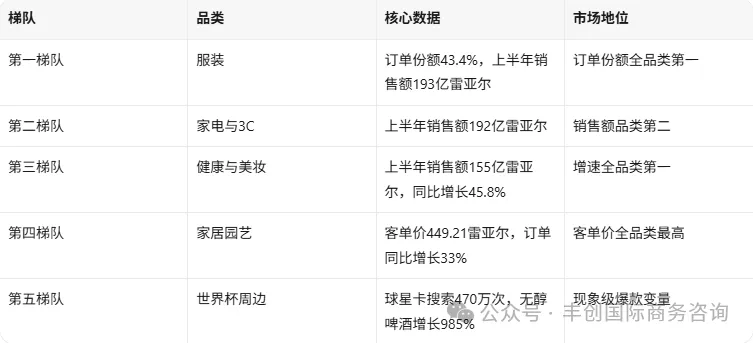
It's not enough to just know the market is good; you also have to know what to sell.. Below are key figures for the top five product categories in the Brazilian market.
Breaking it down step by step:
Top Tier: Apparel—43.41% of orders, ranking first across all categories
Apparel captured a 43.41 TP3T share of orders across all platforms, ranking first among all categories. In the first half of 2026, sales of fashion and accessories reached 19.3 billion reais, making it the top-selling category.
Specific Popular Fields:
Sportswear: First-half sales reached 1.9 billion reais, a year-over-year increase of 139.31%. Dry Fit sports T-shirts generated as many as 6.4 million searches on Meitiao.
Plus-Size Women's Clothing: A classic blue ocean. Brazilian women are generally curvy, local supply is severely insufficient, and the return rate is extremely low.
Second Tier: Home Appliances and 3C Products—19.2 billion reais, closely trailing the apparel sector
Home AppliancesSales for the first half of the year totaled 19.2 billion reais. During the World Cup, sales of televisions on the Meitiao platform rose 59% year-over-year, with 44- to 55-inch large-screen models proving the most popular. Sales of barbecue grills and racks increased by 67%, while sales of beer coolers rose by 60%.
In terms of 3C accessories...Smartphone penetration in Brazil exceeds 70 percent. Most items—such as phone cases, tempered glass screen protectors, Bluetooth headphones, and portable chargers—cost less than $50 each, and their prices drop significantly after tax exemptions.
Tech accessories such as GaN fast chargers, smartwatches, wireless lavalier microphones, and smartphone ring lights continue to be bestsellers.
Third Tier: Health and Beauty—Growth Rate of 45.81 TP3T, Ranked First Across All Categories
Sales in the health category reached 15.5 billion reais in the first half of the year, a year-over-year increase of 45.81%, leading all categories. Among these, sales of weight-loss injections reached 6.1 billion reais, a year-over-year increase of 2,131%. Sales of health products on the Meike Duo platform surged by 74.8% year-over-year during Father’s Day.
Brazil is the world's fourth-largest market for beauty products. In the first quarter of 2026, e-commerce sales in Brazil’s high-end beauty market grew by 21% year-over-year. Perfume remained the largest category, accounting for nearly half of total sales. The number of live-streaming sessions featuring beauty brands on the Shopee platform surged by more than 300% year-over-year.
Beauty tools, hair and body care products, and sunscreen are all small, lightweight items priced under $50—they sell out extremely quickly after the tax-free discount.
Fourth Tier: Home & Garden—Average Order Value of 449.21 reais, the highest across all categories
Home and garden orders increased by 33% year over year, with an average order value of 449.21 reais—the highest among all product categories.
Storage boxes, mirrors, wallpaper, lighting fixtures, shoe cabinets, living room rugs, and cookware sets continue to be highly sought after. Kitchenware, glass and ceramic items, home storage solutions, and holiday decorations are the top categories that South American buyers are focusing on.
High Average Order Value + Steady Growth—Ideal for sellers with a well-established supply chainThe
Fifth Tier: World Cup Merchandise—Phenomenal Bestsellers
The 2026 World Cup Is a Major Wild Card for the Brazilian MarketThe
Panini sports card albums have garnered 4.7 million search queries in Latin America, with over 82,000 album sets and 720,000 packs of sports stickers sold in the Brazilian market.
Searches for projectors exceeded 739,000, while searches for speakers reached 600,000.
Search volume for "green spray paint" increased by 6,421 TP3T, while search volume for "non-alcoholic beer" increased by 9,851 TP3T.
Sales of sports jerseys rose 74% year over year
The World Cup isn’t just a short-term traffic ”gamble”; it’s a structural opportunity with clear timelines that allows for advance inventory preparation.
(For inquiries about Brazil's Meikeduo, contact +csdrcc12345 or scan the QR code below directly))
——
IV. The Underlying Logic of Brazil’s Blue Ocean
When you put all the data and phenomena together, the logic behind Brazil’s “Blue Ocean” is actually quite simple:
Demand Side:With a population of 214 million, the e-commerce penetration rate stands at only 14%, and a massive number of offline users are shifting online.
Policy Perspective:Cross-border packages valued at less than $50 are duty-free, and the combined tax rate has been reduced from 44.51 TP3T to 20.41 TP3T. Amid a global trend of tightening regulations on cross-border small packages, Brazil is bucking the trend.
Platform Side:Meituan is investing 57 billion reais; Shopee is doubling its number of distribution centers to 26; and its market share in Asia has risen from 32.1% to 41.51%. These platforms are educating consumers and expanding their logistics networks on your behalf.
By Product Category:Apparel: 43.41 TP3T order share; Health: 45.81 TP3T growth rate; Home Appliances: 19.2 billion in sales; Home Furnishings: 449 reais average transaction value—each tier is backed by clear data; these aren’t guesses, but results earned through hard work.
Demand is surging, policies are being relaxed, platforms are pouring money into the market, and product categories are expanding.
There is no other market in the world where these four things happen at the same time.。——
V. It’s not a question of ”whether to enter the Brazilian market,” but ”when to do so.”
Finally, let me be honest.
Brazil is not a perfect market.The language is Portuguese, not Spanish; the tax system is complex (tax laws vary by state); compliance requirements are strict (INMETRO certification, ANVISA certification); and the supply chain is long—these are real barriers.
But barriers aren't a sign to give up; they're a filter.The higher the barrier to entry, the fewer people who can clear it, and the less competition there is once they’ve made it through.The
Why is competition so fierce in the European and American markets? Because the barriers to entry are low, so everyone has rushed in. Why is the Brazilian market a blue ocean? Because barriers to entry still exist, and many sellers are still hesitating.
While you're hesitating, others are already stocking their shelves.
Apparel: 43.41 TP3T order share; Healthcare: 45.81 TP3T growth rate; Duty-free for purchases under $50; Meike Duo’s 57 billion infrastructure investment—these figures won’t wait for you to be ready before they emerge.The dividend window has an expiration date.
The people who were on Amazon ten years ago weren't smarter—it was just that...EarlierThe
The people who got into Shopee five years ago weren't just lucky—they wereEven bolderThe
Now it's Brazil's turn.
Want to learn how to open a local store on Meike Duo in Brazil? What are the onboarding process, tax structure, product selection checklist, and tips for avoiding pitfalls? Scan the QR code below or add +csdrcc12345 directly,I’ve put together the complete onboarding process and a product selection checklist for the five major categories for you.
Tags:
Meikeduo Store
Latin America
Mercado Local Store
Mercado, French supermarket chain
Recommended
Cross-border e-commerce B2B must see! Registered Hong Kong company stationed in the Ali International Station, really fragrant!
In today's globalized business environment, the cross-border e-commerce B2B model is rapidly emerging with its unique advantages. For many enterprises engaged in cross-border trade, choosing a suitable platform and registering an advantageous company are undoubtedly the key keys to open the door to the international market.
2024 Hong Kong Company Account Opening Tips! How to choose the right Hong Kong bank account?
Global anti-money laundering regulations are becoming more and more stringent, the banks to maintain an account of the sunk cost is getting higher and higher, not moving hundreds of millions of dollars in fines, so that the major banks to open an account threshold as well as the audit process high up, already have a Hong Kong company bosses, how to choose the Hong Kong bank to open a public account? How much does it cost and how to operate? Today to give you a detailed introduction to the Hong Kong company account how to choose, as well as the approximate costs required and other content.
Hong Kong company registration advantages + registration conditions + registration process to share!
If you want to start a business and develop overseas markets, registering a Hong Kong company is undoubtedly a very forward-looking choice. With its unique geographical location, sound legal system, low tax rate and open business environment, Hong Kong company has become a "sharp weapon" for many business owners to open up overseas markets. Why is it so important to register a Hong Kong company in 2024?