120 million active buyers, 65 billion GMV: Haven’t you checked out this Latin American platform yet?
Published: August 26, 2026
Over the past decade, the path taken by Chinese cross-border sellers has been almost identical:
Start with Amazon US; when that gets too competitive, switch to Amazon Europe; if you can’t figure out the taxes in Europe, check out Amazon Japan; once Japan takes off, move on to Southeast Asia. Profits are thin in Southeast Asia, so head back to Amazon.
Over the past decade, the European and American markets have transformed from a ”blue ocean” into a ”red ocean within a red ocean.” The CPC for ads has risen from $0.30 to $1.20, the number of reviews on the first page has increased from 200 to 5,000, and the cost of cold-starting a new product has tripled.
However, there is one market,Many people have heard the name, but have never really looked closely at its data.—Mercado Libre.
Let's take a thorough look at it today.——
I. Just how big is Meike Duo? It is no longer just a ”regional platform.”
Founded in 1999 and headquartered in Argentina, Mercado Libre has expanded to 18 countries in Latin America over the past two decades. Its core operating sites includeMexico,Brazilian,Argentina,Chile,Columbia (District of, or University etc),PeruThe
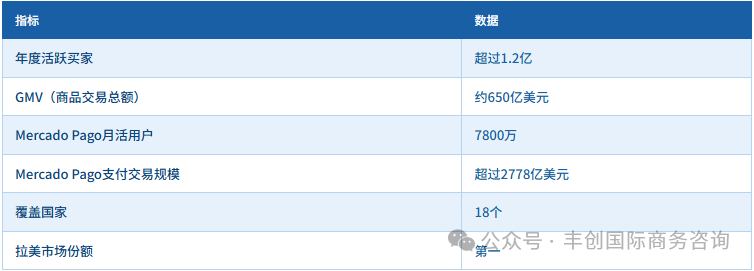
Many people still think of Mercado Libre as the ”Latin American version of Taobao.” But here are the actual figures:
120 million active buyersWhat does that mean? Amazon has approximately 200 million Prime members worldwide, but they are spread across more than a dozen markets. Meikeduo's 120 million members are concentrated inLatin AmericaA regional market.
What does $65 billion in GMV mean? It’s higher than Shopee’s total platform GMV and more than double what Mercado Libre itself reported five years ago.
This is not a ”niche platform.” It connects to hundreds of millions of consumers among Latin America’s 650 million people. —
II. Why Is Latin American E-commerce Entering a Golden Window of Opportunity?
Looking at the global e-commerce landscape, one can see a clear tiering:
First Tier (Europe and the United States): The market is highly mature, with a penetration rate exceeding 80%; competition is fierce, and growth has plateaued.
Second Tier (Southeast Asia): After three years of explosive growth, Shopee, Lazada, and TikTok Shop have seen a massive influx of sellers, and competition has already begun to intensify.
Third Tier (Latin America): Penetration rates are still on the rise, infrastructure is being expanded, and there are still many gaps in the competitive landscape.
The Latin American retail e-commerce market is projected to reach approximately $191 billion in 2025, representing year-over-year growth of more than 12%. This growth rate may not seem particularly impressive, but it’s important to note that growth in Europe and the United States has already fallen below 5% during the same period. Latin America is one of the few regional markets still experiencing double-digit growth.
Why does Latin America still have such significant room for growth? Three underlying reasons:
First, the population has a young demographic structure.
Latin America has a population of 650 million, with a median age of approximately 31. In comparison, the United States (38), Japan (48), and Europe (44),Latin America is one of the world's youngest consumer markets. Young consumers are characterized by:Quick to embrace online shopping, highly reliant on mobile payments, and naturally drawn to social e-commerceThe
Second, the Internet and digital payments are undergoing a major transformation.
In many Latin American countries, the traditional banking system is underdeveloped, and a large number of consumers do not have credit cards. However, this has actually spurred a leapfrog development—skipping the credit card era altogether and moving directly into the era of digital wallets and mobile payments.
Mercado Pago emerged against this backdrop, with 78 million monthly active users and a payment transaction volume of $277.8 billion.
This isn’t about ”catching up” with Europe and the United States; it’s about ”skipping” the old path taken by Europe and the United States and moving directly into a new phase.
Third, the e-commerce infrastructure is being developed.
In the past, it wasn’t demand that limited e-commerce in Latin America, but rather the supply side—inefficient logistics, a lack of payment systems, and weak delivery capabilities. But now, Meituan, Amazon, and TikTok Shop are all continuing to invest in warehousing and logistics.
The market is transitioning from a phase where ”people want to buy but can’t” to one where ”people can buy and have it delivered.”
Taken together, these three factors form the underlying logic behind the golden opportunity for e-commerce in Latin America:The demand has long existed, the infrastructure is being put in place, and competition has not yet intensified.。——
III. Meikeduo is not just an e-commerce platform; it is a business ecosystem.
Don't try to cover all four stations right off the bat. Ask yourself these three questions:
The biggest misconception about Meike Duo is viewing it as ”just another e-commerce platform.”
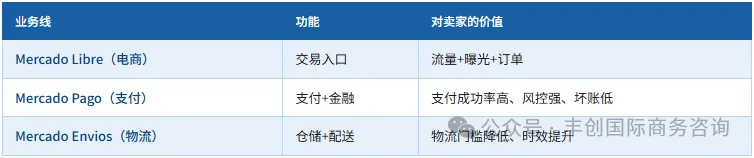
What makes it truly powerful is that it replicates Amazon's ecosystem model—It's not just about selling products; it's about integrating transactions, payments, logistics, and financial services.
1. Mercado Libre (e-commerce): A source of traffic
This is the core business of e-commerce platforms. Electronics, home goods, apparel, beauty products, auto parts, and daily necessities—for Chinese sellers, there are opportunities in nearly every category with an established supply chain.
The key point is that Meituan’s traffic allocation logic is still relatively favorable at this stage. Compared to Amazon in its mature phase, Meituan has less competition for ads, lower CPCs, and more opportunities for new products to gain exposure. This isn’t because the platform’s algorithm is particularly lenient; it’s because sellers haven’t yet reached that level of intense competition.
But this window won't stay open forever.
2. Mercado Pago (Payment): The Foundation of Data
Anyone who’s worked in the Latin American payments industry knows just how challenging it is. Insufficient coverage by traditional banks, low credit card penetration, and complex cross-border payment processes—these were once the biggest obstacles facing e-commerce in Latin America.
Mercado's solution is to build its own payment system. Mercado Pago has 78 million monthly active users and processes $277.8 billion in payment transactions. This means that Mercado has access not only to order data but also to consumer payment data and financial behavior.
What does this mean for sellers? It means the platform has extremely robust risk management capabilities and consumer credit assessment capabilities. Low fraud rates, low bad debt rates, and high payment success rates—these are all tangible operational advantages.
3. Mercado Envios (Logistics): The Cornerstone of Delivery
One of the biggest headaches for cross-border sellers: how to get products into consumers’ hands. Logistics infrastructure in Latin America is not as developed as in Europe and the United States, and last-mile delivery is a bottleneck in many regions.
Meituan continues to invest in its own logistics system, including warehousing centers, a delivery fleet, and a last-mile delivery network. This approach is increasingly resembling Amazon’s FBA model—the platform provides traffic, payment processing, and logistics, while sellers only need to focus on their products.
For cross-border sellers, this means:The barriers to entry in the logistics sector will gradually decrease, but those who establish a local warehousing presence early on will reap the benefits of being first to the market.
When you look at these three business lines together, you’ll understand Meikeduo’s true competitive advantage:
These aren’t three separate products; they’re a closed-loop business ecosystem in which they feed data to one another. Amazon spent a decade paving the way, and Mercado Libre is now following in its footsteps in Latin America.
(Contact Meikeduo at +csdrcc12345 or scan the QR code below))
——
IV. Who Exactly Are Meike Duo's Consumers?
“Do Latin American consumers have purchasing power?”—This is the question Chinese sellers ask most often.
The answer is:Yes, and it's increasing rapidly.The
Mexico: A population of 130 million—the easiest market for Chinese sellers to tap into
Mexico is one of Meitekuo’s most important markets. With a population of 130 million, its proximity to the United States, steadily rising internet penetration, and a large consumer market, Mexico offers significant potential. At the same time, Mexican consumers have a high level of acceptance for Chinese products—for many daily necessities, electronic accessories, and fast-moving consumer goods, Mexican consumers have come to view ”Chinese products” as offering excellent value for money.
For many Chinese sellers,Mexico is the first stop in Latin America. With a relatively low language barrier (Spanish, with manageable learning costs), predictable shipping times (approximately 20–25 days by sea from China to Mexico), and an average order value of $20–$50, small FMCG items are the easiest to succeed with.
Brazil: 215 million people—the biggest pie, but the hardest to slice
Brazil is Latin America's largest economy, with a population of 215 million and an e-commerce market valued at $156.2 billion. This market'sThe ceiling is very high, but the bar is high, too.—The language is Portuguese, not Spanish; the tax system is complex (tax laws vary by state); the logistics chain is long; and compliance requirements are strict.
Brazilian consumers value quality and design....The 25- to 34-year-old demographic accounted for 58% in GMV. They don’t just look at price; they consider whether a product is ”worth it.” This consumer mindset is more similar to that in Europe and the United States than to that in Southeast Asia.
International brands prioritize expanding into Brazil because of its large market size. However, small and medium-sized sellers entering the Brazilian market must be prepared in terms of compliance and logistics.
Argentina, Chile, Colombia: Small in Size but Growing Rapidly
Although these three markets are smaller than MoBa, they each have their own unique characteristics:
Argentina: Meike Duo is the hub, but inflation is severe, and pricing and exchange rate management are the biggest challenges.
Chile: One of the most stable markets in Latin America, with consumers showing extremely high acceptance of cross-border products; niche categories tend to generate sales easily.
Colombia:A blue-ocean marketplace with the least competition; 54% users shop via social commerce, making it ideal for sellers with social media management skills.
For Chinese sellers, there are significant differences in purchasing power across these four markets. However, they all have one thing in common:They’re all growing, they all have a need for China’s supply chain, and they haven’t yet been flooded with Chinese sellers.——
V. Why is joining Meiketuo now equivalent to joining Amazon ten years ago?
Looking back at Amazon's growth trajectory:
2006–2012 (Early Years): Low competition, rapid platform expansion, the recent launch of FBA, and easy access to traffic for sellers. Sellers who entered the market early enjoyed significant first-mover advantages.
2013–2019 (Growth Period): With a large number of sellers entering the market and the advertising system now mature, competition is beginning to intensify, but there are still structural opportunities.
2020–present (Maturity Phase): Soaring CPC costs for ads, high barriers to getting reviews, frequent policy changes, and continuously shrinking profit margins. The barriers to entry for new sellers are already very high.
Take a look at Meike Duo now:
GMV is projected to grow from approximately $20 billion in 2020 to approximately $65 billion in 2025....It has tripled in five years. The number of active buyers has grown from less than 50 million to 120 million. This growth curve closely resembles that of Amazon from 2010 to 2015.
The advertising business is just beginning to be systematized, and CPC is significantly lower than on Amazon. The exposure mechanism for new products is still being optimized. The local warehousing and logistics network is currently being expanded. Many product categories remain untapped—if you search for a category, you’ll find that many listings still feature white-background images and basic titles, without even an A+ page.
Isn't this just what Amazon was like ten years ago?
But let’s be clear: this doesn’t mean ”you can just list anything and it’ll be a hit.” These days, sellers on Meike Duo who actually achieve results need to have three key skills:
First, it has a well-established supply chain. China’s supply chain remains its greatest advantage. Only a supply chain that outperforms local competitors in price, quality, and delivery times can gain a foothold on MeKeduo.
Second, the ability to effectively manage localized operations. Brazil uses Portuguese, while other sites use Spanish—but even among Spanish-speaking countries, search keywords and consumer habits in Mexico, Chile, and Colombia are completely different. Machine-translated product listings have extremely low conversion rates, so localized operations are an absolute necessity.
Third, plan your compliance structure in advance. INMETRO/ANVISA certification in Brazil, NOM certification in Mexico, and tax registration at each location—these aren’t optional; they’re prerequisites. Ensure compliance before listing your products; don’t wait until they’ve been delisted to fix the issues.
——
VI. Where will Meikeduo’s greatest opportunities lie in the coming years?
Looking at Meikeduo’s future direction, there are three areas that deserve the most attention:
1. Local Warehousing and Logistics
Consumers are placing increasing importance onDelivery Speed. The biggest bottleneck for the cross-border direct shipping model in Latin America is delivery time—a 7- to 15-day delivery window that causes return rates to skyrocket on the Mexico marketplace.
Meike Duo is expanding its warehouse and distribution network, moving increasingly toward a model similar to FBA. Sellers who establish a local warehouse presence early on will enjoy two benefits: higher conversion rates driven by faster delivery times, and increased profit margins resulting from lower logistics costs.
The first people to set up local warehouses were the same ones who were among the first to use FBA ten years ago.
2. Branding
In the past, Latin American consumers were not particularly brand-conscious due to limited choices. However, as the market matures, consumers are paying increasing attention to brands, reviews, and service quality. The window of opportunity for low-priced, unbranded products will gradually narrow.
For brand-conscious sellers, now is the best time to build brand equity. If you wait until the market is fully mature to build your brand, the cost will be ten times higher.
3. Structural Advantages of China’s Supply Chain
What is currently most lacking in the Latin American market? It’s not demand—it’sSupply. Cost-effective products, a mature supply chain, and a wide range of SKUs—these are precisely the strengths of Chinese companies.
Many Latin American product categories are still untapped—it’s not that consumers aren’t buying, but that no one is selling. A product that’s a dime a dozen on Yiwu’s 1688 might rank among the top three in its category on Mercado Libre.
As China’s supply chains expand overseas and Latin America’s e-commerce infrastructure matures, a historic convergence is taking shape. ——
VII. Meike Duo: Possibly the Next Growth Opportunity in Cross-Border E-Commerce
Over the past decade, many Chinese sellers have taken their first steps toward global expansion through Amazon.
Over the next decade, new growth may come from Latin America.
Mercado Libre connects to a market of 650 million people, 120 million active buyers, 65 billion in GMV, a payment ecosystem experiencing triple-digit growth, and an expanding logistics network. It is not the ”Latin American version of Taobao”; it is Latin America’s commercial infrastructure.
The question now is:Before competition heats up, are you ready to secure your place in the ecosystem early on?
The people who made money on Amazon ten years ago didn’t do so because they were smarter, but because they got in earlier.
Will Meikeduo follow the same path ten years from now?
Want to know how to open a local store on Meikeduo? Which platform is best suited for your product sources? What are the onboarding process and tips for avoiding pitfalls?
Scan the QR code below or message me directly at +csdrcc12345, and I’ll send you the complete onboarding process and product selection lists for the four platforms.
Tags:
Latin America
Mercado Local Store
México Mercado
Meccadot onboarding
Mercado, French supermarket chain
Recommended
Cross-border e-commerce B2B must see! Registered Hong Kong company stationed in the Ali International Station, really fragrant!
In today's globalized business environment, the cross-border e-commerce B2B model is rapidly emerging with its unique advantages. For many enterprises engaged in cross-border trade, choosing a suitable platform and registering an advantageous company are undoubtedly the key keys to open the door to the international market.
2024 Hong Kong Company Account Opening Tips! How to choose the right Hong Kong bank account?
Global anti-money laundering regulations are becoming more and more stringent, the banks to maintain an account of the sunk cost is getting higher and higher, not moving hundreds of millions of dollars in fines, so that the major banks to open an account threshold as well as the audit process high up, already have a Hong Kong company bosses, how to choose the Hong Kong bank to open a public account? How much does it cost and how to operate? Today to give you a detailed introduction to the Hong Kong company account how to choose, as well as the approximate costs required and other content.
Hong Kong company registration advantages + registration conditions + registration process to share!
If you want to start a business and develop overseas markets, registering a Hong Kong company is undoubtedly a very forward-looking choice. With its unique geographical location, sound legal system, low tax rate and open business environment, Hong Kong company has become a "sharp weapon" for many business owners to open up overseas markets. Why is it so important to register a Hong Kong company in 2024?