The company's annual sales are approaching 5 million. How should we plan for the future?
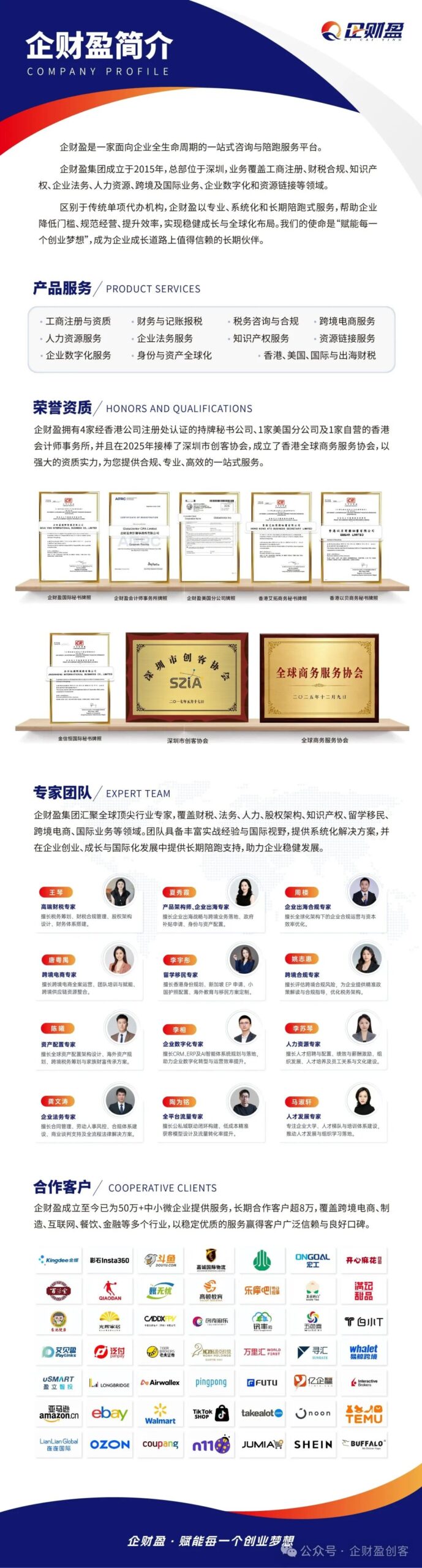
QCY As a professional one-stop business service platform, we are committed to providing our clients with company registration services in major mainland cities such as Beijing, Shanghai, Guangzhou, Shenzhen, and Hangzhou, Cross-Border E-Commerce Services , Hong Kong company registration, offshore company registration, bookkeeping and tax filing, annual reviews and audits, corporate bank account opening, financial and tax compliance, equity structure planning, ODI filing, cross-border e-commerce services, Hong Kong residency, immigration, and study abroad—we provide high-quality services to support businesses in their global expansion.
To request materials and a quote, please contact me (WeChat/phone: JXH23314 ).
Lately, many sellers have been asking:
“Our company’s annual sales are about to reach 5 million. I’ve heard that we’ll automatically be classified as a general taxpayer—will our tax burden increase?”
“I haven’t really requested input invoices in the past. What should I do now that I’ve become a general taxpayer?”
“Is there any way to stay under the 5 million mark?”
Instead of answering one by one, let’s lay out the risks and planning strategies related to the “5 million yuan threshold for small-scale taxpayers” all at once. One policy red line, two levels of tax burden changes, and one set of proactive planning strategies. Once you’ve read this, you’ll have your answers.
This article will outline the tax implications and early planning strategies for small-scale taxpayers when their annual sales reach 5 million.If you need a design proposal, you can also contact our online customer service (WeChat: JXH23314) to have a manager address your questions, provide professional advice, and offer one-on-one service throughout the entire process~
Before reaching 5 million, you're considered “small-scale”; once you exceed 5 million, the system automatically switches.
Many sellers only realize once they reach a certain scale that hitting 5 million isn’t a matter of whether you want to cross that threshold—it’s when the system automatically transfers the funds for you.
According to the “Value-Added Tax Law of the People’s Republic of China,” small-scale taxpayers are defined as those with annual taxable sales subject to value-added tax of 5 million yuan or less. If, during a consecutive business period not exceeding 12 months or four quarters, the cumulative taxable sales subject to value-added tax exceed 5 million yuan, the taxpayer must register as a general taxpayer with the competent tax authority, except in special circumstances.
It’s only when you look at it from a different angle that you realize—the tax calculation method is completely different.
The 5 million isn't a suggestion—it's a legal requirement that you must transfer it. If you don't, expect the tax authorities to come knocking.
With two different tax calculation methods, the difference in tax burden could double.
Small-scale taxpayers are taxed at a collection rate of 3%, while general taxpayers are taxed at a rate of 13%. The key difference lies in the input invoices —Small-scale businesses can enjoy a low tax rate even without input tax credits, while general taxpayers must have full input tax credits to reduce their tax burden.
Small-scale taxpayers: Pay taxes based on a percentage of their revenue
Small-scale taxpayers calculate their tax based on the collection rate; currently, a collection rate of 3% applies, and VAT is exempted for monthly sales of 100,000 yuan or less. If quarterly sales exceed 300,000 yuan, the tax may be levied at a reduced rate of 1%.
General Taxpayers: Pay Tax Based on the Value-Added Amount
General taxpayers calculate their taxes based on the applicable tax rate; cross-border e-commerce companies are typically subject to the 13% tax rate.
The tax calculation formula is: Tax payable = Output tax – Input tax.
What's the difference?
① Small-scale taxpayers can benefit from lower tax rates even without input invoices.
② General taxpayers must have a complete set of input invoices in order to reduce their tax burden.
Many cross-border e-commerce sellers are unable to obtain invoices—or cannot obtain complete sets of them—from their suppliers, and their logistics and advertising expenses are not recorded in their books. It is only after they become general taxpayers that they realize: With revenue falling far short of expectations, the tax burden has effectively doubled.
Small-scale 3% vs. general taxpayer 13%—the numbers seem four times different, but the real issue is: how much of your input tax can you claim as a credit?
If you haven't reached 5 million yet, these next few months are your last chance.
If your company's annual sales are still below 5 million, these past few months have been your last chance to make adjustments. Once sales exceed 5 million, it becomes much more difficult to make changes.
✅ Suggestion 1: Start by breaking down the business
Spread the sales revenue across multiple entities so that none of them exceeds the 5 million threshold. However, please note: The two companies must engage in genuine, independent operations; otherwise, they may be deemed to be evading taxes.
✅ Suggestion 2: Record all costs and expenses in the books
For procurement, logistics, and advertising expenses, request invoices whenever possible. This is to prepare for input tax credits after becoming a general taxpayer.
✅ Recommendation 3: Estimate the tax burden in advance after transitioning to general taxpayer status
Take the time to review the company’s procurement costs and expense invoices in advance, calculate the actual tax burden after transitioning to general taxpayer status, and make sure you have a clear understanding of the situation.
Plan ahead. Once the system automatically reassigns you, it’ll be too late to request a transfer.
The 5 million mark—you absolutely must plan ahead!
Qicaiying offers a one-stop solution for tax planning tailored to small-scale taxpayers, with end-to-end, one-on-one support from a professional tax team to help you smoothly navigate the 5 million threshold and avoid a sharp increase in your tax burden.
If you’re unsure how your company is structured, you can scan the QR code, and we’ll arrange for a professional consultant to conduct a free preliminary assessment so you can identify potential risks before developing a plan. You can also scan the QR code to add our online customer service representative (WeChat ID: JXH23314) to connect with a professional consultant who will answer your questions and provide end-to-end, one-on-one service ↓↓↓