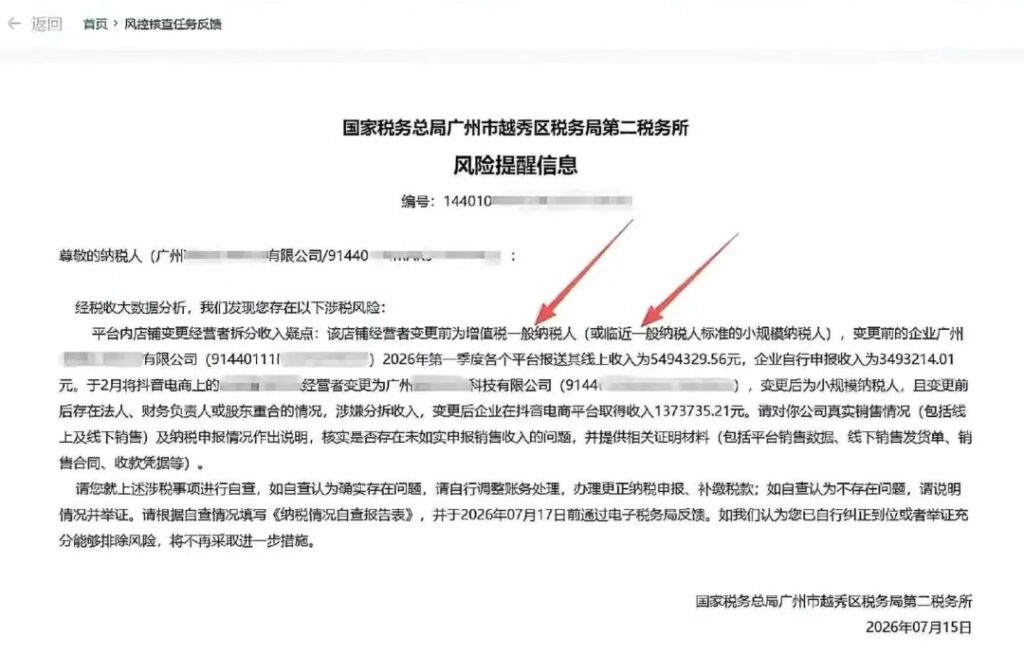
Attention Taobao Individual C-Store Sellers! The platform has begun routine reporting of tax-related information, and some sellers have already received reminders to pay back taxes.
Published: July 23, 2026
Recently, we have been receiving a steady stream of inquiries from individual C-store sellers on Taobao.
Some people have received calls from the tax authorities asking them to verify their platform’s business data; others have received text messages or written notices requiring them to file amended returns and pay back taxes within a specified timeframe. Industry chat groups and private messages are filled with anxious voices.
“I don’t have a business license—do I still have to pay taxes?”
“There’s such a big difference between the platform’s transaction volume and what I actually receive—which figure should I use?”
“Will they bring up past issues? Will I be able to keep the store open after making the payments?”
Everyone wants to know the answers to these questions. But many sellers don’t even know who to ask or where to start.
If you also run a Taobao C-Store and have recently received calls, text messages, or risk alerts from the tax authorities, we recommend that you read this article carefully. Scan the QR code to contact Qicaiying’s online customer service (WeChat ID: jxhqcy890 / Mobile: 16625410105) 👉 Based on your specific situation, we’ll assign a professional consultant to address your concerns and provide one-on-one, end-to-end compliance solutions.
01Why are small businesses now in the spotlight?
Many sellers have a misconception:If you don't have a business license, you don't have to pay taxes.
This perception is incorrect.
Under current Value-Added Tax and Individual Income Tax regulations, individuals engaged in business activities are not exempt from their tax obligations simply because they have not obtained a business license or displayed their business registration certificate.
Why was everything fine in the past, but now I’m suddenly being investigated? The key change lies inThe platform's data is fully integrated with the tax system.The
The "Regulations on the Reporting of Tax-Related Information by Internet Platform Companies," which took effect in June 2025, explicitly require that:E-commerce platforms are required to submit all transaction data for merchants to the tax authorities on a quarterly basis.The
Your store name, registration information, order totals, refund history, commissions, subsidies, and settlement statements—it’s all included.
In the past, the platform would report some of this information, but the reports were incomplete and had gaps. Now it’s different,Individual C-stores and corporate stores are treated equally, and all data is reported.The
The Golden Tax Phase IV system automatically compares two sets of data:Sales reported by the platform vs. your reported income. As soon as a discrepancy occurs, the system immediately triggers an alert.
You might think that since you “didn’t report it,” no one will know, but the platform has already submitted the data.
.
02The Real Struggles of a Taobao C-Store Clothing Seller
Recently, a client who has long operated a Taobao clothing store as an individual business owner reached out to us.
This store has been in business for many years, and its traffic and sales have remained relatively stable. The client had considered incorporating the business but was concerned that changing the legal entity might affect the store’s search ranking and historical operational data, so they never went through with it.
Proceeds from the store are primarily deposited into Alipay and personal bank accounts.
There were indeed quite a few expenses related to clothing procurement, shipping, warehousing, packaging, "Direct Express" advertising, platform service fees, photography and models, and after-sales compensation, among others.
The problem is that the client has not kept systematic records in the past.
Some purchases are documented only by bank transfer records, without complete contracts or invoices; some promotional expenses were paid from personal accounts; and data on platform refunds, returns, subsidies, and settlements was not organized on a monthly basis.
Until recently, the client suddenly received a call from the tax authorities informing them that there were discrepancies between the platform’s operating data and historical tax filings, and that the relevant information needed to be verified.
It was only then that he realized he couldn’t immediately answer a few important questions:
What is the exact amount of revenue shown on the platform? How many of those orders have been refunded, returned, or canceled? How much money was actually received via Alipay and bank cards? How much has already been reported? How much of the procurement, marketing, and personnel costs can still be substantiated? How much additional tax might ultimately need to be paid? Will there be late payment penalties or other consequences? Can the store continue to operate? Should I set up a company right away?
This is also a common problem faced by many individual C-stores on Taobao.
It’s not that the store has absolutely no costs, nor is it necessarily the case that the seller is intentionally underreporting them; rather, after many years in business, it has become impossible to accurately match platform orders, cash flow, cost documentation, and historical reporting.
It wasn’t until the tax authorities requested an explanation that the seller realized they didn’t have complete data on the store’s actual revenue and profits.
.
03 You should pay special attention to these types of Taobao C-stores run by individual sellers
Not all Taobao stores will receive a tax payment notice.
Based on actual business conditions, the risks associated with the following categories of sellers are relatively more concentrated.
1. The store has high sales volume, but it has always been operated as a sole proprietorship.
Many Taobao C-stores started out as side businesses for individuals; while their sales gradually increased over time, the store’s registered entity, payment account, and tax filing methods were never updated accordingly.
The store still looks like a small, family-run shop, but its actual scale of operations has clearly expanded.
If there is a significant discrepancy between the income reported by the platform and the individual’s historical tax filing data, it may trigger further verification. .
2. The store has been in business for many years, but has never established a systematic accounting system.
Many individual sellers typically focus only on sales volume, marketing spend, and their bank account balances, without keeping a complete record of their monthly income, refunds, purchases, and expenses.
In the absence of any tax notices, this business model does not appear to have any significant impact.
When it comes to providing historical data, sellers may not even be able to accurately reconstruct their annual valid sales volume, refund amounts, and actual profits.
At this point, what’s truly causing anxiety isn’t just how much back taxes to pay, but the fact that you have no idea which number to use as the starting point for your calculations. .
3. There is a significant discrepancy between the platform’s transaction volume and reported revenue
The order amount displayed on the platform does not usually correspond exactly to the seller’s actual, net income.
These may include:Order Cancellation; Refunds and Returns; Partial Refunds; Platform Subsidies; Merchant Discounts; Cross-Period Settlement; Uncompleted Transactions.
Therefore.A high platform turnover does not necessarily mean that taxes must be calculated based on the total turnover.
The problem is that if the seller does not have a complete record of orders, refunds, and settlements, it is difficult to prove which amounts need to be deducted.
“We have a lot of returns at our store” is just an explanation. An effective explanation can only be provided by referencing specific orders, refund records, and settlement data. .
4. Actual profits are not high, but there is insufficient documentation of costs
For example, a clothing store may appear to have high sales, but in reality, it may be incurring significant costs:
Clothing procurement, shipping, warehousing, packaging, advertising fees (such as for "Direct Express"), platform service fees, photography and modeling fees, after-sales compensation, rent, and employee salaries. .
A common challenge for many individual sellers is that while these costs were actually incurred, the supporting documentation is incomplete.
Payments for purchases were transferred to suppliers without invoices or contracts; promotional expenses were paid from personal accounts; expenses for photography, models, and temporary staff were documented only by simple transfer records; and some purchases lacked even warehouse receipt records.
When sellers need to prove their actual profits, they realize that “having spent this money” is not the same as “being able to prove this business expense.”
Sellers with individual Taobao stores can start by conducting a self-assessment. If your store falls under any of the above categories, we recommend evaluating the situation as soon as possible. Not sure if your store has any reporting discrepancies, or unsure how to respond after receiving a notification?
👉 Scan the QR code to add our online customer service representative (WeChat ID: jxhqcy890 / Cell: 16625410105), we will arrange for a professional consultant to address your questions based on your specific situation and provide one-on-one service for a comprehensive compliance solution throughout the entire process.
04 Not having a business license does not mean you are not required to pay taxes.
Whether individual sellers are required to pay value-added tax, individual income tax, and other relevant taxes and fees depends on factors such as the scale of their operations, the continuity of their business activities, their taxpayer status, the period during which the transactions occurred, and applicable policies.
This should not be simply interpreted as:“If you don’t have a business license, you don’t have to pay taxes.”
Nor can we simply say:“All individual Taobao stores must be calculated based on the platform's total transaction volume.”
The specific procedures for filing, eligibility for applicable tax incentives, and the recognition of costs and expenses should be analyzed based on the store’s actual operating conditions.
For example: If monthly sales are 150,000, a sole proprietor may not have to pay VAT as long as quarterly sales remain under 300,000, butIndividual stores must pay the full amount based on the 1% rate.——The VAT alone is 1,500 yuan, plus a few hundred yuan in surcharges.The
Individual Income Tax: Business Income, Progressive Tax Rate: 5%–35%
Income from individual stores is classified as “business income” and is subject to5%-35% Five-Tier Excessive Progressive Tax Rate. The taxable income for business operations is the balance remaining after deducting costs, expenses, and losses from total revenue.
Many people believe that “whatever you earn is yours,” but that way of thinking is outdated.
A Real-Life Case Study::An individual C-store selling clothing achieved a total platform turnover of 2.8 million yuan in 2025 but has never filed a tax return. Calculated using the 10% profit margin for individual business income, the taxable income is 280,000 yuan, which is subject to the 20% tax rate,The back taxes alone amount to nearly 45,500 yuan., plus late fees and penalties,The total cost will ultimately range from 70,000 to 100,000 yuan.The
.
05 Converting a sole proprietorship to a corporation now does not automatically resolve past issues.
After some sellers received tax reminders,My first thought was to immediately set up a company and transfer the Taobao store to the company's name.
However, changing the business entity primarily addresses future operational arrangements and does not automatically resolve historical filing issues that arose during the period of individual operation.
If the transition isn't complete, it could lead to further confusion:
The store is registered under an individual's name, yet some of the payment for the goods goes into the company's account;
The purchase invoice was issued to the company, but the sales revenue was generated during the individual business phase;
Marketing expenses and employee salaries are paid by the company, but it is unclear which part of the business they correspond to;
There is a lack of documentation regarding the contract between the individual and the company, as well as records of collection and payment on behalf of the company and the transfer of assets.
Ultimately, personal and business income and expenses may become intertwined, making it even more difficult to reconcile them later.Therefore, the decision to switch to a sole proprietorship or a corporation should not be based solely on tax rates, nor should it be made hastily simply because a notice has been received.
A more reasonable approach is to first verify historical business data and then, taking into account the store’s size, platform rules, procurement and invoicing, financial settlements, and staffing arrangements, determine the entity that will continue operations.
.
06 The focus of compliance is not limited to calculating the amount of back taxes owed
The focus of compliance processing goes beyond simply calculating the amount of back taxes owed. For Taobao C-stores, we typically prioritize addressing four key issues.
First, verify the scope of risk
First, we need to determine which tax years and tax types are involved, what the platform-reported income is, and how significant the discrepancies are compared to historical filings.
Second, reflect actual operating results
Compare platform orders, refunds and returns, subsidies, settlements, Alipay, bank cards, invoicing, and historical reports to verify the authenticity and validity of completed transactions.
Third, organize the evidence regarding costs
Take into account procurement, shipping, warehousing, marketing, platform service fees, and personnel expenses to determine to what extent the available data can substantiate the actual operating costs.
Fourth, develop a follow-up corrective action plan
Based on the calculation results and the criteria confirmed by the competent tax authority, file the corresponding tax returns and, at the same time, standardize subsequent accounting, collections, procurement, and entity management.
The value of professional services lies not in promising in advance “how much less tax you’ll have to pay,” but in helping sellers clarify the relationship between their platform transaction volume, actual income, operating costs, and historical tax filings.
Now that the submission of tax-related information by the platform has become routine,Individual Taobao sellers continue to rely on the notions that “if no invoice is issued, there’s no need to file a tax return,” “if the platform has deducted fees, that’s equivalent to paying taxes,” and “I have high sales volume but no profit.”Based on experience, the risk is expected to increase.
Platform transaction volume does not necessarily equal the final taxable income, but each discrepancy must be supported by accurate data and evidence.
If you’re running a Taobao C-Store as an individual seller and are concerned that your platform data doesn’t match your historical tax filings, or if you’ve already received calls, text messages, or tax payment reminders from the tax authorities,You can reply with “Taobao Compliance.”
We will first review the notice, platform orders, refund records, fund flow statements, cost documentation, and historical tax filings to determine the scope of the discrepancies, and then evaluate options for filing supplementary returns, organizing cost evidence, and implementing a plan to bring the entity into compliance.
Don’t promise results without understanding the data; first, get a clear picture of the actual business situation.
👉 Scan the QR code to add our online customer service representative (WeChat ID: jxhqcy890 / Mobile: 16625410105)), arranging professional managers to answer queries and provideFull Process Compliance ProgramOne-to-one service ↓↓↓
Tags:
Taobao C-Store
E-commerce tax compliance
Financial and Tax Compliance
Recommended
Cross-border e-commerce B2B must see! Registered Hong Kong company stationed in the Ali International Station, really fragrant!
In today's globalized business environment, the cross-border e-commerce B2B model is rapidly emerging with its unique advantages. For many enterprises engaged in cross-border trade, choosing a suitable platform and registering an advantageous company are undoubtedly the key keys to open the door to the international market.
2024 Hong Kong Company Account Opening Tips! How to choose the right Hong Kong bank account?
Global anti-money laundering regulations are becoming more and more stringent, the banks to maintain an account of the sunk cost is getting higher and higher, not moving hundreds of millions of dollars in fines, so that the major banks to open an account threshold as well as the audit process high up, already have a Hong Kong company bosses, how to choose the Hong Kong bank to open a public account? How much does it cost and how to operate? Today to give you a detailed introduction to the Hong Kong company account how to choose, as well as the approximate costs required and other content.
Hong Kong company registration advantages + registration conditions + registration process to share!
If you want to start a business and develop overseas markets, registering a Hong Kong company is undoubtedly a very forward-looking choice. With its unique geographical location, sound legal system, low tax rate and open business environment, Hong Kong company has become a "sharp weapon" for many business owners to open up overseas markets. Why is it so important to register a Hong Kong company in 2024?