7 Cases, Nearly 30 Million in Fines! The Tax Authorities Are Getting Serious This Time—Under the New Rules, These Red Lines Must Not Be Crossed
Published: July 20, 2026
In the past, when tax evasion was uncovered, the amount of the fine depended largely on which province you were in—for the same amount of tax owed, some places would impose a fine of one times the amount, while a neighboring province might impose a fine of three times the amount. This situation is about to come to an end.
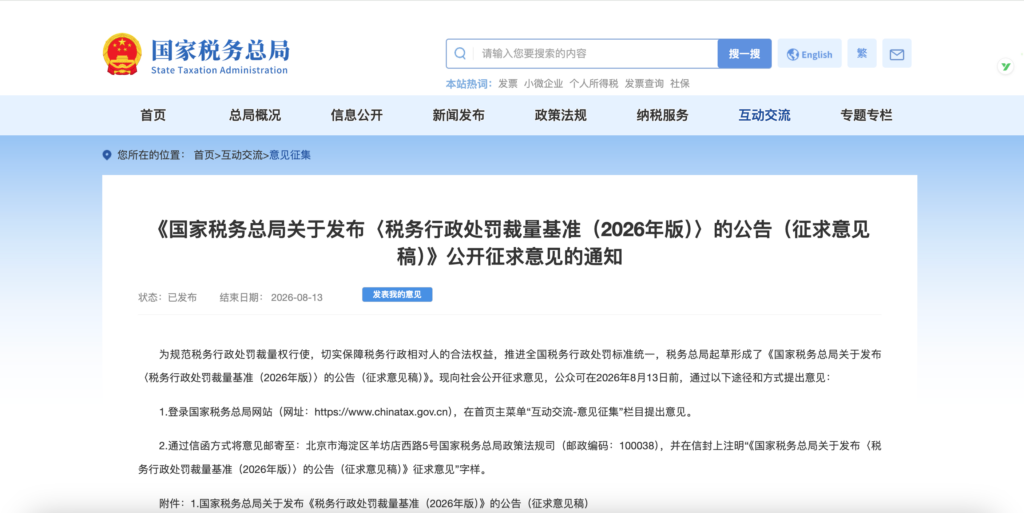
On the evening of July 16, the State Taxation Administration published a draft of the “Benchmarks for Discretion in Tax Administrative Penalties (2026 Edition)” on its website, establishing for the first time systematic and unified standards for discretion in tax administrative penalties. At the same time, tax authorities recently publicly disclosed seven cases of tax evasion involving online streamers and online stores, which resulted in a total underpayment of 16,185,100 yuan in taxes and fees. Ultimately, 29,644,500 yuan was collected in back taxes, late payment penalties, and fines.
New regulations are here, and so are the case studies. This article will help you get a clear understanding of everything at once:What Will the Penalties for Tax Evasion Be in the Future? Which Actions Are the Most Risky?
"one" radical in Chinese characters (Kangxi radical 1), Key Points of the New Regulations:The amount of the fine depends on how many times you've committed the offense and whether you cooperate.
The new regulations cover tax registration, accounting records and supporting documents, tax filing, tax collection, and invoice management, among other areas.66 items in 9 major categoriesFor each penalty provision, the legal basis, levels of discretion, conditions for application, and specific criteria are clearly specified. According to a spokesperson for the State Taxation Administration, the new regulations have three key features: a unified structure that lists the legal basis, levels of discretion, conditions for application, and specific criteria for each provision, making them easy to understand and implement.
Taking the most common form of tax evasion (Article 63 of the Tax Collection and Administration Law) as an example, the multiplier for fines ranges from0.5 to 5 times. How is it determined? It mainly depends on three factors:
First, look at the number of times.
Whether it’s your first offense within five years or your second or subsequent offense, the fine amount jumps to the next tier.
Second, look at their attitude.
The difference—whether you cooperate with the inspection or refuse to do so—can be as much as several times greater.
Third, look at the amount.
The amount of tax evaded as a percentage of the tax due—10%—serves as a threshold: exceeding this threshold means you’re immediately disqualified from the leniency bracket.
The new regulations also include eight instances where “minor violations will not be penalized”—that is, penalties may be waived if the violation occurs for the first time, is promptly corrected, and does not result in any harmful consequences. This is good news for small and medium-sized enterprises, as minor oversights will not result in immediate fines,Provided that the changes are made in a timely mannerThe
II. Seven Cases Exposed: These “Routine Practices” Are All Landmines
Just as public comments were being solicited on the new regulations, tax authorities publicly disclosed seven cases of tax evasion involving online streamers and online stores. The tax evasion methods used in these cases are essentially the same tactics that many businesses employ on a daily basis.
Type 1: Concealing income by receiving payments through personal accounts.
Xu Jingwan, a live-streamer with 6 million followers, received payments for goods and product placement fees through her personal accounts from 2021 to 2023. By concealing her income and reclassifying its nature, she underpaid taxes and fees by 3,134,500 yuan. Ultimately, she was required to pay a total of 6,319,600 yuan in back taxes and penalties. Tax authorities discovered that the tax return data for the two online stores she promoted showed zero revenue, which was highly inconsistent with their publicly reported sales figures.Many merchants are in the habit of accepting payments through their personal WeChat and Alipay accounts, assuming that no one checks the transaction history of personal accounts—but that line of reasoning no longer holds true.The
Type 2: Zero-reporting with revenue.
Wang Yifang, a live-streamer with one million followers, earned substantial income by promoting medical aesthetics on the platform to drive traffic, but her business entity consistently filed zero tax returns. Ultimately, she was required to pay back taxes, late payment penalties, and a fine totaling 1.8537 million yuan.Many sole proprietors have normal sales at their stores but consistently report zero revenue to the tax authorities; now, as soon as the platform’s transaction records are compared with tax data, the discrepancy becomes immediately apparent.The
Option 3: Reduce the tax burden by changing the nature of income.
Live streamer Chen Xu “converted” his live-streaming tip income into company revenue, reclassifying his personal service income as business income to illegally reduce his tax rate. Registering a company is not illegal in itself, but if the company lacks staff, physical premises, and genuine business operations—and is used solely to disguise income—it may be deemed a false tax filing.
Type 4: Abandonment-style deregistration.
Liaocheng Milk Foam Trading Department is a sole proprietorship operating an online store with annual revenue of 200 million yuan. It had never filed tax returns since its establishment and sought to close its business in July 2024 to put an end to the matter once and for all. However, in 2025, tax authorities still tracked down the actual controller and collected 9.7129 million yuan in back taxes.Many business owners believe that once a business is deregistered, all liability is eliminated—this is the biggest misconception. For individually owned businesses, the operator is personally liable for debts with their personal assets; deregistration does not eliminate tax obligations that arose during the period of operation.The
Type 5: Mixing fake orders with actual revenue and failing to record them in the books.
The operator of a telecommunications-related online store in Suining argued that orders totaling nearly 51 million yuan were the result of fake transactions. Tax officials cross-checked the logistics tracking numbers and package weights and determined that the relevant orders had in fact been shipped. They ultimately confirmed that the store’s sales revenue over three years amounted to 123 million yuan, of which 98% had not been reported in accordance with the law.Failing to record the costs of fake orders and not reporting actual income is equivalent to hiding actual income within the transaction records of fake orders. Now that platforms report all order data in full, the system can accurately distinguish between genuine orders and fake ones.The
III. Tax Audits Rely on Automated Big Data Alerts, Not Tips from the Public
It’s not that these businesses were unlucky enough to get caught; rather, the regulatory approach has completely changed.
In the past, inspections were conducted manually on a random basis—one out of every 100 businesses—and relied on tips and luck;We are now using big data for automated screening, conducting cross-checks by combining tips from reports, platform operational data, tax returns, bank statements, and logistics information.
The first layer of the regulatory framework isThe platform submits its full dataset on a quarterly basis.The "Regulations on the Reporting of Tax-Related Information by Internet Platform Enterprises" were promulgated and took effect in June 2025. All e-commerce, live-streaming, and local services platforms are required to report the identity information, revenue data, and order details of all business operators on their platforms to the tax authorities on a quarterly basis.
The second layer isTaxationBig Data Analytics. Tax authorities can compare publicly available information—such as the number of followers, livestream engagement, and product sales—with the data reported on tax returns. For example, if a streamer has 6 million followers, products in their shop window are priced at several hundred yuan each, and sales number in the hundreds, yet the reported personal income tax is extremely low—this kind of anomaly, characterized by “high traffic but low reported taxes,” is immediately apparent through big data analysis.
IV. Let’s Do the Math: Just How Much Do You Lose by Evading Taxes?
Many businesses engage in tax evasion primarily to save money, but once they do the math, they realize—Tax evasion is a complete losing proposition.The
pay a tax one has evaded: Whatever is stolen will be replaced in full; not a single cent of the principal will be missing.
overdue fine: Calculated at 0.05% per day, this amounts to an annualized rate of 18.251 TP3T—higher than the interest rates on many online loans. If you evade 1 million yuan in taxes and delay payment for three years, the late payment penalties alone will total 547,500 yuan—nearly half the principal.
fine (monetary): Under the new regulations, cases involving egregious circumstances are subject to a fine of up to five times the maximum amount. Calculated at twice the maximum fine for cases of moderate severity, if tax evasion of 1 million yuan goes undetected for three years before being discovered, the taxpayer would ultimately have to pay 1 million yuan in back taxes + 547,500 yuan in late payment penalties + 2 million yuan in fines = 3.5475 million yuan; If the maximum penalty of five times the tax amount is applied, the total amount exceeds 6 million yuan.
And there’s also joint liability that can’t be avoided. Operators of individually owned businesses and sole proprietorships bear unlimited joint and several liability; even if the business is dissolved, their personal liability does not disappear, and any real estate, bank deposits, or vehicles registered in their names may be subject to enforcement proceedings. A limited liability company is not a safe haven either—if shareholders fail to maintain a clear separation between business and personal affairs or conceal income, they will still be held personally liable.
The most serious consequence is criminal liability.. Where the amount of tax evaded accounts for 10% or more of the tax due and the amount is substantial, the offender shall be sentenced to fixed-term imprisonment of not more than 3 years; where the amount is enormous and accounts for 30% or more of the tax due, the offender shall be sentenced to fixed-term imprisonment of not less than 3 years but not more than 7 years.
put at the end
Tax penalty standards are being standardized nationwide, and big data-driven oversight is being rolled out across the board; the heavy penalties imposed in these seven cases serve as the clearest signal of this trend.
For business owners and merchants, the question is no longer whether to comply, but when to start complying. Compliance is not a cost—it’s an investment. The sooner you comply, the less risk you face.
If you’re concerned about potential historical tax issues or want to ensure compliance before the new regulations take effect, feel free to scan the QR code to connect with one of our tax advisors and receive a free consultation.Corporate Tax Health CheckupThe
WeChat: qcygscszk or call 18676749275
Enterprise Finance Group
Founded in 2015 and headquartered in Shenzhen, Qicaiying Group is a leading provider of corporate services and tax compliance solutions in China.
The Group is deeply committed to providing services across the entire corporate lifecycle. Its core business areas include: business registration, bookkeeping services, tax compliance, overseas company registration (Hong Kong, the U.S., Singapore, Mexico, etc.), cross-border structuring, outbound direct investment (ODI) filing, overseas tax planning, bank account opening assistance, and identity planning.
Over the past decade, Qicaiying has served more than 10,000 corporate clients and has accumulated solid practical experience in key areas such as corporate structuring in Hong Kong and overseas, cross-border tax and financial compliance, and corporate accounting management. The Group boasts a team of seasoned financial and tax advisors who closely monitor changes in domestic and international tax systems and regulatory trends, providing clients with one-stop solutions ranging from structural planning to implementation.
Tags:
Finance and Tax News
Recommended
Trump 2.0, what is the impact of China's trade and cross-border e-commerce? How do companies going overseas respond?
U.S. Republican presidential candidate Donald Trump was declared the winner of the 2024 presidential election in the early morning of June 6, according to Xinhua Express. The news not only shook the U.S. political scene, but also triggered widespread concern in the global foreign trade as well as cross-border e-commerce industry.
The tax department announced 5 typical cases of tax-related violations ! Involving foreign trade, medicine, gas stations and other key industries
Recently, the State Administration of Taxation announced five major tax-related criminal cases on its official website, involving foreign trade export enterprises fraudulently obtaining export tax refunds; medical equipment enterprises falsely reporting R&D expenses plus deductions for tax evasion; shell enterprises violently making false invoices; gas stations stealing taxes; and pharmaceutical enterprises obtaining falsely opening invoices for traditional Chinese herbs and agricultural products. Relevant industries should be warned.
Companies busy listing in Hong Kong Autonomous driving, artificial intelligence become hot tracks
The enthusiasm of enterprises to go public in Hong Kong continues.Wind data show that as of November 17, the Hong Kong Stock Exchange this year, 57 new IPO enterprises, debut fund-raising scale of about 71.583 billion Hong Kong dollars, far more than the whole of last year. Only since the fourth quarter, there have been 14 enterprises successfully listed in Hong Kong, such as Crowe Hydrogen, China Resources Beverage and Midea Group. At the same time, as of November 17, the Hong Kong Stock Exchange accepted a total of 86 listing applications, including many star companies in the field of automatic driving, artificial intelligence, and other areas, but also includes a number of large A-share companies.