Premium Products, Store Networks, Personal Accounts, and Overseas Sourcing: Which Compliance Framework Should Be Used for These Four Business Models? The Complete Guide to Structural Design for Cross-Border Sellers in 2026
Published: July 8, 2026
Once you’ve figured out the taxes and sorted out the five flows—the next question is: Which architecture should I use for my business?
Cross-border e-commerce is not a single business model. The "premium product" model, "store cluster" inventory distribution, "account management" services, and "overseas procurement and sales"—these four entirely different business models each require their own distinct compliance frameworks.
Using the wrong structure isn't just a matter of paying more taxes; it's a matter of the structure itself being illegal.
Today, we’ll break down the compliance frameworks for the four mainstream business models one by one.
💡 Not sure which business model your business falls under or which architecture to choose?Cell phone: 18676749275 | WeChat: qcygscszk, text 【Architecture Diagnosis】 to get a free one-on-one assessment.
01 Let’s start by taking a look at the four architecture overviews
Business Model
Typical Profile
Recommended Architecture Solutions
Core logic
Premium Mode
Annual sales of over 50 million; established brand and supply chain
ODI Filing + Hong Kong Company + Mainland Entity
Use Hong Kong to capture profits and conduct operations on the mainland to legally reduce the overall tax burden
Store Cluster Model
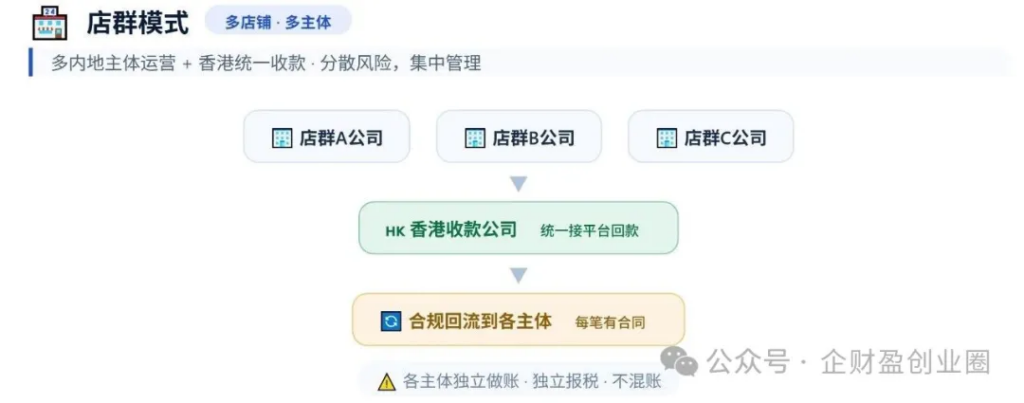
Multiple stores and business entities, with a focus on scale
Multiple Mainland Entities Handling Operations + Centralized Payment Collection in Hong Kong
Diversify Business Risks, Centralize Financial Management
This Account
Opening a store using an overseas identity while operating from within China
Compliance Filing + Agreement Structure
Resolving the Compliance Issue of “The Person Is Not Abroad, but the Store Is”
Purchased Overseas, Sold Overseas
Goods are shipped from Southeast Asia, Japan, and South Korea directly to Europe and the United States.
Hong Kong/Singapore Intermediate Holding Company + Transaction Pricing Compliance
Ensure that every transaction is backed by a contract, has a transaction history, and yields a reasonable profit.
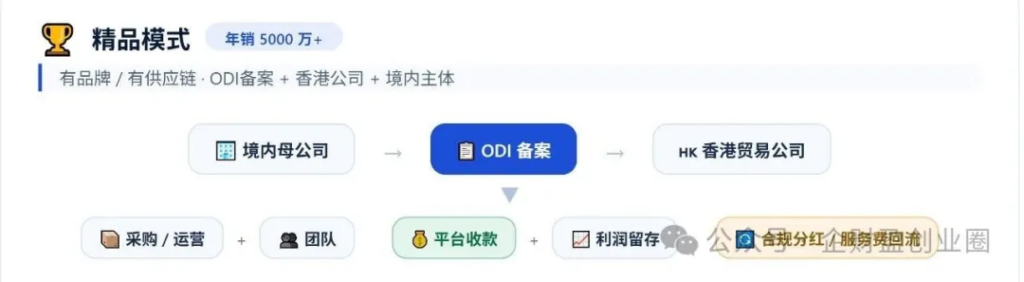
Image: You have your own brand or supply chain advantages; while your SKU count is low, you handle high order volumes and enjoy strong profit margins. With annual revenue exceeding 50 million, your net profit margin is likely between 10% and 15%.
Tax Burden Pain Points: Profits can easily exceed the 3 million threshold for corporate income tax, causing the tax bracket to jump directly from 5% to 25%. Combined with the 20% personal income tax on shareholder dividends, the take-home pay is significantly reduced.
Recommended Structure: ODI Filing + Hong Kong Company + Mainland Entity
Three Key Points:
ODI FilingEnsure the legality of capital outflows. Domestic entities hold equity in Hong Kong companies in compliance with filing requirements, and the capital flows are fully documented.
Hong Kong Companies Receive Profits. Payments received through the platform are deposited into a Hong Kong account; Hong Kong’s profits tax rate is low and may qualify for offshore exemptions, resulting in an overall tax burden far lower than the 25.1% rate in mainland China.
Profit Repatriation Compliance. Profits are repatriated to the mainland through compliant channels such as dividend distributions, trade in services, and royalty payments, with each transaction supported by a contract and a pricing basis.
Prerequisites for Adaptation: If your annual profit exceeds 3 million, the cost of ODI registration is worth it. For small sellers whose profits aren’t high enough, the cost of maintaining the structure may outweigh the tax savings.
03 Multi-Store Model: Risk Management Is More Important Than Reducing the Tax Burden
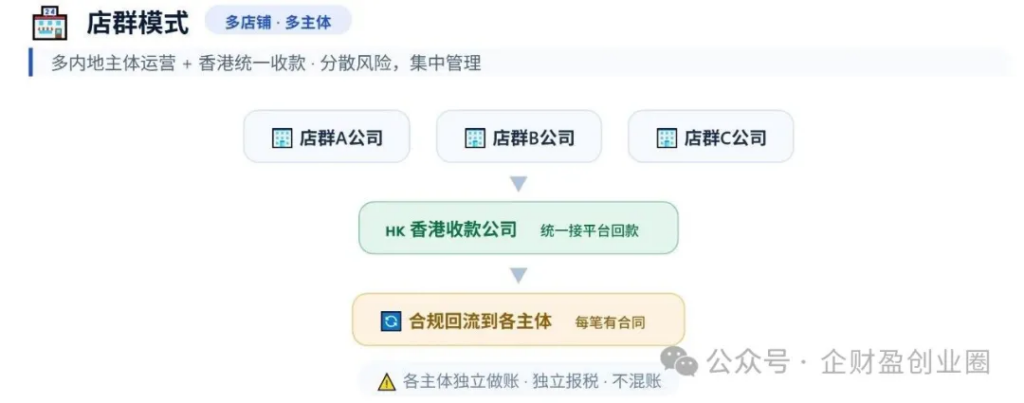
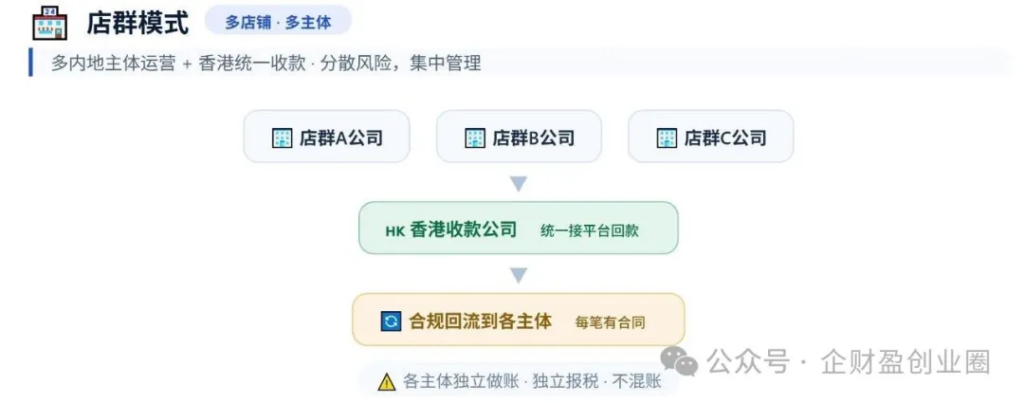
Image: Operating multiple stores, across multiple categories, and under multiple business entities. It’s possible that each product category is run by a separate company, resulting in high daily order volumes but low profit margins per item.
Tax Burden Pain Points: It’s not that taxes are too high, but rather that there are too many entities and the flow of funds is too chaotic. When one entity is investigated, it can easily implicate others.
Recommended Structure: Multiple Mainland Entities for Operations + Centralized Payment Collection in Hong Kong
Three Key Points:
Each mainland company maintains its own accounting records and files its own tax returns.. Don't be reckless; don't share a bank account.
Hong Kong companies only handle collections; they do not conduct business.. If a Hong Kong company is subject to “piercing the corporate veil” and deemed the actual business entity, it faces the risk of being classified as a Mainland enterprise resident.
Clear Path for Capital Repatriation. Each mainland entity has a formal service agreement or trade contract with a Hong Kong company, and profits are remitted to the corresponding mainland entity as stipulated in the contract.
In a nutshell: The core of the store cluster model isn’t “how to save on taxes,” but “how to ensure that if one entity runs into trouble, it doesn’t affect the others.”
04 The "Benben" Account Model: Profits Come from Operations, Compliance Depends on Registration
Image: Opening a store on Amazon or TikTok under the name of overseas relatives, friends, or foreign service providers, while the actual operations—including product selection, customer service, and supply chain management—are all handled by a team based in mainland China.
Tax Burden Pain Points: The store is owned by an overseas entity, but both actual control and profit attribution are in China—this is the gray area where transfer pricing and controlled foreign corporation rules intersect.
A formal service agreement must be signed.. When a domestic company provides operational management services to an overseas business entity, the agreement must clearly specify the scope of services, pricing method, and settlement cycle.
Pricing should be fair. We cannot allow domestic companies to transfer all their profits out of the country, nor can we allow foreign entities to retain all their profits abroad. The arm’s-length principle is the bottom line.
Income earned within the country must be reported for tax purposes. Service fees constitute taxable income for domestic companies; it is not possible to “earn money in China but pay taxes overseas.”
In a nutshell: A domestic account is not inherently a tax avoidance structure. Since operations are conducted in China, profits are attributed to China—the key is to clearly define rights, responsibilities, and interests through agreements.
05 Overseas Purchases and Overseas Sales: Transaction Pricing Isn’t Something You Can “Just Make Up”
Image: Goods are sourced directly from factories in Southeast Asia or from Japanese brands and shipped to warehouses in Europe and the U.S. or to FBA fulfillment centers. The goods do not pass through Chinese customs, and funds are received from overseas platforms into overseas accounts.
Tax Burden Pain Points: “If the goods haven’t entered China and the money hasn’t entered China, does that mean we don’t have to pay taxes in China?”—This is the most dangerous misconception.
Recommended Structure: Hong Kong/Singapore Intermediate Holding Company + Transaction Pricing Compliance
Three Key Points:
Procurement Pricing Cannot Be “Filled In Arbitrarily”. When an intermediate holding company purchases from affiliated factories, pricing must be supported by transfer pricing documentation—such as the comparable uncontrolled price method or the resale price method—and cannot be set arbitrarily.
Hong Kong/Singapore companies must have economic substance. It’s not enough to simply register a shell company—you must have office space, employees, and genuine business decisions. Under Order No. 837, offshore intermediary companies with no substantive operations are the primary targets of look-through scrutiny.
Profit Allocation Must Be Planned. Keeping money in overseas accounts does not mean you are exempt from paying taxes. With the CRS information exchange and the “see-through” regulation under Order No. 837, overseas profits held by individual ultimate beneficial owners will sooner or later be subject to tax obligations.
06 The Core Value of a Two-Tier Structure: Not “Tax Avoidance,” but “Compliance and Reduced Burden”
There is a common logic underlying these four architectures:Two-tier architecture—Domestic operating entity + overseas trading/collection company.
fig. values (ethical, cultural etc)
clarification
risk insulation
Overseas legal entities bear independent liability for the platform’s breaches of contract and intellectual property disputes, without involving domestic assets.
Tax Burden Optimization
Take advantage of the low tax rates and offshore tax exemptions in Hong Kong and Singapore to legally reduce your overall tax burden
Corporate Value-Added
An overseas company has a compliant structure, bank accounts, and genuine transaction records—these are assets in and of themselves when it comes to raising capital, selling the company, or going public.
The essence of architectural planning is not “how to hide money,” but “how to ensure that money flows through legitimate, appropriate, and reasonable channels.”
📞 Would you like to receive a comprehensive architectural design solution tailored to your business model? Please feel free to contact Qicaiying.Cell phone: 18676749275 | WeChat: qcygscszkJust send [Architecture Proposal].
The most important thing to do right now is to take three minutes to check yourself:
Which category does your business fall under: boutique, multi-store, personal accounts, or overseas sourcing?
Is your architecture designed proactively, or do you simply “register components wherever the business logic takes you”?
Have you completed your ODI filing? Does your Hong Kong company have staff, office space, and business operations?
For each stage of the process by which your profits are repatriated from overseas to China, are there contracts and pricing bases in place?
If an audit in the second half of the year were to trace back to your ultimate beneficiary, would your structure hold up to scrutiny?
See if this applies to you:
If 2 = “Register wherever you go” → Your architecture likely has vulnerabilities; the sooner you address them, the lower the cost will be.
If 3 = None completed → The risk of penetration under Order No. 837 is the highest, and the window of opportunity is closing
If you're unsure about any of the above → First, figure out which model your business falls under, then choose the appropriate architecture.
Send us your business model and current architecture, and Qicaiying will help you determine whether your current architecture is appropriate, where improvements are needed, and where to start making changes.
Enterprise Finance Group
Enterprise Finance GroupFounded in 2015 and headquartered in Shenzhen, we specialize in cross-border e-commerce tax and financial compliance, business registration, bookkeeping services, overseas company registration, and ODI filing services. We provide one-stop solutions ranging from business model analysis and structural design to implementation. Ahead of the audits in the second half of the year, we offer a free structural assessment to help you understand where you stand and which direction you should take.
✅ Full-Service ODI Filing Agency: Ensuring the Legality of Capital Outflows
✅ Hong Kong Company Registration + Substantive Business Support Services: Compliance with Order No. 837
✅ Two-Tier Architecture Design: Four Solutions for Premium Products, Multi-Store Operations, Laptop Sales, and Overseas Sourcing
✅ Transfer Pricing Documentation: Compliance with Related-Party Transactions in Overseas Procurement
✅ Designing Profit Reinvestment Pathways: Each section includes a contract and pricing basis
Tags:
Premium Mode
Store Cluster Model
Cross-border e-commerce fiscal compliance
Financial and Tax Compliance
Recommended
Cross-border e-commerce B2B must see! Registered Hong Kong company stationed in the Ali International Station, really fragrant!
In today's globalized business environment, the cross-border e-commerce B2B model is rapidly emerging with its unique advantages. For many enterprises engaged in cross-border trade, choosing a suitable platform and registering an advantageous company are undoubtedly the key keys to open the door to the international market.
2024 Hong Kong Company Account Opening Tips! How to choose the right Hong Kong bank account?
Global anti-money laundering regulations are becoming more and more stringent, the banks to maintain an account of the sunk cost is getting higher and higher, not moving hundreds of millions of dollars in fines, so that the major banks to open an account threshold as well as the audit process high up, already have a Hong Kong company bosses, how to choose the Hong Kong bank to open a public account? How much does it cost and how to operate? Today to give you a detailed introduction to the Hong Kong company account how to choose, as well as the approximate costs required and other content.
Hong Kong company registration advantages + registration conditions + registration process to share!
If you want to start a business and develop overseas markets, registering a Hong Kong company is undoubtedly a very forward-looking choice. With its unique geographical location, sound legal system, low tax rate and open business environment, Hong Kong company has become a "sharp weapon" for many business owners to open up overseas markets. Why is it so important to register a Hong Kong company in 2024?