Is the Hong Kong-to-Mainland Company Structure Still Safe Under Order No. 837? Three Compliance Remediation Paths for Return Investment
Published: June 18, 2026
There is a very common structure in the cross-border business community: registering a company in Hong Kong and then using that Hong Kong company to hold a controlling stake in a company on the mainland.
Historically, the purpose of doing so was clear—to take advantage of tax incentives for foreign-invested enterprises and reap the policy benefits of “fake foreign investment.”
Following the implementation of Order No. 837, the compliance foundation for this business model was completely undermined.Return investments have been explicitly included within the scope of outbound investment regulation; structures lacking valid ODI procedures will face compliance risks in both mainland China and Hong Kong.
If you or your clients are using this architecture, we recommend reading this article carefully. There’s a link to a free assessment at the end of the article—be sure to claim it.
I. What Is Return Investment?
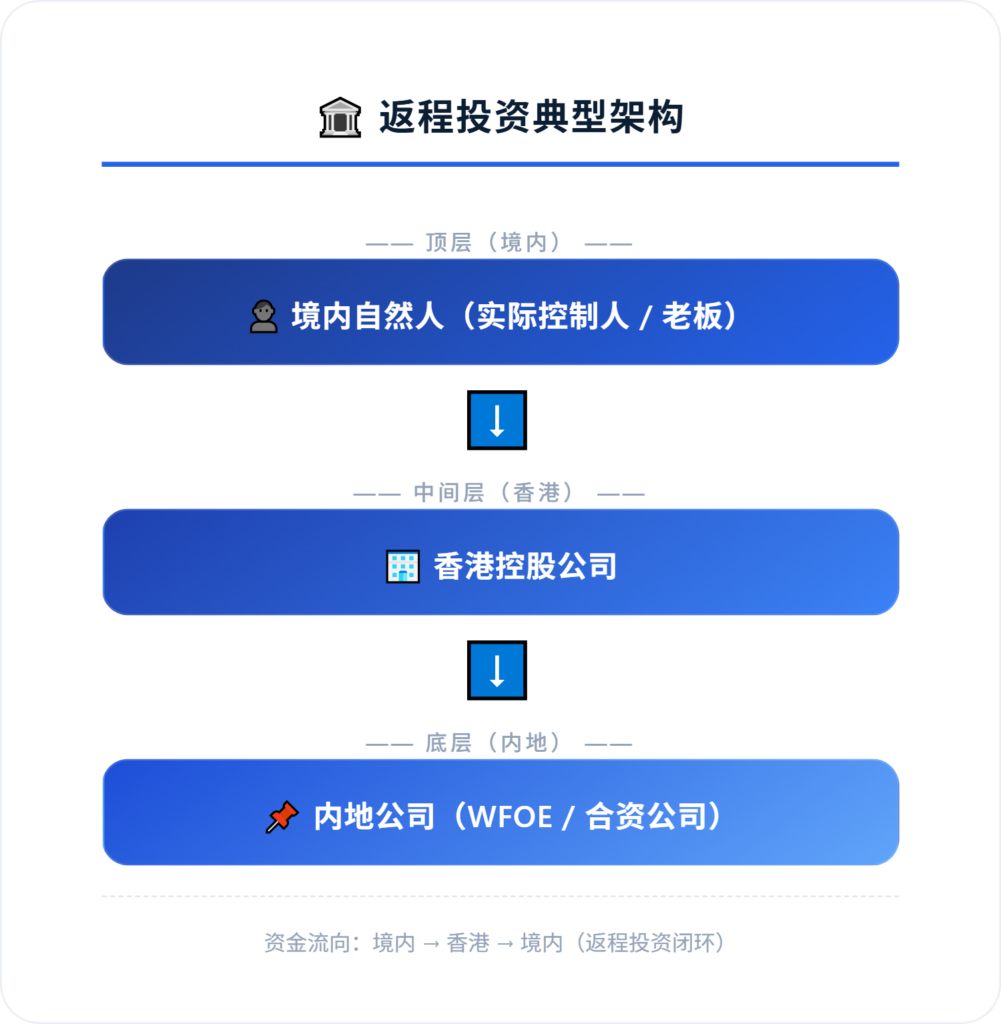
Return Investment = Domestic residents/enterprises establish a company overseas → The overseas company then invests in establishing a business back in China.
Typical Architecture:
This structure is extremely common in the cross-border e-commerce sector. Many sellers have their operational entities based in mainland China, while their payment-receiving entities are based in Hong Kong—and then use the Hong Kong company to hold a controlling stake in the mainland company, creating a “fake foreign-invested” shell.
II. Three Core Risks Facing Return Investments Under Order No. 837
Risk 1: Lack of ODI procedures; the architecture itself is non-compliant
When you established your Hong Kong company from within mainland China, you did not file for ODI registration (because at the time you thought it was “just setting up a company”). Following the implementation of Order No. 837, the entire chain—from source to end—has been brought under regulatory oversight. An overseas company without ODI registration that goes on to hold a controlling stake in a mainland company—that entire chain is operating “unprotected” from start to finish.
Risk 2: Freeze by the Bank
When conducting KYC and anti-money laundering reviews, banks will look beyond a company’s shareholder structure. If they discover that your Hong Kong company is an “offshore shell company” owned by the ultimate beneficial owner and lacks ODI filing documents, the bank has the right to freeze the account and restrict transactions.
Risk 3: Retroactive Tax Assessments by the Tax Authority
When the Mainland tax authorities conduct a review of related-party transactions, if they discover “transactions lacking commercial substance” between your domestic company and its Hong Kong holding company (such as profit-shifting arrangements like cost sharing or brand licensing fees) without supporting ODI and transfer pricing documentation, you will face back taxes and fines.
III. At a Glance: The Difference in Return on Investment Before and After Order No. 837
dimension (math.)
Prior to Order No. 837
Following Order No. 837
ODI Procedures
“There’s a lot that hasn’t been done, and no one’s checking up on it.”
“No ODI = Missing the Most Critical Component of the Architecture”
The Bank's Stance
The account opening review process is relatively lenient
Look-through review; proof of ODI filing is required
tax treatment
"Fake" foreign investment enjoys preferential treatment and is less controversial
Tighter Scrutiny of Related-Party Transactions: No ODI = High Risk
Repatriation of Profits
Service fees/dividends may be arranged at your discretion
Must be consistent with the ODI+ transfer pricing documentation
Compliance costs
Low (gray)
Moderate (manageable after compliance measures are implemented)
If your Hong Kong company has a genuine business record, you should act quickly to complete the ODI filing before Order No. 837 takes effect.
Applicable conditions:
The Hong Kong company has business transactions and operational records.
The source of funding is clear, and the industry is not subject to foreign investment restrictions.
The company hasn't been in business for very long (the sooner you file the retroactive registration, the higher the approval rate).
Action: Submit an ODI filing application to the National Development and Reform Commission and the Ministry of Commerce → Register the transaction with the State Administration of Foreign Exchange → Compliance completed.
Option 2: Restructuring—Transferring the Hong Kong Company to a Mainland Chinese Entity
If the conditions for reissuing an ODI are not met (e.g., the company has been in operation for too long or its cash flows are complex), you may consider restructuring the company.
Proposal: Transfer the individual’s equity interest in a Hong Kong company to an affiliated enterprise in mainland China that has completed ODI filing. The mainland enterprise becomes the parent company of the Hong Kong company, and the individual’s ownership becomes indirect.
Applicable conditions:
Domestic affiliated companies are operating normally and have independent business operations.
Capable of completing ODI registration or already has a record of ODI registration
This approach is more flexible than directly reapplying for an ODI, but it requires addressing the tax implications of the equity transfer at the same time.
Path 3: Break It Down—Disrupt the Return Investment Chain
Break down the structure in which a Hong Kong company holds a controlling stake in a mainland company into two separate entities, thereby severing the round-trip investment chain.
Proposal: The mainland company will revert to being wholly domestically owned (with shares held directly by natural persons), while the Hong Kong company will operate independently, handling functions such as collections and brand licensing. Related-party transactions between the two companies will be conducted through genuine commercial contracts (such as service trade and licensing agreements).
Applicable conditions:
Mainland companies are inherently capable of reverting to a domestically-owned structure
There are indeed genuine business dealings between the companies in the two locations.
This approach takes the longest and involves the most complex plan, but it offers the highest level of compliance—it meets the requirements of Order No. 837 while preserving the flexibility to operate in both locations.
If you have any questions, please feel free to contact us:Cell phone: 18676749275 | WeChat: qcygscszk
V. Which path should your architecture take? Don’t guess—let the experts help you decide.
All three approaches sound reasonable, butEvery company’s situation is different—the length of time a Hong Kong company has been in operation, its business turnover, the source of its capital, its industry classification in mainland China… Any one of these variables can affect the choice of the final solution and the likelihood of approval.
The cost of making your own judgment is too high; if you choose the wrong path, at best your application will be rejected and you’ll waste several months, and at worst, you’ll trigger an audit risk.
VI. Qi Cai Ying: Experts in Compliance for Return-Investment Structures
Qicaiying Group has specialized in cross-border tax and financial compliance and structuring for over 10 years, offering:
✅ Compliance Assessment of the Return Investment Structure: Assess the risk level of the existing architecture under Order No. 837
✅ ODI Filing Reissuance Agency Services: If the conditions are not met, conduct a feasibility assessment before proceeding.
✅ Organizational Restructuring Plan: Designing the Optimal Transition Path from “Fake Foreign Investment” to a “Compliant Structure”
✅ Transfer Pricing Documentation: Provide compliance documentation to support related-party transactions
🔍 Compliance Assessment of Return Investment Structures
Want to know how much compliance risk your Hong Kong-to-Mainland China corporate structure poses under Order No. 837? Not sure whether to go through the reissuance, reorganization, or spin-off process? Contact us today to schedule a free, one-on-one professional assessment.
The evaluation includes the following:
Risk Level of the Current Architecture (Low/Medium/High)
The Best Remediation Path for You (with Reasons)
Optimal Timeline (Avoiding Peak Review Periods)
If you have any questions, please feel free to contact us:Cell phone: 18676749275 | WeChat: qcygscszk
Notes when adding “Architecture Assessment” , Qicaiying Consulting will arrange for a senior expert to conduct an in-depth assessment for you. Spots for this free assessment are limited and will be allocated on a first-come, first-served basis, so we recommend securing your spot as soon as possible.
About Enterprise Caiying Group
Established in 2015 and headquartered in Shenzhen, Qicaiying Group specializes in providing one-stop financial, tax, and corporate compliance services to cross-border e-commerce companies and businesses expanding overseas. Its services cover Hong Kong/ overseas company registration, bank account opening, cross-border financial and tax compliance, ODI filing, structural planning, compliance rectification for return investments, VAT/EPR registration, bookkeeping services, and corporate identity planning. The group has served over 500,000 enterprises to date.
If you have any questions, please feel free to contact us:Cell phone: 18676749275 | WeChat: qcygscszk
Tags:
return investment
Document No. 837
Hong Kong company
Recommended
Cross-border e-commerce B2B must see! Registered Hong Kong company stationed in the Ali International Station, really fragrant!
In today's globalized business environment, the cross-border e-commerce B2B model is rapidly emerging with its unique advantages. For many enterprises engaged in cross-border trade, choosing a suitable platform and registering an advantageous company are undoubtedly the key keys to open the door to the international market.
2024 Hong Kong Company Account Opening Tips! How to choose the right Hong Kong bank account?
Global anti-money laundering regulations are becoming more and more stringent, the banks to maintain an account of the sunk cost is getting higher and higher, not moving hundreds of millions of dollars in fines, so that the major banks to open an account threshold as well as the audit process high up, already have a Hong Kong company bosses, how to choose the Hong Kong bank to open a public account? How much does it cost and how to operate? Today to give you a detailed introduction to the Hong Kong company account how to choose, as well as the approximate costs required and other content.
Hong Kong company registration advantages + registration conditions + registration process to share!
If you want to start a business and develop overseas markets, registering a Hong Kong company is undoubtedly a very forward-looking choice. With its unique geographical location, sound legal system, low tax rate and open business environment, Hong Kong company has become a "sharp weapon" for many business owners to open up overseas markets. Why is it so important to register a Hong Kong company in 2024?