Latest Updates from the Hong Kong Inland Revenue Department: Is Your “Zero Return” Still Safe Under the CRS Data Exchange?
Published: June 11, 2026
Recently, many cross-border business owners, foreign trade entrepreneurs, and owners of red-chip companies with operations in Hong Kong have been focusing on one issue:
Can Hong Kong companies continue to file zero tax returns indefinitely?
Over the past few years, many business owners have registered companies in Hong Kong for a very simple reason:
“Hong Kong has a low corporate tax rate.” “If you don’t have an office in Hong Kong, you don’t have to pay taxes.” “The Hong Kong company is just for receiving payments; don’t worry too much about it.” “As long as the account can receive payments normally, I’ll file a zero-income tax return for now.” “Everyone used to do it this way, and nothing ever went wrong.”
But now, it's really time to change this old way of thinking.
Business owners who need business consultation can also add our Qicaiying customer service WeChat account directly for inquiries (WeChat ID: jxhqcy890 / Mobile: 16625410105).
On the one hand, the CRS mechanism for the automatic exchange of financial account information has been in operation for many years; Hong Kong exchanges information automatically with tax jurisdictions with which it has established information exchange arrangements. The Hong Kong Inland Revenue Department has also clearly stated that the automatic exchange of information is intended to enhance tax transparency and combat cross-border tax evasion, and Hong Kong completed its first exchange of information by the end of 2018.
On the other hand, compliance requirements for Hong Kong companies in areas such as banking, auditing, taxation, offshore exemptions, and cross-border structures are becoming increasingly stringent. In particular, Hong Kong companies held by actual controllers in mainland China are at risk of being reclassified from “payment collection tools” to “risk targets” if, over a long period, they lack actual business operations data, have not undergone audits or filed tax returns, and do not maintain a complete chain of accounting evidence—yet exhibit a large volume of account transaction records.
In today’s article, we’ll start withCRS Data Exchange + Hong Kong Tax Resident Certification (CoR) + Risks Associated with Zero-Declaration for Hong Kong CompaniesThree perspectives, explained clearly in one go.
Summary of this article:
I. Why Can’t Hong Kong Companies Operate Without Compliance Anymore Under the CRS Data Exchange?
II. What Is the Real Danger of Reporting Zero Revenue Despite Having Cash Flow?
III. What Exactly Is the Certificate of Residence (CoR) for Hong Kong Tax Residents?
4. Does obtaining a CoR mean you don’t have to pay taxes?
V. Which Hong Kong companies should prioritize a compliance audit?
VI. What are the top priorities for business owners with companies in Hong Kong right now?
01Under CRS data exchange, why can’t Hong Kong companies operate without proper compliance measures anymore?
For many business owners, their first reaction upon hearing the term “CRS” is:
“Will Hong Kong account information be exchanged?” “Can the tax authorities on the mainland see my Hong Kong company’s bank statements?” “Does having a Hong Kong company automatically mean you’ll be investigated?” “Is there any way to avoid being exposed without meaning to?”
Let’s make one thing clear: CRS is not a new concept.
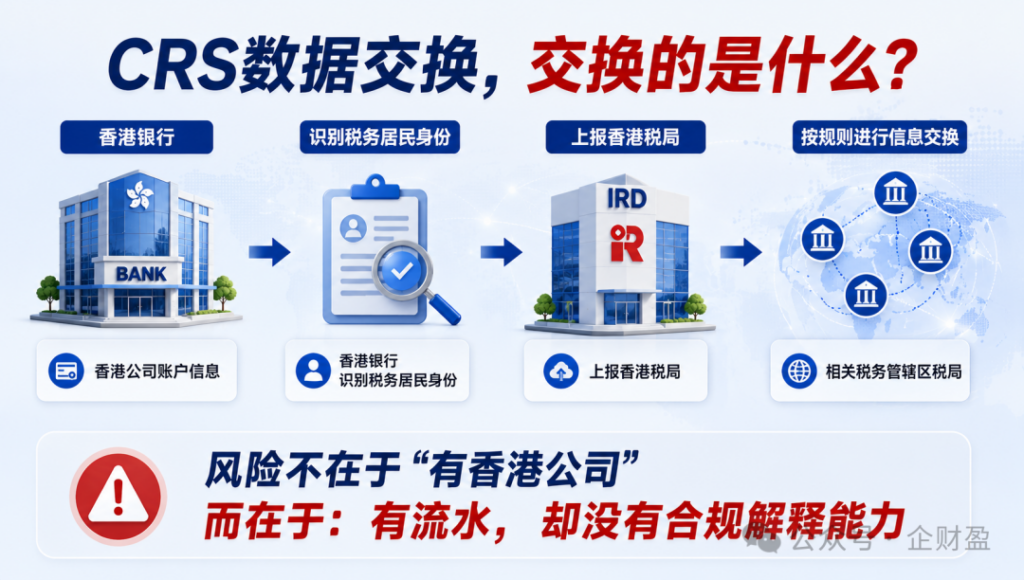
CRS, which stands for Common Reporting Standard, is commonly referred to in Chinese as the “Common Reporting Standard.” Simply put, it is a system whereby financial institutions identify the tax residency status of account holders or beneficial owners, report relevant account information to tax authorities in accordance with established rules, and facilitate the automatic exchange of that information between tax authorities and relevant tax jurisdictions.
Public information from the Hong Kong Inland Revenue Department also states that the automatic exchange of information involves the transmission of financial account information from Hong Kong to tax jurisdictions that have signed an agreement or arrangement with Hong Kong regarding the automatic exchange of information; such information pertains only to tax residents of jurisdictions that are partners in the automatic exchange of information.
So, what we really need to be wary of is not the idea that “Hong Kong companies can’t be used.”
Instead:
If the actual controller of your Hong Kong company is a Mainland tax resident, and the company has long lacked substantive business operations, does not maintain proper accounting records or undergo regular audits, and lacks clear transaction records—yet has a large volume of account transaction history—then it will become increasingly difficult to account for this company’s status under the CRS, in terms of bank risk control, tax filing, and audits.
The risk is particularly higher in the following situations:
The Hong Kong company simply collects payments on behalf of the platform;
The Hong Kong company simply collects payments from foreign trade customers;
The Hong Kong company has no office in Hong Kong, no local employees, and no records of business decisions;
The company's account has had large deposits and withdrawals, but it has consistently filed zero tax returns;
Funds remain tied up in Hong Kong companies for long periods, with companies hesitant to pay dividends or repatriate funds;
There are transactions between Hong Kong companies and mainland entities, but there is no chain of evidence regarding contracts, invoices, logistics, or funds.
In such cases, Hong Kong companies are easily subject to scrutiny: Are they genuine business entities, or are they merely “conduit companies” or “shell companies set up solely to receive payments”?
If your current Hong Kong company already has platform refunds, foreign trade receipts, or large-scale inflows and outflows of funds, but has consistently filed zero-declaration returns in the past, we recommend that you don’t rush to ask, “Will we be audited?” Instead, start by conducting a preliminary screening of accounting risks to determine whether the company can provide a valid explanation.
.
02There’s Cash Flow but Zero-Reporting—Where Does the Real Danger Lie?
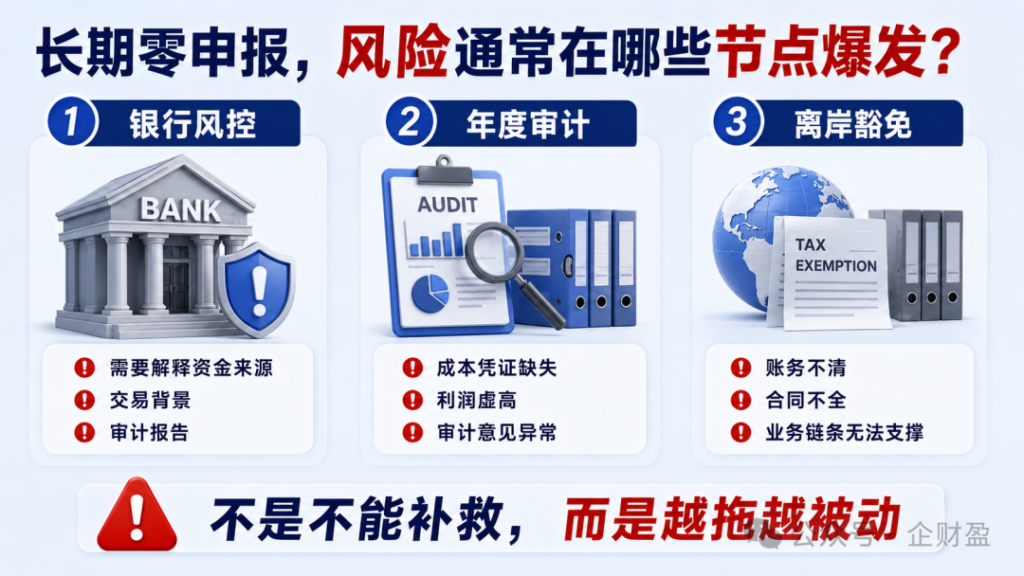
Hong Kong companies that have business transactions but consistently file zero-revenue tax returns may not face immediate risks; instead, these risks tend to surface all at once at several critical junctures.
1. When the bank updates its records, it cannot clearly explain the source of the funds.
Hong Kong banks are now implementing increasingly strict ongoing due diligence procedures for corporate accounts.
Banks may require businesses to provide:
Company Business Overview;Information on major customers and suppliers;Contracts, invoices, and purchase orders;Audit Report;The context of the transactions reflected in the bank statements;Actual business operations data.
If a Hong Kong company has in the past merely collected payments without maintaining accounting records, undergoing audits, drafting contracts, or keeping cost documentation, the owner will find themselves in a very difficult position once the bank requests additional information.
In many cases, the problem with an account isn’t that “the company has transaction activity,” but rather that the company cannot prove the genuine business activity behind that activity. .
2. During the audit and tax filing process, costs cannot be recorded in the books, resulting in an artificially inflated profit.
The actual costs for cross-border e-commerce and foreign trade companies are often complex:
Purchasing costs;Platform commissions;Advertising expenses;Overseas warehouse fees;Cross-border shipping fees;Customs clearance fees;Service fee;Small supplier expenditures;Payment is handled by a domestic team.
If you don’t keep your books up to date on a quarterly basis and only scramble to gather documents at the last minute during the year-end audit, a problem is likely to arise:
The money was indeed spent, but there is no evidence that it was related to business.
As a result, costs are not properly recorded, and profits are artificially inflated. Although the company did not actually earn that much, the financial statements show high profits, which may ultimately lead to paying more taxes than necessary and could even affect the auditor’s opinion. .
3. The combined impact of CRS and mainland tax risks
Many business owners are most concerned about whether their Hong Kong companies’ account information and profit data will be reported back to the mainland.
To be objective here: The CRS does not directly calculate how much back taxes you owe on behalf of a specific tax authority; rather, it exchanges information on eligible financial accounts. What truly puts business owners on the defensive are obvious discrepancies between account data, tax residency status, the substance of the company’s operations, and tax filing records.
For example:
The Hong Kong company is effectively controlled by a mainland owner; There have been large-scale inflows and outflows of funds from the account; The company has not had its books audited for a long time; The Hong Kong company has no evidence of substantive business operations; The data reported by mainland entities does not match their overseas revenue; The source of the funds returning to the individual or company cannot be clearly explained.
When these factors combine, they can turn a Hong Kong company that “seems fine” at first glance into a high-risk entity in terms of future tax interpretations and bank risk control. .
4. Lack of a basis for applying for offshore exemptions or tax treaty benefits
Many business owners register Hong Kong companies in the hope of qualifying for offshore tax exemptions in the future or benefiting from the tax treaty between mainland China and Hong Kong.
However, neither offshore exemptions nor tax treaty benefits can be claimed simply by stating, “I do not conduct business in Hong Kong.”
It requires supporting evidence from various areas, including accounting, contracts, personnel, office operations, transactions, finances, logistics, and decision-making.
If a Hong Kong company has consistently filed zero tax returns in the past, without maintaining accounting records, undergoing audits, or keeping operational records, it will be extremely difficult to establish a foundation for compliance later on.
If your Hong Kong company has had cash flow over the past few years but your accounting records have not been organized, we recommend first conducting a review of “historical cash flow, cost documentation, and audit risks.” Many issues aren’t unsolvable, but if you wait until the bank’s risk control department or the tax authorities raise questions before addressing them, you’ll find yourself in a very passive position.
03What Exactly Is the Certificate of Residence (CoR) for Hong Kong Tax Residents?
A Hong Kong Tax Resident Certificate, commonly referred to in English as a Certificate of Resident Status (CoR), is a document issued by the Hong Kong Inland Revenue Department certifying a person’s tax resident status.
Simply put, it is used to prove that a company or individual is a Hong Kong tax resident under a specific tax treaty arrangement, thereby making them eligible to apply for the relevant tax treaty benefits.
According to the Hong Kong Inland Revenue Department’s official website, the Hong Kong authorities will issue a certificate of tax residency after a double taxation treaty between Hong Kong and the relevant tax jurisdiction enters into force; generally, only one certificate of tax residency is issued per year for each tax treaty.
Here's a special reminder:
The CoR is not a “tax exemption certificate,” nor is it a “universal safeguard.”
The Hong Kong Inland Revenue Department has also explicitly noted that the issuance of a tax residency certificate does not guarantee that the applicant will be able to successfully claim the benefits under the relevant tax treaty; the final decision on whether to grant tax relief remains at the discretion of the relevant tax treaty partner, based on the applicable conditions.
Therefore, the correct interpretation should be:
CoR isn't here to help you evade taxes; Obtaining a CoR does not mean you are exempt from paying taxes; CoR is not a one-size-fits-all solution; CoR plays a crucial role in determining a Hong Kong company’s compliance status, the applicability of tax treaties, and the ability to interpret cross-border structures.
.
04Does obtaining a Certificate of Residence (CoR) as a Hong Kong tax resident mean you no longer have to pay taxes?
No, this point must be made clear.
Many business owners ask:
“If I apply for a Hong Kong tax residency certificate, does that mean I don’t have to pay taxes?” “Does bringing income from abroad back into the country mean there won’t be double taxation?” “If I get a CoR, will the mainland stop interfering with me?”
None of these interpretations are accurate; a more accurate and compliant way to put it is:
The core value of CoR is not to help companies avoid paying taxes, but to assist them—based on genuine business operations, compliant bookkeeping, and regular audits and tax filings—in proving the tax residency status of their Hong Kong companies, securing tax treaty benefits, and reducing the risk of being classified as shell or conduit companies.
For example, under the double taxation avoidance agreement between the Mainland and Hong Kong, when a Mainland company pays dividends to a Hong Kong resident, if the Hong Kong company holds at least 25% of the equity in the dividend-paying company, the maximum withholding tax rate may be reduced from 10% to 5%.
However, it is important to note that the benefits under such agreementsIt is not the case that “registering a Hong Kong company automatically entitles you to”...nor does obtaining a CoR automatically guarantee benefits. Companies must also meet requirements such as beneficial ownership, commercial substance, and the authenticity of transactions.
So, as a boss, you need to first determine:
Does the Hong Kong company actually conduct business?
Have the books been kept and audited properly?
Is there any business rationale for using a Hong Kong company as the operating entity?
Is there a chain of evidence regarding contracts, funding, logistics, personnel, decision-making, and so on?
Is there a risk of being classified as a shell conduit company?
If these fundamentals aren’t properly established, simply obtaining a single certificate may not be sufficient to support subsequent tax explanations.
.
05Which Hong Kong companies should prioritize a compliance audit?
A reminder to the following four types of employers:
Category 1: Cross-border e-commerce business owners
For example, sellers on Amazon, TikTok, Meike Duo, and independent websites often use a Hong Kong company specifically to receive payments from these platforms.
Common problems with this type of boss include:
The Hong Kong company does not have an office in Hong Kong; No local employees; There are no records of business decisions; Annual account turnover ranging from several million to several tens of millions; Funds remain in Hong Kong for long periods, with companies reluctant to pay dividends or repatriate funds; The business relationship between the mainland company and the Hong Kong company is unclear. .
The first thing companies like this should do is not to immediately prepare a set of financial statements, but rather to firstHong Kong Company Compliance Review::
How should payments received from the platform be recorded in the books? What role do Hong Kong companies play in the transaction chain? How are costs and expenses allocated? Is it necessary to do quarterly bookkeeping? Do you meet the eligibility requirements for a CoR application? Is it necessary to provide additional evidence of substantive business operations? .
Category 2: Traditional Foreign Trade Business Owners
For example, companies that export hardware, building materials, machinery, and home furnishings—which have factories or trading companies in mainland China—use their Hong Kong companies to collect payments from overseas customers.
The problem with this type of boss is usually:
Overseas customers have been making regular payments to the Hong Kong company; The goods are shipped from a domestic factory, but the Hong Kong company receives the payment; The Hong Kong company does not have a complete sales contract or cost documentation; When the bank requests an explanation of the source of funds, it takes a long time to prepare the documentation; In the future, capital will want to flow back into the country, but there is a lack of compliant channels.
We recommend that such companies set up a business ledger for their Hong Kong entity in advance, organizing all contracts, invoices, procurement records, logistics records, receivables, payables, and audit documents to avoid repeated requests for additional documentation from the bank later on.
.
Category 3: Red Chip Structures or Cross-Border Holding Companies
These types of companies typically have a holding company in Hong Kong, overseas assets, international brand expansion, financing plans, or future IPO plans.
If a Hong Kong company is merely a shell holding company—lacking tax residency status, substantive business operations, clear records of board decisions, and accounting documentation—it will face potential risks in the future regarding dividend distributions, financing, due diligence, and the application of tax treaty benefits.
For companies like these, the focus should not be merely on whether “the account is usable,” but rather on whether the entire structure can withstand scrutiny from tax authorities, banks, investors, and auditing firms.
.
Category 4: Hong Kong High-Caliber and Outstanding Talent Business Owners
Some business owners have already obtained Hong Kong residency and also have Hong Kong-based companies that handle overseas business.
This type of customer tends to overlook one issue:Compliance at the individual level does not equate to corporate compliance.
You may personally qualify as a High-Talent or Outstanding Talent in Hong Kong, but if your Hong Kong company is still operating as a shell entity—with long-term zero tax filings and no bookkeeping or audits—the business risks remain.
.
06What should the owner of a Hong Kong company do first right now?
If you own a Hong Kong company—especially one that already has business transactions and has received payments from online platforms or from foreign trade—it is not advisable to continue relying on past experience and assume that “since there were no problems before, there won’t be any in the future.”
We recommend following these 5 steps.
Step 1: First, check whether the Hong Kong company has any evidence of actual business operations. Key points to check: Are there bank statements? Are there payments received from platforms? Are there payments from foreign trade customers? Are there payments to suppliers? Have contracts been signed with Hong Kong companies? Are there transactions between mainland companies and Hong Kong companies? Are there retained earnings over the long term?
As long as these circumstances exist, do not simply treat them as “inactive companies.”
.
Step 2: Check whether there have been any prolonged periods of zero reporting in the past If a Hong Kong company’s account has consistently shown transaction activity but has filed zero-revenue tax returns for many years, it is necessary to sort out the accounting records as soon as possible. Do not randomly backdate receipts or fabricate expenses.
The correct approach is to base your analysis on actual business operations, gather all relevant documents—including bank statements, platform invoices, purchase records, shipping documents, contract materials, and payment vouchers—and first identify exactly where the accounting risks lie.
.
Step 3: Lay the Groundwork for Bookkeeping and Auditing Compliance for Hong Kong companies isn’t just a matter of rushing to prepare an audit report at the end of the year.
We recommend that you organize at least the following information:
Bank flow;Platform Backend Invoices;Customer Contracts;Supplier Contracts;Purchasing documents;Logistics documents;Breakdown of Expenses;Transactions with Affiliated Companies;Records of board decisions or business decisions;Explanation of the Actual Operations of a Hong Kong Company.
The more complete this information is, the more confident you’ll be when conducting audits, applying for a Certificate of Registration (CoR), applying for an offshore exemption, and dealing with bank risk control measures. .
Step 4: Determine Whether You Are Eligible to Apply for a Certificate of Residence (CoR) in Hong Kong
Not all Hong Kong companies are suitable for applying for a CoR right away.Before applying, you should first determine:
Whether the company is truly in business;
Whether there is a legitimate business purpose;
Do you have a background in auditing and tax filing?;
Could you please explain the role and positioning of a Hong Kong company?;
Is there sufficient evidence to support Hong Kong tax resident status;
Does this involve tax treaty benefits between China and Hong Kong, dividend arrangements, or cross-border structuring arrangements?
If the basic documentation is incomplete, we recommend first organizing your financial records, filling in gaps in the chain of evidence, and ensuring the business operates in good faith before deciding whether to apply.
.
Step 5: Establish a Long-Term Maintenance Mechanism
CoR is not a one-time process, and compliance for Hong Kong companies is not a one-time process either.
We will continue to do the following:
Quarterly bookkeeping;Annual audit;Capital Gains Tax Return;Retention of business records;Update of bank KYC information;Maintenance of tax residency status;Architecture Risk Review.
Otherwise, even if we fix a vulnerability today, a new problem will pop up next year.
.
CRS is not some kind of monster. And Hong Kong companies are not off-limits either.
The real danger is that business owners are still clinging to outdated ways of thinking, treating their Hong Kong companies as mere shell entities that “only collect payments, but do not keep books, undergo audits, file tax returns, or provide explanations.”
In the past, many business owners believed that:
As long as the account can receive payments, that's all that matters; As long as you don't have an office in Hong Kong, you can file a zero return; As long as the funds remain in Hong Kong, they are safe; As long as you don't return to China, there's no risk.
However, cross-border capital flows are becoming increasingly transparent, bank due diligence is getting stricter, and audits of Hong Kong companies and their tax residency status are becoming increasingly important.
Whether a Hong Kong company can operate safely over the long term does not depend on whether you have registered a company, but rather on:
Can income explain this?; Can the cost be recorded in the books?; Can the cash flow be matched?; Can the audit report support this?; Can the commercial substance be proven?; Can tax resident status be established?; Can you explain the logic behind offshore operations?
If your Hong Kong company currently has:
Long-term zero reporting;
I haven't kept track of my finances for many years;
The audit documentation is incomplete;
Missing cost documents;
The platform's payment receipts do not match the accounting records;
I want to apply for an offshore exemption but I'm not sure if my financial records will support it;
The bank is asking for additional documents, but I don't know how to explain it;
We recommend that you don’t wait until your account is flagged by risk control, your audit is held up, or you receive an inquiry from the tax authorities before taking action.
You can try it once first.Hong Kong Company Compliance Risk Assessment...First, get a clear understanding of the historical transaction history, cost documentation, audit risks, the substance of the business, the feasibility of the CoR application, and the scope for offshore exemptions.
If you need assistance with applications for Hong Kong company offshore exemption, Hong Kong tax residency certification, Hong Kong residency, opening a Hong Kong bank account, Hong Kong company registration, as well as other services such as overseas company registration, overseas structuring, and cross-border e-commerce financial and tax compliance, please scan the QR code to contact our online customer service (WeChat ID: jxhqcy890 / Mobile: 16625410105)We will arrange professional managers to answer your questions and provide professional advice andFull one-on-one service ↓↓↓
Tags:
CRS Information Exchange
Tax Compliance in Hong Kong
Certification of Hong Kong Tax Residency
Hong Kong Tax Resident
Hong Kong offshore exemption
tax planning
Tax Compliance
Financial and Tax Compliance
Hong Kong company
cross-border e-commerce
Register Hong Kong Company
Hong Kong Company Registration
Recommended
Cross-border e-commerce B2B must see! Registered Hong Kong company stationed in the Ali International Station, really fragrant!
In today's globalized business environment, the cross-border e-commerce B2B model is rapidly emerging with its unique advantages. For many enterprises engaged in cross-border trade, choosing a suitable platform and registering an advantageous company are undoubtedly the key keys to open the door to the international market.
2024 Hong Kong Company Account Opening Tips! How to choose the right Hong Kong bank account?
Global anti-money laundering regulations are becoming more and more stringent, the banks to maintain an account of the sunk cost is getting higher and higher, not moving hundreds of millions of dollars in fines, so that the major banks to open an account threshold as well as the audit process high up, already have a Hong Kong company bosses, how to choose the Hong Kong bank to open a public account? How much does it cost and how to operate? Today to give you a detailed introduction to the Hong Kong company account how to choose, as well as the approximate costs required and other content.
Hong Kong company registration advantages + registration conditions + registration process to share!
If you want to start a business and develop overseas markets, registering a Hong Kong company is undoubtedly a very forward-looking choice. With its unique geographical location, sound legal system, low tax rate and open business environment, Hong Kong company has become a "sharp weapon" for many business owners to open up overseas markets. Why is it so important to register a Hong Kong company in 2024?