What’s the Difference Between Bookkeeping and Auditing for Hong Kong Companies? 90% Business Owners Are Confused—An Analysis of the Latest 2026 Processes and Common Misconceptions
Published: June 4, 2026
Many people ask this question: “Is the money I pay my accountant each year for bookkeeping or for auditing?”
These are two distinct matters, both of which are essential, and they must be carried out in a strict sequence.
💡 If you're unsure about the difference between bookkeeping and auditing, or aren't sure how your company should proceed, feel free to add us on WeChat. qcygscszk or call 18676749275, text 【Bookkeeping】 to get a free process overview.
01 What Is Bookkeeping?
Bookkeeping—known as “li zhang” in Hong Kong—is the process of classifying and organizing all of a company’s financial transactions in accordance with accounting standards to produce:
Statement of Income and Expenses (Revenue and Expenses)
Balance Sheet (Assets and Liabilities)
Statement of Cash Flows
The person doing the bookkeeping: The position can be filled by a bookkeeper; a Certified Public Accountant (CPA) is not required.
Accounting Output: A set of financial statements (which have not yet been audited by an independent auditor).
02 What Is an Audit?
An audit is conducted byLicensed and Registered Certified Public Accountant(A member of the Hong Kong Institute of Certified Public Accountants (HKICPA)) will conduct an independent review of your financial statements and issue an audit report.
The core value of an audit: to provide assurance that financial statements are true, fair, and in compliance with accounting standards.
Auditor: The individual must be a Hong Kong-registered certified public accountant and have no affiliation with the company.
Audit Outputs: Auditor’s Report — This report is a legally required attachment to the tax return; without it, the tax return cannot be filed.
03 The Relationship Between the Two: Bookkeeping First, Auditing Second
Many business owners think, “Just hand it over to the accountant and that’s it,” but the actual process is as follows:
You organize the supporting documents and bank statements
 ↓
The accountant prepares the books (records)
 ↓
The accountant prepares the financial statements
 ↓
The auditor reviews the financial statements
 ↓
An audit report is issued
 ↓
Tax returns are filed along with the audit report
Without bookkeeping, there can be no audit; without an audit, it is impossible to file a complete tax return.
04: 3 Common Misconceptions—How Many Have You Fallen For?
❌ Misconception 1: “I only need to do audits; I don’t need to keep the books.”
The subject of an audit is the financial statements; without bookkeeping, there would be no financial statements, and auditors would have nothing to verify.
The logic is similar: without an essay, you can't grade it.
❌ Misconception 2: “If you file a zero return, you don’t need to keep books or undergo an audit.”
Re. The prerequisites for filing a zero-report are extremely strict (no business operations, no assets, and no bank transaction records—all three conditions must be met simultaneously).
There are bank statements, a small amount of purchases, and a small amount of service fees—none of these meet the criteria for a zero-reporting filing, so you must maintain regular accounting records and undergo an audit.
❌ Misconception 3: “Audits can be done retroactively, and it’s okay if the books aren’t in order.”
Audits must be based on complete source documents (invoices, contracts, bank statements).
If the supporting documents have been lost, bank statements cannot be traced, and suppliers are unwilling to issue replacement invoices—the accounts cannot be fully reconstructed, and the auditor will be unable to issue an unqualified audit report.
The cost of rectifying this situation is 3 to 5 times that of a standard accounting and auditing fee, and the audit report may include a “qualified opinion,” which could have a negative impact on opening bank accounts and filing tax returns.
📌 If you’ve fallen into any of the pitfalls mentioned above and need a solution, please contact us. Cell phone: 18676749275 | WeChat: qcygscszk(Send [Remedy])
05 The Right Pace for Bookkeeping
We recommend keeping your books on a quarterly basis rather than waiting until the end of the year to handle everything at once.
paradigm
practice
exposures
Quarterly settlement of accounts
Organize the vouchers once a quarter
Document Omission Rate < 5%, Low Cost
One-time year-end accounting
To be processed collectively at the end of the year
Document omission rate > 30%; difficult to issue replacement orders; high costs
Benefits of quarterly bookkeeping: Vouchers are entered as soon as they’re created, so they won’t get lost; you’ll have real-time profit figures every quarter; and you’ll be prepared for the year-end audit.
06 Four Core Advantages of Enterprise Finance Hong Kong Company Services
🔹 1. A team of experts to guide you throughout the process
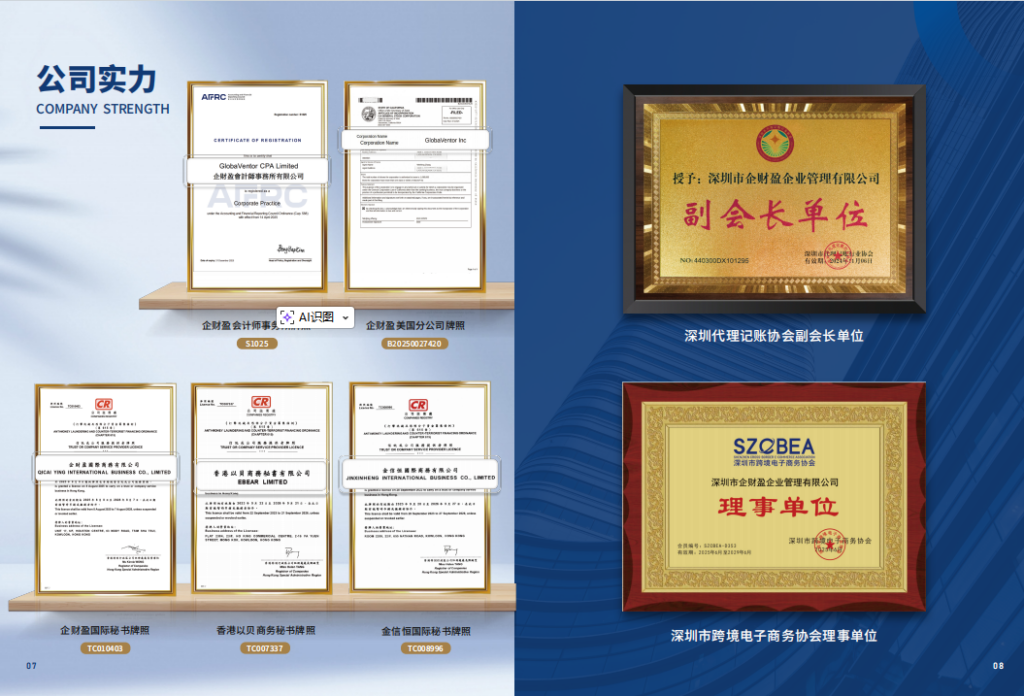
Our team of nearly 400 professionals, comprising senior Hong Kong licensed secretaries, certified public accountants, tax accountants and cross-border business consultants, handles tens of thousands of Hong Kong company registration and maintenance cases annually. We provide ”one-to-one” customized solutions from company structure design (e.g. Mainland-Hong Kong dual entity, VIE structure), name search, document preparation to government filing. We have 3 TCSP licensed secretaries and 1 self-owned Hong Kong CPA firm to ensure that every step of the process is legally compliant and to avoid risks from the source.
🔹 2. digitally empowered, smart and efficient
We have invested tens of millions of dollars to develop our own digital system ”E-Tron”, which realizes the standardization of the whole process and visualization of the progress of Hong Kong company registration, bank account opening, annual review, audit and tax filing, and so on. Customers can track the key nodes such as certificate issuance, bank interview, tax return submission, etc. in real time. The integration of AI intelligent analysis can quickly assess whether your business is suitable for applying for offshore exemption, whether you need to do transfer pricing, and assist in generating the optimal compliance program, so that complex matters are clear and transparent.
🔹 3. Eco-links, extra value
We connect over 500,000+ entrepreneurs with domestic and international associations (e.g. Shenzhen Cross-border E-commerce Association, Hong Kong Chinese General Chamber of Commerce), and regularly organize cross-border salons and seminars on finance and tax law. Registering a Hong Kong company through us is not just about getting a certificate - it is also about linking ecological resources such as green channel for bank account opening, cross-border payment, overseas warehouses, auditing and taxation, etc., which solves the problem of ”not knowing who to look for next after registering”, and creates secondary business opportunities.
🔹 4. Full-cycle accompaniment for worry-free sailing
Our services go beyond ”successful registration” to provide full life-cycle support for Hong Kong companies:
Previously: Free assessment of whether you need a Hong Kong company, recommending the optimal type of entity (Mainland company/Hong Kong company/Offshore company);
Midterm: Assist in completing Hong Kong company registration, bank account opening (HSBC / Overseas Chinese / Dah Sing / CBI and many other green channels), VAT / EIN application;
Late: Annual audits, audit tax returns, offshore exemption applications, CRS compliance, account freezes in case of emergencies, to become a long-term and robust partner for your overseas business. We automatically remind and handle all annual compliance matters on behalf of you on a nodal basis, and you just focus on your business.
Tags:
Hong Kong Company Audit and Taxation
Hong Kong Company Audit
Recommended
Cross-border e-commerce B2B must see! Registered Hong Kong company stationed in the Ali International Station, really fragrant!
In today's globalized business environment, the cross-border e-commerce B2B model is rapidly emerging with its unique advantages. For many enterprises engaged in cross-border trade, choosing a suitable platform and registering an advantageous company are undoubtedly the key keys to open the door to the international market.
2024 Hong Kong Company Account Opening Tips! How to choose the right Hong Kong bank account?
Global anti-money laundering regulations are becoming more and more stringent, the banks to maintain an account of the sunk cost is getting higher and higher, not moving hundreds of millions of dollars in fines, so that the major banks to open an account threshold as well as the audit process high up, already have a Hong Kong company bosses, how to choose the Hong Kong bank to open a public account? How much does it cost and how to operate? Today to give you a detailed introduction to the Hong Kong company account how to choose, as well as the approximate costs required and other content.
Hong Kong company registration advantages + registration conditions + registration process to share!
If you want to start a business and develop overseas markets, registering a Hong Kong company is undoubtedly a very forward-looking choice. With its unique geographical location, sound legal system, low tax rate and open business environment, Hong Kong company has become a "sharp weapon" for many business owners to open up overseas markets. Why is it so important to register a Hong Kong company in 2024?