The Era of Tax-Free Dividends for Foreign Shareholders Has Come to an End: Out of 10 Million, 2 Million Is Immediately Deducted
Published: September 9, 2026
On September 1, 2026, a measure that had been implementedMore than 30 yearsThe tax incentive policy has officially come to an end.
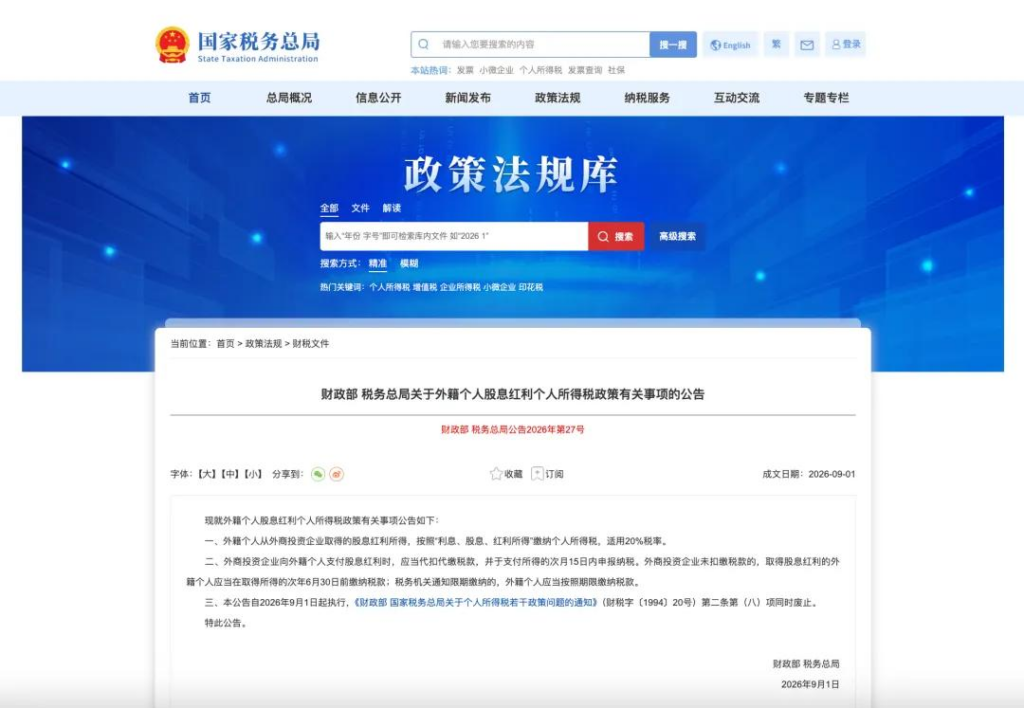
On that day, the Ministry of Finance and the State Taxation Administration jointly issued the “Announcement on Matters Concerning Individual Income Tax Policies for Dividends and Bonuses Received by Foreign Individuals” (Announcement No. 27 of 2026 by the Ministry of Finance and the State Taxation Administration), which clarifies that:Income from dividends and profits received by foreign individuals from foreign-invested enterprises is subject to individual income tax under the “interest, dividends, and profits” category, with a tax rate of 20%.The
This means that, since 1994, foreign individuals have received dividends from foreign-invested enterprisesCompletely tax-freeThat era has officially come to an end.The
In a nutshell:For the same dividend payment of 10 million, foreign shareholders used to pay no tax at all, but now they have to pay 2 million.
This isn’t just “the boy who cried wolf”—it’s a policy that has already been implemented.
I. What exactly has changed about this policy?
Old policy: Tax-free for more than 30 years
According to Item (8) of Article 2 of the “Notice of the Ministry of Finance and the State Administration of Taxation on Several Policy Issues Concerning Individual Income Tax” (Cai Shui Zi [1994] No. 20), issued in 1994, income in the form of dividends and profits received by foreign individuals from foreign-invested enterprises,Temporary Exemption from Personal Income TaxThe
This policy was introduced in the early days of reform and opening up with the aim of attracting foreign investment.. For more than 30 years, a large number of foreign individual shareholders have thus enjoyed tax-free dividends.
New Policy: Taxation Will Be Uniformly Based on 20%
Effective September 1, 2026,Item (8) of Article 2 of Document No. 20 [1994] of the Ministry of Finance and Taxation is hereby officially repealed.The
Hereinafter, dividends received by foreign individuals from foreign-invested enterprises shall, like those received by domestic individual shareholders, be uniformly subject to individual income tax under the category of “interest, dividends, and bonuses,” and shall be subject to20% Tax RateThe
Who withholds the tax? When is it due?
The announcement clarifies tax administration responsibilities::
foreign-invested enterpriseWhen paying dividends,Withholding and remittance should be performedTaxes, and from the proceeds of the payment,Within 15 days of the following monthTax Filing
corporationsNot withheldYes, foreign individuals must, upon receiving their income,By June 30 of the following yearPay Taxes on Your Own
If the tax authorities issue a notice requiring payment within a specified time limit, foreign individuals must pay the tax by that deadline.
Simply put: Employers are required to withhold and remit taxes. If the employer fails to withhold the taxes, the individual must pay them personally.
II. Does This Have Anything to Do with You? — Three Types of People Are Most Affected
Category 1: Shareholders of foreign-invested enterprises in which foreign individuals hold direct equity interests
this isThe most direct and most impactfula type of .
Dividends used to be tax-free, but now they’re taxed at a flat rate of 20%. If you’re a shareholder whose company has accumulated significant profits and plans to pay dividends in the future,It's time to start crunching the numbers.The
Let's do the math:
1 Million Dividends: Previously, I received 1 million; now I receive800,000
10 million in dividends: Previously, the net amount received was 10 million; now, the net amount received is8 million
50 million dividend: Previously, the net amount received was 50 million; now, the net amount received is40 million
The difference is 10 million.
Category 2: Individuals Who Obtain Tax Exemption Through a Change of Nationality
Some entrepreneurs change their nationality before going public or distributing dividends in order to take advantage of the tax exemption on dividends for foreign shareholders.. Following the new policy, this roadIt's a complete dead end.—Regardless of when you obtained your foreign national status, if you are a foreign individual receiving dividends from a foreign-invested enterprise, the tax code is 20%.
Li Xuhong, Vice President of the Beijing National Academy of Accounting, clearly stated that repealing this tax exemption policy would be beneficial forPrevent tax loopholes and prevent certain investors from obtaining tax arbitrage by changing their foreign residency statusThe
Category 3: High-net-worth individuals with cross-border asset allocation needs
If you are planning a cross-border investment structure and are unsure whether to hold shares as an individual or through an offshore company,The new policy has directly changed the answers to the multiple-choice questions. Individual stock ownership has gone from being the “optimal solution” to the “most expensive solution.”
III. Why is it being canceled right now, of all times?
Many people ask: This policy has been in place for more than 30 years, so why is it being abolished now?
Reason 1: Times have changed
Li Xuhong, Vice President of the Beijing National Academy of Accounting, pointed out that the policy exempting foreign individuals from individual income tax on dividends and profits was a tax incentive designed to attract foreign investment in the early days of China’s reform and opening-up.. However, as China enters a phase of high-quality development, “factors such as the market, talent, the rule of law, and the business environment have become more important determinants in foreign investors” decisions, rather than just tax incentives.”The
In simple terms: In the past, foreign investment was attracted through tax incentives; now, it relies on the business environment, market size, and the rule of law.
Reason 2: Tax Equity
As fellow investors, when receiving dividends from the same portfolio company,Foreign investors are exempt from taxes, but Chinese investors must pay a 20% tax.—At this stage, this differential tax treatment no longer meets the requirements of a fair tax environment.The
Reason 3: To Prevent Tax Arbitrage
In actual operation, byChange of Nationality, Restructuring of Enterprise StatusCases of individuals exploiting tax exemptions through such means occur from time to time.. This policy was repealed precisely to close this loophole.
Reason 4: The policy trend is very clear
On August 21, Liao Min, Vice Minister of Finance, stated clearly at a press conference held by the State Council Information Office that the government will promote a fair and unified tax system, eliminate “tax havens,” and systematically review tax preferential policies that were introduced to meet past needs,Stop what needs to be stopped, and optimize what needs to be optimized in a timely manner.The
This is not an isolated incident, but the beginning of a long-term trend.
IV. There’s another twist: the actual tax burden “may not have changed”
Hearing this, many people may already be starting to feel anxious.
But there's one thing hereA Twist That Many People Don't Know About::
Under the basic rules of international taxation, taxpayers have a worldwide tax obligation based on the principle of personal jurisdiction—Foreign individuals who earn investment income in China are generally required to report and pay taxes on that income to their home country upon returning there.The
In other words, having previously enjoyed tax exemptions in China,Upon returning to your home country, you may still have to pay back taxes.. I currently pay 20% in personal income tax in China,You can apply for a tax credit upon returning to your home country., to avoid double taxationThe
KPMG’s tax experts also pointed out that Taiwanese shareholders who directly hold equity in Chinese foreign-invested enterprises in their personal capacity may, in principle, apply for a tax credit for the taxes they pay in China in accordance with regulations,From the perspective of the overall tax burden, this may not necessarily increase the ultimate tax burden.The
But there is one key前提: Your home country must have a tax credit agreement with China. If you are from a low-tax or tax-exempt jurisdiction such as the Cayman Islands or the British Virgin Islands, this “no increase” provision may not apply.
V. What Should We Do Now?
If you are a foreign individual shareholder
First, calculate exactly how your tax burden will change. How much does your foreign-invested enterprise plan to pay out in dividends in the future? Based on the 20% formula, how much tax will you have to pay? Have you set aside the funds for this?
Second, be aware of the risks associated with “historical profits.” This AnnouncementNo distinction was made between new and old surpluses—Unretained earnings accumulated in a company’s books in the past, even if they were generated during the period when tax-exemption policies were in effect, will, in principle, still be subject to the new regulations and require the payment of 20% individual income tax if distributed after September 1, 2026.The
Third, consider restructuring. Shifting from direct individual ownership to ownership by offshore legal entities, such as Hong Kong companies, is not as simple as “registering a company”; it involves a series of practical matters, including changes in equity structure, filing procedures, and cross-border fund transfers, each of which requires professional judgment.
If you are planning a cross-border investment structure
Stop treating “direct shareholding by foreign individuals” as the preferred option. Following the new policy, the tax burden associated with this option is no longer competitive.
We recommend reassessing the matter from the following perspectives:
Currently, foreign individuals hold shares directly, and there are plans for future dividend distributions → Evaluate structural adjustments as soon as possible
Companies with substantial accumulated profits that plan to distribute those profits in the future → Recalculate the tax burden
For those planning a cross-border investment structure → Compare the tax implications of holding shares personally versus through an offshore company
VI. What Can Qi Cai Ying Do for You?
In response to the new policies on dividend distributions to foreign shareholders and the need to adjust cross-border shareholding structures, Qicaiying offers:
Tax Impact Assessment of the Current Shareholding Structure—Get a comprehensive overview of your stock holdings and calculate how your tax burden will change before and after the new policy takes effect.
Risk Assessment of Historical Profit Distributions—Assessing the Tax Implications of a Company’s Accumulated Retained Earnings Under the New Policy
Comparative Analysis of Different Shareholding Structures—Individual Shareholding vs. Hong Kong Company Shareholding vs. Other Overseas Entities: We’ll Help You Calculate the True Cost of Each Option
Hong Kong Company Registration and Compliance Guidance— Hong Kong Company Registration, Application for Tax Residency, and Establishment of Business Substance
Setting Up a Cross-Border Shareholding Structure—A Practical Guide to the Entire Process: From Equity Changes and Filing Procedures to Cross-Border Fund Transfers
Who is this for?
Shareholders who are foreign individuals directly holding equity in a foreign-invested enterprise——Following the new policy, the tax burden on dividends jumped from 0 to 20%
Business owners whose companies have accumulated significant profits and have plans to distribute dividends in the future—It is necessary to recalculate the tax burden and evaluate the structure.
Company founders who are planning a cross-border investment structure—Unsure whether to hold shares personally or through an overseas company
Individuals Who Obtain Tax-Exempt Status Through a Change of Nationality—This path is no longer viable.
If you're unsure how the new policy will specifically affect you, or if you'd like to learn about the feasibility and costs of transferring ownership from an individual to a Hong Kong company, feel free to add us on WeChat and send us your basic information. Qicaiying will provide you with a preliminary assessment—free of charge.
📱 WeChat: qcygscszk 📞 Phone: 18676749275
statement denying or limiting responsibility
The content of this article is based on Announcement No. 27 of 2026 issued by the Ministry of Finance and the State Taxation Administration, and has been compiled to provide an interpretation of the policy and highlight compliance risks; it does not constitute any tax, legal, or financial advice. The specific application of the policy is subject to the determination of the competent tax authority. The tax burden calculations in this article are provided for illustrative purposes only. Actual tax burdens are subject to various factors and are subject to the determination of the competent tax authority. If readers encounter specific tax issues, they should consult a qualified tax professional or the competent tax authority. Qicaiying assumes no legal liability for any losses arising from reliance on the content of this article.
Tags:
Dividend Tax for Foreign Shareholders
The Era of Tax Exemptions
Dividend Tax
Recommended
Cross-border e-commerce B2B must see! Registered Hong Kong company stationed in the Ali International Station, really fragrant!
In today's globalized business environment, the cross-border e-commerce B2B model is rapidly emerging with its unique advantages. For many enterprises engaged in cross-border trade, choosing a suitable platform and registering an advantageous company are undoubtedly the key keys to open the door to the international market.
2024 Hong Kong Company Account Opening Tips! How to choose the right Hong Kong bank account?
Global anti-money laundering regulations are becoming more and more stringent, the banks to maintain an account of the sunk cost is getting higher and higher, not moving hundreds of millions of dollars in fines, so that the major banks to open an account threshold as well as the audit process high up, already have a Hong Kong company bosses, how to choose the Hong Kong bank to open a public account? How much does it cost and how to operate? Today to give you a detailed introduction to the Hong Kong company account how to choose, as well as the approximate costs required and other content.
Hong Kong company registration advantages + registration conditions + registration process to share!
If you want to start a business and develop overseas markets, registering a Hong Kong company is undoubtedly a very forward-looking choice. With its unique geographical location, sound legal system, low tax rate and open business environment, Hong Kong company has become a "sharp weapon" for many business owners to open up overseas markets. Why is it so important to register a Hong Kong company in 2024?