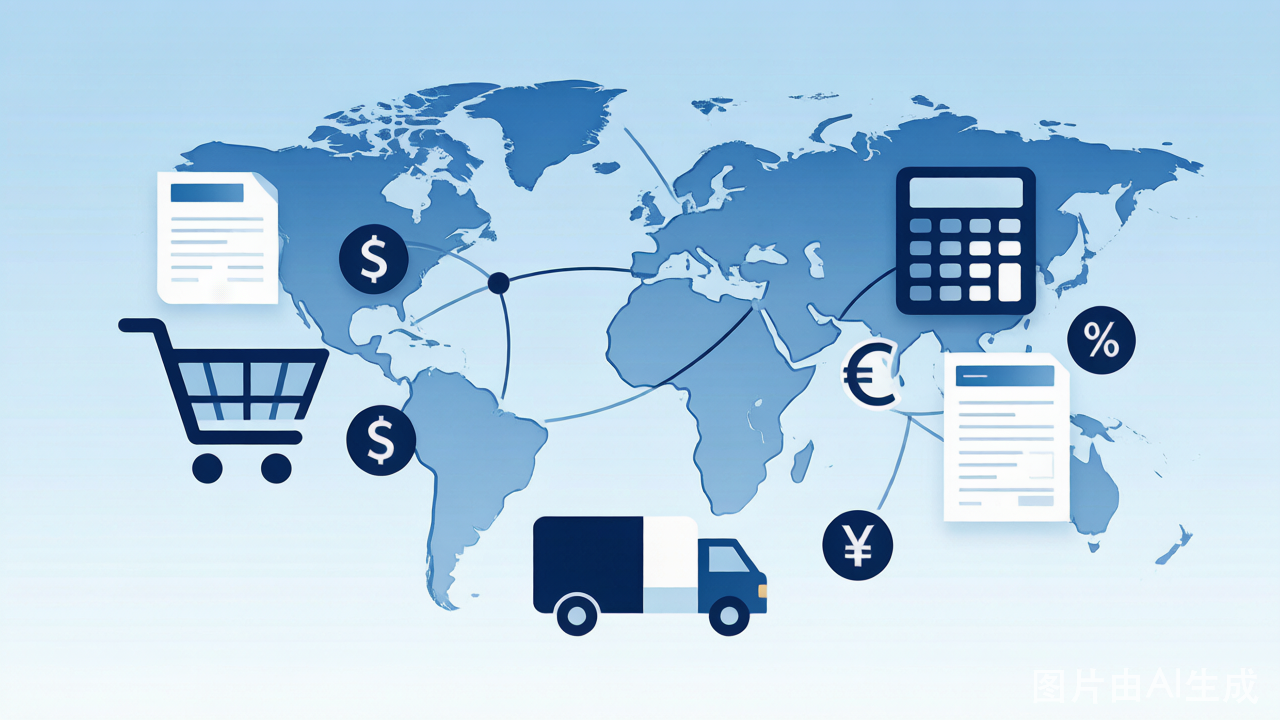
July 2026 is bound to be a watershed moment for e-commerce professionals.State Order No. 810Effective immediately, platform data must be submitted on a quarterly basis;Nine Departments Issue Joint DocumentCall for strict enforcement of the law;First Major Revision of the E-Commerce LawTo kick things off, the maximum fine has skyrocketed from 2 million to 5 million, and in serious cases, penalties may be levied at a rate of 5% of revenue.
One sentence summary:The tax authorities can see every transaction made on every e-commerce platform and in every store.The practices of the past—such as ”not reporting income if no invoice is issued,” ”changing the business entity to evade taxes,” and ”securing a low tax rate through assessed taxation”—have now been completely shut down.
I. Three Major Measures Take Effect Simultaneously; July Marks the First Year of E-commerce Taxation
If you think this is just ”another round of empty slogans,” you're wrong. This time, it'sLegislation + Law Enforcement + TechnologyA three-pronged strategy, executed all at once:
First Measure: State Decree No. 810— "Regulations on the Reporting of Tax-Related Information by Internet Platform Enterprises"
Effective July 1. Taobao, Douyin, Pinduoduo, JD.com, Xiaohongshu, Kuaishou… all e-commerce platforms,Merchants must submit their order, payment, and logistics data to the tax authorities on a quarterly basis.. This is not a recommendation; it is a legal obligation.
Second Move: Nine Departments Issue Joint Notice—The Ministry of Commerce, in conjunction with the National Development and Reform Commission, the Ministry of Justice, the Ministry of Public Security, and others—
Issued on July 2, with clear requirements“Enforce strictly in accordance with the law”Regulations on the Reporting of Tax-Related Information by Platforms. Please note the phrase ”strict enforcement”—this means it is not just a formality, but a serious matter.
The Third Move: The First Amendment to the E-Commerce Law—The first major overhaul since its implementation in 2019
A public comment period began on July 4. The maximum fine was raised from 2 million to 5 million,In serious cases, a fine of 5% of the company’s turnover from the previous year may be imposed.. Freight forwarders, third-party logistics providers, and overseas warehouses are all subject to regulation, ensuring comprehensive oversight across the entire supply chain.
Behind these three powerful blows lies a signal that could not be clearer:The ”wild-west era” of e-commerce taxation has come to an end, and the era of full compliance has begun.
II. Just How Stringent Are the Platform Data Reporting Requirements? What Can the Tax Authority See?
Many sellers have long believed that ”if I don't issue invoices, the tax authorities won't know how much I've sold.” This notion became completely outdated after July 1.
The core requirements of State Order No. 810 are extremely clear: platforms must submit reports on merchants on a quarterly basis.Order data, payment data, and shipping data. What does that mean?
Examples:You opened a store on Taobao and sold 800,000 in merchandise over the course of a year. In the past, you only issued 200,000 in invoices to customers and reported 200,000 as your income. Starting in July, the platform began directly reporting your full transaction data—totaling 800,000—to the tax authorities. The Golden Tax Phase IV system automatically cross-checks:Platform data: 800,000 vs. your reported amount of 200,000 = a discrepancy of 600,000; flagged as suspicious.
What's even worse is that this system isn't monitored by humans—it'sAI-Powered Automatic Comparison. Your store's sales data, payment transactions, and shipping records are cross-verified through a three-way link. Even if you split your operations across five or six stores using different business licenses, as long as the shipping address, legal representative, or contact number matches in any one of them, the system will automatically link them.
Three key changes, each of which directly affects your wallet:
Domestic E-commerce
Sales data is completely transparent throughout the process. Invoiced revenue, uninvoiced revenue, refunds, and coupon deductions—you can see it all.
cross-border e-commerce
The fixed-rate tax assessment method has been completely abolished, and a unified audit-based tax assessment system has been implemented. The transition period for existing cases will end in 2025; starting this year, taxpayers must maintain complete accounting records and file accurate tax returns based on actual circumstances.
live streaming with goods
All commission information for individual streamers and settlement details with brands must be included in the tax filing. Whether working independently or under an MCN contract, all income must be fully reported for individual income tax purposes.
III. First Amendment to the E-Commerce Law—Previously, a 2 million fine was the maximum; now, 5 million is just the starting point
On July 4, the State Administration for Market Regulation and the Ministry of Commerce solicited public comments on the “Draft Amendment to the E-Commerce Law (Draft for Public Comment).” This marks the first time since the E-Commerce Law took effect in 2019 that...First Systematic Revision...the scale of the effort is unprecedented.
This revision includes three key changes, each of which targets gray areas in the e-commerce industry:
1. The entire chain is subject to regulation, leaving no room for gray areas to hide
The previous version of the E-Commerce Law only applied to online stores and trading platforms, while freight forwarders, third-party operators, overseas warehouses, and payment processing companies have long operated in a regulatory gray area. The draft amendment clarifies that:All parties involved in cross-border transactions are subject to legal jurisdiction.Whether online or offline, the same standard applies; there is no gray area where ”overseas operations are exempt from domestic regulation.”
2. Penalties have been doubled and strengthened, with fines of up to 5% of revenue possible
Under the old regulations, the maximum fine on the platform was 2 million—a drop in the bucket for top merchants. After the revision: the cap on fixed-amount fines was raised to5 million, and also added“Based on the previous year’s revenue of 5%”Proportional penalties will be imposed. A store with annual sales of 50 million may face a maximum fine of 2.5 million. Additional tiered penalties will also be applied, including suspension of business operations, restrictions on store registration, and store closures.
3. International Interoperability of Cross-Border Regulations, with Compliance Benefits Unlocked Simultaneously
The country is actively promoting mutual recognition of standards for e-commerce transactions, logistics, and electronic documentation among nations. This means that the process of repeatedly obtaining paper-based certifications from various countries—which sellers previously had to undergo when expanding into international markets—is expected to be streamlined, and the time required for customs clearance and obtaining qualifications will be significantly reduced. Compliant sellers will, in fact, enjoy greater convenience.
IV. How Should Small and Medium-Sized Enterprises Respond? A 5-Step Approach to Turn Compliance from a ”Reactive Necessity” into a ”Proactive Advantage”
Faced with this series of policy measures, many small and medium-sized sellers are panicking. But honestly, panicking won’t help—the key isLet's get moving!. Here is a 5-step plan that can be put into practice:
Step 1: Quickly Organize Your Store's Core Elements
How many stores are there? Under which business licenses are they registered? Are there any overlaps among the legal representatives, shareholders, and contact persons? The same warehouse, the same shipping address, and the same supply channels—these are all important clues that the tax system uses to identify connections.The "Golden Tax Phase IV" system can now automatically detect and identify schemes in which multiple sole proprietorships are registered using relatives' ID cards to spread out sales revenue.
Step 2: Establish a Comprehensive Inventory, Sales, and Purchasing Ledger
In the past, it was acceptable to ”keep the books however you liked,” but that’s no longer the case. You must maintain complete procurement, sales, and inventory ledgers, with each purchase matched to an invoice and each sale matched to a shipping document. This is especially true for cross-border e-commerce sellers: inventory in overseas warehouses, FBA shipping records, and platform settlement data must all be included in a unified accounting system.
Step 3: Switch from a fixed-rate tax assessment to an audited tax assessment
The fixed-rate taxation system for cross-border e-commerce has been fully abolished. What you need to do is: hire a professional accountant or engage a financial and tax services firm to maintain your books and file your taxes based on actual profits. Be sure to collect all invoices for costs and expenses—including purchase invoices, shipping invoices, advertising invoices, and warehousing invoices—as these serve as the basis for your legitimate tax deductions and expense claims.
Step 4: Plan Ahead for General Taxpayer Status Certification
Businesses with annual sales exceeding 5 million must be designated as general taxpayers, and their tax rate jumps directly from 1% to 13%.Stop thinking about ”reaching 4.9 million and switching entities.”—Once data is submitted to the platform, the total sales for a given store over its entire operating period are automatically aggregated; changing the business entity as many times as you like won’t make a difference. The correct approach is to plan your taxes in advance, optimize your cost structure, and make reasonable use of input tax credits.
Step 5: Seek guidance from a professional team of financial and tax advisors
We are no longer in an era where e-commerce tax and financial compliance can be handled simply by ”hiring an accounting firm for 200 yuan a month.” What you need is a professional team that truly understands e-commerce operations, platform rules, and the logic behind tax audits. We provide end-to-end coverage—from designing corporate structures and establishing accounting systems to filing tax returns and conducting risk assessments.
V. Qicaiying’s Perspective: Compliance Is Not a Cost—It Is Your Moat in the New Landscape
Many sellers view compliance as an ”additional cost.” This perception needs to change completely.
When the entire industry is operating ”in the open,” it doesn’t really make much difference whether you comply with regulations or not. But when the regulatory curtain comes down and the industry shakeup begins—Those who comply stay; those who violate the rules are eliminated.. By then, compliant companies will not only survive but also take over the market share of those that have been forced out of the market.
More importantly, compliance offers three tangible competitive advantages:
First, the path to financing and going public has been opened.Companies with clear financial records and tax compliance find it easier to obtain bank loans, attract investment, and even enter the capital markets. Companies with disorganized financial records, on the other hand, will forever remain stuck in the ”small-scale operation” category.
Second, increased influence in the supply chain.More and more major brands are making financial and tax compliance a prerequisite when selecting distributors and suppliers. If you don’t comply, you won’t even be able to land major contracts.
Third, being able to sleep.No need to worry every day about the tax authorities knocking on your door, no need to fret about your bank account being frozen, and no need to fear being reported by competitors. That peace of mind is something you can’t buy with the small amount of taxes you save.
Write at the end:July 2026 marks a turning point for e-commerce taxation, but it is not the end. The tightening of policies is essentially weeding out non-compliant competitors to make room for businesses that operate in compliance. Rather than waiting on the sidelines, worrying, or hoping for the best, it’s better to start building a solid compliance system right now. If you don’t know where to begin,Scan the QR code below to add a Qicaiying consultant and receive a free one-on-one e-commerce tax compliance assessment.
📞 One-on-One Professional Consultation
As a professional one-stop business service platform, Qicaiying is committed to providing our clients with high-quality services, including mainland company registration, Hong Kong company registration, offshore company registration, bookkeeping and tax filing, annual reviews and audits, corporate bank account opening, financial and tax compliance, equity structuring, ODI filing, cross-border e-commerce services, Hong Kong residency, immigration, and study abroad—all designed to support businesses in their global expansion, One-stop business services. Feel free to add me on WeChat (phone number is the same: 18620388671) for inquiries at any time.