Urgent Notice! Amazon reports seller data to IRS, how cross-border sellers can land safely?
Published: 2025-10-28
Recently, a notification from Amazon's back office blew up all Amazon sellers!
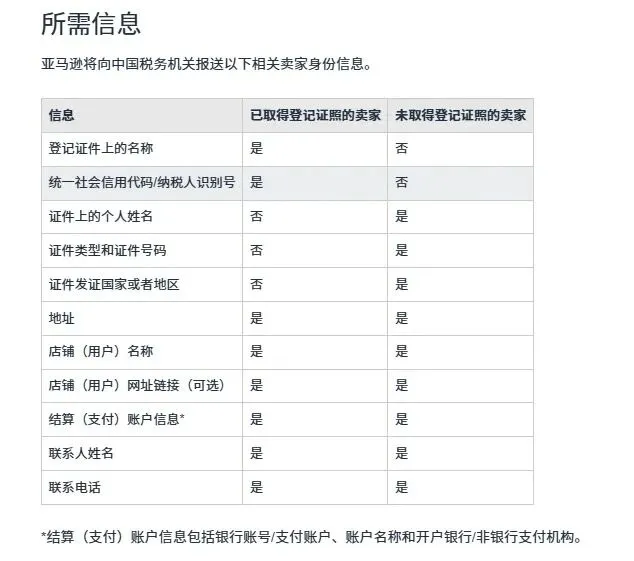
Amazon officially released the Notice on Requirements for Reporting Tax-Related Information of Platform Enterprises, which will report seller identity information, transaction flow, revenue amount and other key data to China's tax authorities on a quarterly basis starting from the third quarter of 2025.The first submission is scheduled for October, with data covering all transactions from July to SeptemberThis marks the formal entry of the cross-border e-commerce industry into the "era of real-name tax system".
Amazon Information Reporting, Key Points Sellers Must Know
Scope and content of submission
Amazon will conduct its first quarterly information filing covering the period July through September 2025 The filing contains:
Identifying information:Personal ID number or enterprise unified social credit code Number of transactions:Number of orders sold and total revenue of the store on the Amazon platform Revenue Information:Uniform reporting of revenue information, commissions and service fees paid to the platform at the end of each quarter
Key point: the reporting behavior by the Amazon initiative to complete, sellers "do not need to operate", but this does not mean that you can rest easy.
Compliance Challenges Behind Information Reporting
Full-platform coverage, no dead-end supervision
Even if you only sell goods in Amazon.com mall (US), your relevant information will still be included in the tax-related information reporting scope and reported to the Chinese tax authorities. This means that no matter which Amazon.com store you sell your products in, you will be subject to tax supervision.
Time is of the essence, data is already being counted
The most easily overlooked by sellers: the first report in October, is the data of July-September, not from October 1 only began to count. If your third-quarter revenue has triggered the tax conditions, the reported data will become the direct basis for tax audits.
Clear compliance requirements, no gray space
According to the Regulations on the Reporting of Tax-Related Information on Internet Platforms:
No splitting of income is allowed and full income needs to be declared; Over $5 million needs to be treated as a general taxpayer; Under the tax information sharing mechanism, sellers with irregular tax declarations, inconsistent subjects or account anomalies may be automatically identified by the system.
Cross-border e-commerce ushers in compliance watershed, how do sellers respond?
Long-term reliance on "gray operation" or "informal collection channels" will be gradually removed, and replaced by a more transparent and traceable business system. This is a challenge but also an opportunity for the cross-border e-commerce industry, and compliance will become the core competitiveness of enterprises.
Cross-border sellers are in dire need in the face of the new regulations:
Verify subject information: Ensure company name, bank account and registration information are consistent Improve financial and tax information: timely preparation of business license, VAT, CPC report and other compliance documents Establishment of a tax compliance system: introduction of professional tax consultants and regular checking of the filing process Adjusting business thinking: from "tax avoidance thinking" to "compliance thinking"
Warm tips: In the face of increasingly stringent tax regulatory environment, the only way for enterprises to survive is to do a good job of compliance planning in advance. This live broadcast will provide you with practical compliance solutions, helping you to move forward in the cross-border market.
Recommended
Trump 2.0, what is the impact of China's trade and cross-border e-commerce? How do companies going overseas respond?
U.S. Republican presidential candidate Donald Trump was declared the winner of the 2024 presidential election in the early morning of June 6, according to Xinhua Express. The news not only shook the U.S. political scene, but also triggered widespread concern in the global foreign trade as well as cross-border e-commerce industry.
The tax department announced 5 typical cases of tax-related violations ! Involving foreign trade, medicine, gas stations and other key industries
Recently, the State Administration of Taxation announced five major tax-related criminal cases on its official website, involving foreign trade export enterprises fraudulently obtaining export tax refunds; medical equipment enterprises falsely reporting R&D expenses plus deductions for tax evasion; shell enterprises violently making false invoices; gas stations stealing taxes; and pharmaceutical enterprises obtaining falsely opening invoices for traditional Chinese herbs and agricultural products. Relevant industries should be warned.
Companies busy listing in Hong Kong Autonomous driving, artificial intelligence become hot tracks
The enthusiasm of enterprises to go public in Hong Kong continues.Wind data show that as of November 17, the Hong Kong Stock Exchange this year, 57 new IPO enterprises, debut fund-raising scale of about 71.583 billion Hong Kong dollars, far more than the whole of last year. Only since the fourth quarter, there have been 14 enterprises successfully listed in Hong Kong, such as Crowe Hydrogen, China Resources Beverage and Midea Group. At the same time, as of November 17, the Hong Kong Stock Exchange accepted a total of 86 listing applications, including many star companies in the field of automatic driving, artificial intelligence, and other areas, but also includes a number of large A-share companies.