2026 ODI filing the latest policy interpretation: the whole process of practical operation and the core of the pit avoidance guide
Published: 2026-01-27
In 2026, the environment for Chinese companies going overseas is expected to see more significant structural changes. The compliance review of outbound direct investment (ODI) filings will continue to deepen, with more stringent requirements on project authenticity, source of funds and strategic fit. At the same time, emerging sectors that fit the national strategic direction and global market demand are expected to continue to be the main growth line through the cycle.
This trend reveals clear signals:The generalized overseas path narrows, while the compliant, strategic and refined overseas layout will become the core pillar for enterprises to build global competitiveness. Whether you're planning to set up an overseas subsidiary, make a technology acquisition, or expand into a new market, understand and efficiently complete the ODI FilingIt is the starting point and fundamental guarantee of compliance in all this.
Based on a forward-looking perspective, this article will systematically sort out the core points, detailed processes and key risk avoidance strategies for ODI filing in 2026.
I. What is an ODI filing? Why is it an insurmountable compliance red line?
ODInamelyOverseas direct investment filingIt is a domestic approval or filing procedure that must be performed by Chinese domestic enterprises in accordance with the law before they make substantial overseas investments (e.g., new establishments, mergers and acquisitions, equity participation and obtaining the right to operate and manage).
It consists of three main authorities that form a closed-loop regulation:
National and local development and reform commissions: Responsible for auditing "Project compliance" In addition, it assesses whether the investment direction is in line with the national industrial policy and macro-strategy, which is the "birth certificate" of the project.
Ministry of Commerce and local commerce departments: Responsible for auditing "Subjective authenticity" The "credentials" of the investor are to verify that the domestic enterprise has the qualifications and true investment intent to comply with the law.
Foreign Exchange Bureau and Designated Banks: Responsible for implementation "Funding compliance" Audit, with the aforementioned approval for foreign exchange registration, is the legal exit of the funds "release gate".
Neglecting ODI filings will lead directly to four major dilemmas:
Funds exit channel closed: Banks are unable to handle the purchase and payment of remittances for unfiled projects.
Overseas entities' operations hampered: Offshore companies face legal identity challenges when opening accounts and obtaining local licenses.
Profit return path interrupted: Overseas earnings cannot be repatriated to the domestic parent company through compliant channels.
Impaired corporate credit and compliance: May face administrative penalties and affect all subsequent offshore investment and financing activities.
If you have domestic company registration (Shenzhen / Guangzhou / Shanghai / Beijing / Hangzhou, etc.), overseas company registration (Hong Kong / U.S. / Japan / Britain / Singapore / Thailand / Vietnam / BVI / Cayman Islands, etc.), Hong Kong identity applications and renewals, cross-border tax planning, shareholding structure design, compliance and risk control programs and other needs, you can add customer service (WeChat: qcygscszk, cell phone: 18676749275), we will customize your exclusive optimization program to help you comply with the business, save money and increase efficiency!
II. 2026 ODI filing full process text details
The entire process must strictly follow the three stages described below, without reversing the order or jumping around.
Phase I: NDRC approval or filing
The purpose of this stage is to confirm the compliance and reasonableness of the investment project at the national macro level.
Core work: Prepare and submit a Feasibility Study Report on Overseas Investment Projects, detailing the content of the investment, source of funds, market analysis, economic benefits and risk countermeasures.
Key Judgments: Depending on whether the investment involves sensitive industries (e.g., real estate, entertainment, sports clubs, etc.) or sensitive countries and regions, the decision to apply the "Approval system"(Critical Review) or "filing system"(Formal review). Non-sensitive projects are generally submitted to the local development and reform commission for filing.
Outcome document: To obtain a copy of theNotification of Filing of Overseas Investment Projector approved documents.
Phase II: Approval or filing by the Ministry of Commerce
The purpose of this stage is to examine whether the domestic investment entities have qualified qualifications and genuine investment behavior.
Core work: Fill in the application online through the "Overseas Investment Management System" and submit business license, internal decision-making documents (e.g., shareholders' meeting resolution), audited financial statements, etc.
Focus of Audit: The standardization of the operation of the enterprise, its financial status in recent years, the authenticity of the investment project and whether it involves circumventing the restrictive regulations on outbound investment in China.
Outcome document: To obtain a copy of theCertificate of Enterprise Overseas Investment", this is the main qualification certificate of the enterprise's foreign investment.
Phase III: Foreign exchange registration and exit of funds
This stage is the final step in the fulfillment of the procedure to achieve the legal cross-border movement of funds.
Core work: Go to the bank of the domestic enterprise to apply for foreign exchange registration of overseas direct investment with the official authorization issued by the two departments mentioned above.
Key actions: After the bank's examination and approval, it will open a special account for the enterprise's overseas investment, so that the funds can be remitted according to the filed amount and purpose.
Follow-up attention: Upon completion of the capital contribution, it is required to report the capital contribution of the foreign direct investment through the banking system within the prescribed period.
If you have domestic company registration (Shenzhen / Guangzhou / Shanghai / Beijing / Hangzhou, etc.), overseas company registration (Hong Kong / U.S. / Japan / Britain / Singapore / Thailand / Vietnam / BVI / Cayman Islands, etc.), Hong Kong identity applications and renewals, cross-border tax planning, shareholding structure design, compliance and risk control programs and other needs, you can add customer service (WeChat: qcygscszk, cell phone: 18676749275), we will customize your exclusive optimization program to help you comply with the business, save money and increase efficiency!
Three, 2026 declaration of the four core "pit points" and avoidance of pit strategy
Pothole Point 1: Wrong Logical Order - "Before the Soldiers Move, the Food Comes First"
exposures: Entering into a contract with a rigid payment clause or actually paying a deposit with a counterparty without obtaining approval for ODI filing will result in the funds not being able to leave the country legally and will constitute a breach of contract.
avoidance strategy: It is imperative that you adhere to the "Get approved first, fund later" Iron law. In the investment agreement, the "completion of China ODI filing" must be a core prerequisite for the payment of the investment and the settlement of the transaction.
Pitfall 2: Stepping out of line in the direction of investment - misguidedly entering sensitive areas
exposures: If an investment project is identified as belonging to a sensitive industry that is restricted or prohibited by the state, or if the destination is of extremely high political risk, it will be rejected outright at the DRC stage.
avoidance strategyBefore making an investment decision, it is important to thoroughly study the "Catalog of Sensitive Industries for Outbound Investments" and related country-specific guidelines, which are regularly updated by the National Development and Reform Commission (NDRC) and the Ministry of Commerce (MOFCOM). For strategic emerging areas (e.g., green energy, digital economy), we can focus on demonstrating their compatibility with the policy guidelines.
Pit three: defective qualification of the main body - "medical examination" failure
exposures: Domestic investment entities that have been established for too short a period of time (usually less than one year), have unpaid registered capital, have suffered continuous losses, or have a record of major violations of laws and regulations will be deemed not to have the strength to invest abroad.
avoidance strategy: Ensure that the domestic company that is the subject of the investment is operating in a standardized manner and is financially healthy. Prepare a compliant audit report of at least one year in advance, and be able to clearly demonstrate the company's profitability and good credit.
Pitfall 4: Weak declarations - insufficient probative power
exposures: Crude materials, conflicting data, and weak arguments are the main reasons for delayed or returned reviews.
avoidance strategy::
Proof of source of fundsThis is the most important aspect of the review. A clear path of funding must be provided: own funds correspond to equity items in the audited financial statements; bank loans require a special letter of intent; and it is essential to eliminate "fuzzy funds" that do not have a legitimate source.
Feasibility studyIt should be a serious business plan with solid data and logic to prove the necessity, feasibility and risk controllability of the project, avoiding empty templates.
Enterprise Caiying Professional Services: Protecting Your 2026 Overseas Journey
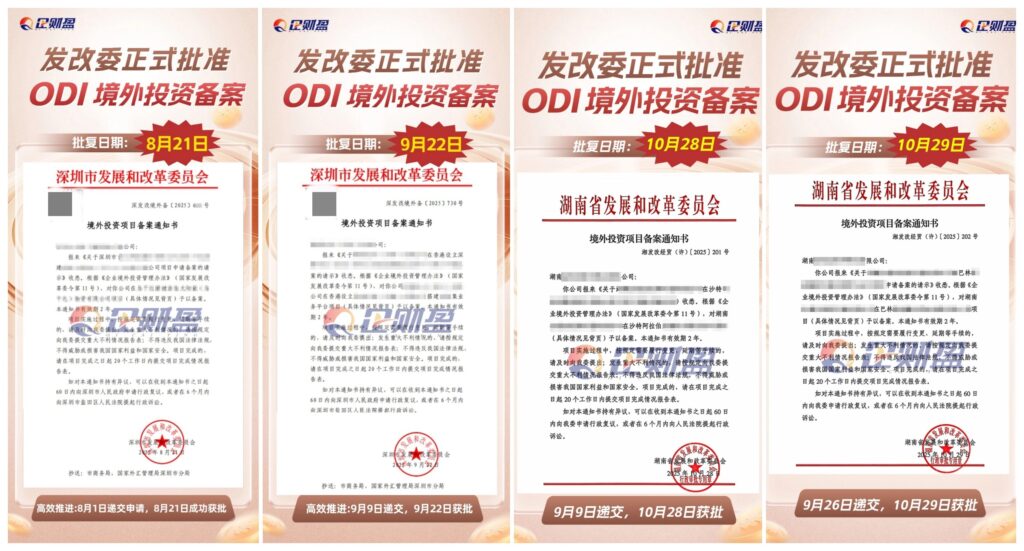
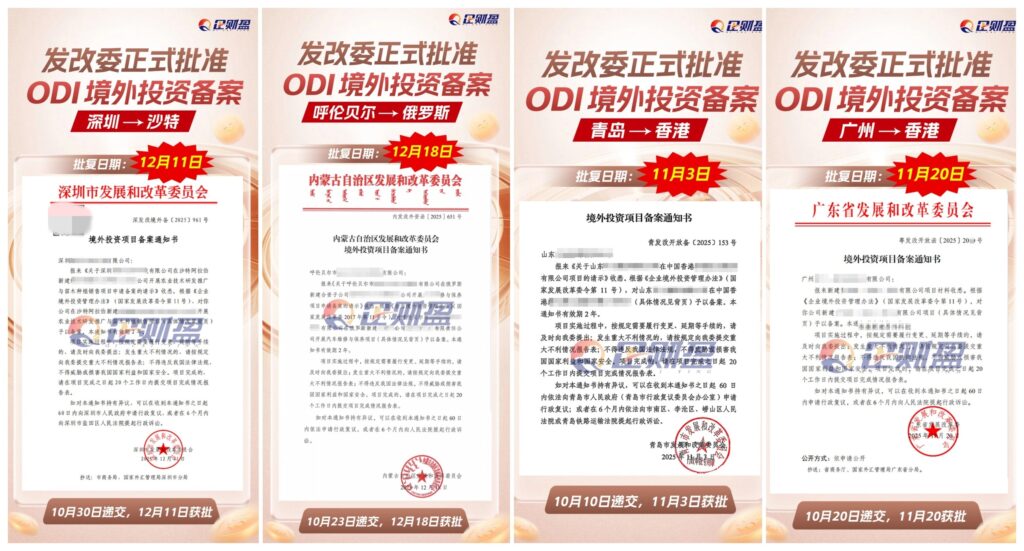
Professional ODI filing is not only about obtaining approvals, but also about building a safe and sustainable cornerstone for enterprises to operate globally. The following are successful cases of Enterprise Caiying odi filing:
In the face of evolving regulatory requirements and complex cross-border practices, an experienced professional partner can greatly enhance the efficiency of success and systematically avoid risks.QCYThe team understands the policy kernel of ODI filing and the whole chain of practice, and is committed to providing the following values to our clients:
Cross-border Compliance System Setup: Provide extended services such as ODI follow-up maintenance (e.g., annual report, change, extension), return investment design, etc. to help enterprises build a long-term, stable cross-border compliance management system.
Strategic Planning and Risk Assessment: In the early stages of the project, combine your business objectives with the 2026 policy direction, conduct filing feasibility prediction and optimal path planning, and identify potential compliance risks.
Full-cycle material preparation and declaration: Professional writing of persuasive Feasibility Study Report and a full set of application documents, to ensure that the material is internally logical and the chain of evidence is complete, and agent to complete the whole process of declaration from the Development and Reform Commission, the Ministry of Commerce to the foreign exchange registration.
Effective communication and process managementAs a professional bridge between enterprises and regulatory authorities, we are responsible for all communication and coordination work, responding to audit feedback accurately and controlling the pace of filing throughout the process.
Tags:
odi filing process
Recommended
Cross-border e-commerce B2B must see! Registered Hong Kong company stationed in the Ali International Station, really fragrant!
In today's globalized business environment, the cross-border e-commerce B2B model is rapidly emerging with its unique advantages. For many enterprises engaged in cross-border trade, choosing a suitable platform and registering an advantageous company are undoubtedly the key keys to open the door to the international market.
2024 Hong Kong Company Account Opening Tips! How to choose the right Hong Kong bank account?
Global anti-money laundering regulations are becoming more and more stringent, the banks to maintain an account of the sunk cost is getting higher and higher, not moving hundreds of millions of dollars in fines, so that the major banks to open an account threshold as well as the audit process high up, already have a Hong Kong company bosses, how to choose the Hong Kong bank to open a public account? How much does it cost and how to operate? Today to give you a detailed introduction to the Hong Kong company account how to choose, as well as the approximate costs required and other content.
Hong Kong company registration advantages + registration conditions + registration process to share!
If you want to start a business and develop overseas markets, registering a Hong Kong company is undoubtedly a very forward-looking choice. With its unique geographical location, sound legal system, low tax rate and open business environment, Hong Kong company has become a "sharp weapon" for many business owners to open up overseas markets. Why is it so important to register a Hong Kong company in 2024?